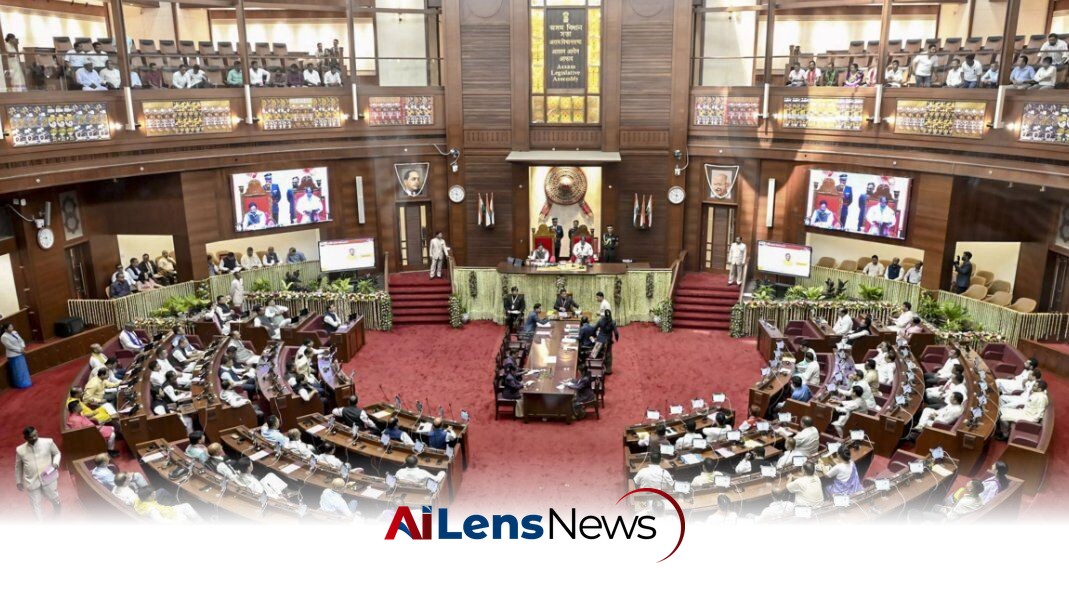


The Assam Legislative Assembly's Budget Session wrapped up with discussions on border disputes, illegal liquor issues, and e-rickshaw restrictions affecting livelihoods.
Dispur, India Jul 29, 2026 ALN: The concluding day of the Budget Session of the 16th Assam Legislative Assembly on Wednesday witnessed members raising a wide spectrum of public concerns, from long-pending inter-state border disputes and the menace of illegal liquor to restrictions on e-rickshaw movement.
Ministers, in their replies, outlined the government's position on each issue, assuring the House of continued intervention and remedial measures.
Border disputes
Border disputes in Assam have been a persistent issue, particularly with neighboring states like Meghalaya, Nagaland, and Mizoram. These disputes stem from historical claims and administrative boundaries that have led to tensions and occasional violence. The Assam-Meghalaya border, in particular, has seen clashes between local groups, leading to calls for a more robust security presence in the area. BJP MLA from Rongkhang, Tuliram Ronghang, raised concerns over recurring tensions along the Assam-Meghalaya border and urged the government to consider establishing a Central Reserve Police Force (CRPF) Commando Training Institute in the region to ensure lasting peace.
Ronghang highlighted that recent clashes between groups from Meghalaya and Karbi Anglong had escalated tensions, though he noted that dialogue had helped defuse the immediate situation. He emphasized the need for a permanent solution, stating, "We need a long-term solution. A CRPF training institute in the border region would strengthen security and help maintain lasting peace. A similar proposal had earlier been suggested for the Assam-Nagaland border, and I believe such an institution is equally necessary along the Meghalaya border."
In response to these concerns, Border Protection and Development Minister Atul Bora reiterated the state government's commitment to resolving all pending border disputes through dialogue. He stated, "The Chief Minister has consistently maintained that these long-standing disputes should be resolved through negotiations. Regional committees have been constituted and are verifying claims on the basis of administrative convenience, the wishes of local people, and other established criteria. We are confident the remaining issues will also be settled through talks." This approach reflects a broader strategy of the Assam government to engage in dialogue rather than resorting to force, which has historically exacerbated tensions in border regions.
In a separate written reply to a question by Raijor Dal MLA Akhil Gogoi, Bora disclosed that 82,751.86 hectares of Assam's land remain under the control of Nagaland, Meghalaya, and Mizoram. Nagaland accounts for the largest share, with 59,490.21 hectares, followed by Meghalaya (16,144.01 hectares), Mizoram (3,675.78 hectares), and another mention of Meghalaya (3,441.86 hectares). This distribution of land control highlights the complexity of inter-state relations in the region and underscores the need for a comprehensive resolution to these disputes.
Illegal liquor concern
The issue of illegal liquor and narcotics has emerged as a significant concern in Assam, particularly in tea garden areas where the consumption of spurious liquor has become a public health crisis. BJP MLA from Makum, Sanjoy Kishan, emphasized the detrimental effects of illegal liquor on communities, stating, "Illegal liquor and drugs are destroying lives, especially in tea garden communities. Many people consume spurious liquor without knowing its contents, resulting in serious illness and even death. Despite enforcement efforts, the problem persists and requires stronger intervention." This issue is particularly pressing given the socio-economic context of Assam, where many individuals depend on tea gardens for their livelihoods, and the proliferation of illegal substances can have devastating impacts on families and communities.
In response to the escalating concern, Bora assured the House that the government would intensify its crackdown on illegal liquor production and distribution. He stated, "We will review the issue and take stringent action. Several measures are already in place, but effective enforcement requires cooperation from elected representatives and the public. If MLAs have information about illegal liquor dens, they should immediately inform the authorities so that prompt action can be taken." This call for collaboration highlights the need for a multi-faceted approach to tackle the issue, involving both government action and community engagement.
E-rickshaw restrictions
The discussion also extended to the restrictions imposed on e-rickshaws in parts of Barpeta district, a matter raised by Congress MLA from Pakabetbari, Jakir Hussain Sikdar. He argued that these restrictions adversely affected the livelihoods of thousands of drivers who had purchased their vehicles through loans. Sikdar stated, "E-rickshaws have reduced dependence on fuel and created employment for thousands of people. Restricting them from operating on certain routes has severely affected their livelihoods, and the government should reconsider the decision." This concern reflects the broader economic challenges faced by many in Assam, where alternative livelihoods are often limited.
Transport Minister Charan Boro clarified that the restrictions were limited to specific stretches and imposed solely in the interest of public safety. He explained, "E-rickshaws have become an integral part of transport, particularly in villages and small towns, providing crucial last-mile connectivity. However, they pose significant safety risks on high-speed corridors. Based on recommendations of the National Highways Authority of India, restrictions have been imposed only on NH-27 and the stretch from Saokhowa Bridge to Howli in Barpeta district. They have not been banned across the district." This explanation underscores the delicate balance that the government must maintain between ensuring safety on roads and supporting economic livelihoods, particularly in rural areas.
Boro further noted that Barpeta was among the districts reporting the highest number of road accidents in the state. Official data showed alarming statistics regarding road safety in the region, with 47 accidents and 11 deaths in January, 35 accidents and 14 deaths in February, 57 accidents and 15 deaths in March, 50 accidents and 17 deaths in April, 51 accidents and seven deaths in May, and 63 accidents and seven deaths in June. These figures highlight the urgent need for effective road safety measures and underscore the complexity of the transport issues faced by the state.
As the Budget Session concluded, the discussions reflected the pressing issues facing Assam, from border disputes and illegal liquor to transport safety. The government’s responses indicated a commitment to addressing these challenges through dialogue, enforcement, and careful consideration of public safety, while also needing to balance economic development and community welfare. The implications of these discussions will likely resonate throughout the state as stakeholders from various sectors seek to find solutions that promote both safety and economic viability in Assam's diverse landscape.
To learn more about the latest developments in Elections, stay updated with our exclusive reports and analyses on AiLensNews.

