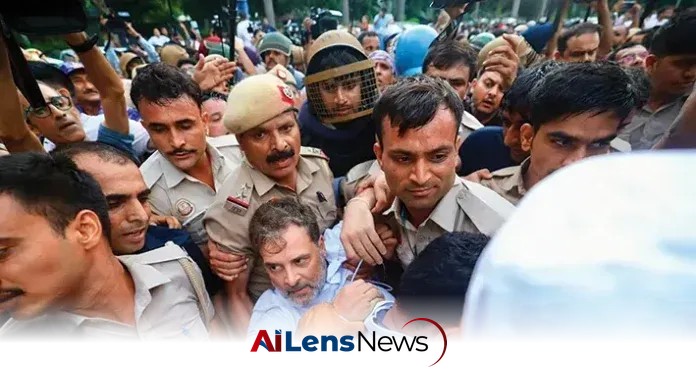


Opposition leaders, including Rahul Gandhi and Priyanka Gandhi Vadra, were detained by Delhi Police during a protest against police violence towards students protesting the NEET exam irregularities.
Itanagar, India Jul 22, 2026 ALN: NEW DELHI, 21 Jul: Opposition leaders, including Congress leader Rahul Gandhi, Priyanka Gandhi Vadra, Congress president Mallikarjun Kharge, and Samajwadi Party chief Akhilesh Yadav, were forcibly removed and detained by the Delhi Police on Tuesday after staging a sit-in outside Prime Minister Narendra Modi’s residence. This escalation marks a significant political confrontation over the alleged police crackdown on students protesting the NEET paper leak issue.
The protest was organized a day after thousands of students led by the Cockroach Janta Party (CJP) marched towards Parliament, demanding the resignation of Union Education Minister Dharmendra Pradhan over alleged irregularities in the NEET examination. The National Eligibility cum Entrance Test (NEET) is a highly competitive examination in India that determines admission to medical colleges. The integrity of this examination is crucial for students aspiring to enter the medical field, and any allegations of irregularities can lead to widespread unrest among students and their families.
Student groups alleged that police used lathi charges and tear gas to disperse protesters, resulting in injuries and detentions. The use of force against demonstrators, particularly students, has raised questions about the government's handling of dissent and its commitment to upholding democratic rights. In recent years, India has witnessed a surge in student-led movements, often centered around issues of educational policy, social justice, and government accountability. The NEET protests are part of this broader trend, reflecting the frustrations of young people who feel their voices are not being heard.
The opposition’s dharna near the prime minister’s residence demanded accountability for the alleged police excesses against students, an apology from Prime Minister Narendra Modi, and the resignation of Union Home Minister Amit Shah and Education Minister Dharmendra Pradhan. The call for accountability is significant as it highlights the growing discontent with the ruling government’s approach to handling protests and its perceived failure to address the concerns of the youth.
The surprise demonstration in the high-security zone prompted the Centre to send Minister of State in the Prime Minister’s Office Jitendra Singh and Union Home Secretary Govind Mohan to negotiate with the protesting leaders. According to Singh, Rahul Gandhi initially agreed to end the protest if the government assured a discussion on the NEET issue in Parliament. Singh stated that the government accepted the demand but alleged that Gandhi subsequently added a fresh condition seeking the resignation of the education minister. The Congress party has not accepted this version of events, indicating a significant rift between the opposition and the government regarding the narrative of the protests.
Talks failed to break the impasse, and police moved in during the evening to remove the protesters. Congress leaders reported that Gandhi was taken to Chhatrasal Stadium after being detained. Television visuals showed police personnel carrying Gandhi from the protest site as he resisted removal. His aides alleged that he sustained a minor injury below his eye as well as injuries to his hands and legs during the detention. Such incidents raise concerns about the treatment of political leaders and activists during protests, particularly when the state employs force to quell dissent.
As police cleared the site, Priyanka Gandhi Vadra was seen clinging to the door of a police vehicle while other Members of Parliament and opposition leaders were also detained. Several MPs alleged that police used force while dispersing the demonstration, which further exacerbates tensions between the opposition and the government. The optics of opposition leaders being forcibly removed from a peaceful protest can have significant implications for public perception and may galvanize further support for the opposition.
Before the sit-in, Gandhi and Vadra had met students injured during Monday’s protest. Gandhi accused the government of responding to peaceful student demonstrations with violence, stating that “an attack on students is an attack on every Indian family.” He demanded that the prime minister apologize for the alleged police brutality and resign along with the union home minister. This framing positions the government’s actions as not just a political issue, but a moral one, resonating with families across the country who may empathize with the plight of students.
Congress president Mallikarjun Kharge alleged that the government had “unleashed lathicharge” on students seeking justice, refused a parliamentary debate on the issue, and later used force to remove opposition MPs from their protest. Congress general secretary Jairam Ramesh described the government’s actions as authoritarian, while party leader Pawan Khera accused police of “brutally” removing opposition leaders. The characterization of the government’s response as authoritarian is indicative of the broader political narrative that the opposition is attempting to construct, framing the ruling party as increasingly intolerant of dissent.
Student protest organizers also alleged a coordinated crackdown. CJP founder Abhijeet Dipke claimed that the government invited his delegation for talks while simultaneously dispersing demonstrators outside. He alleged that members of the delegation were made to wait for hours, their mobile phones were seized, and two leaders were effectively confined during the negotiations, while police carried out baton charges against students. These allegations have not been independently verified but highlight the chaotic nature of the events and the challenges faced by protest organizers in communicating their grievances effectively.
Aam Aadmi Party national convener Arvind Kejriwal also criticized the police response, alleging that officers used excessive force against students, including women, without provocation. The party announced a helpline to provide medical assistance to injured protesters and legal aid to families of detained students. This move not only positions the Aam Aadmi Party as a defender of student rights but also serves to mobilize public support and solidarity with the protesting students.
The NEET paper leak controversy, along with the events surrounding the protests, underscores the growing tensions in Indian society regarding issues of educational integrity, youth activism, and government accountability. As students continue to voice their concerns, the implications for the ruling government could be significant, especially in light of upcoming elections. The handling of these protests may influence public opinion and voter sentiment, as discontent among the youth demographic could translate into political consequences for the current administration.
In conclusion, the recent protests over the NEET paper leak and the subsequent detentions of opposition leaders reflect a critical moment in Indian politics. The intersection of student activism, government accountability, and police conduct raises important questions about the state of democracy in the country. As the situation evolves, it will be essential to monitor how both the government and opposition navigate these challenges and what that means for the future of political discourse in India.
To learn more about the latest developments in Political Controversies, stay updated with our exclusive reports and analyses on AiLensNews.

