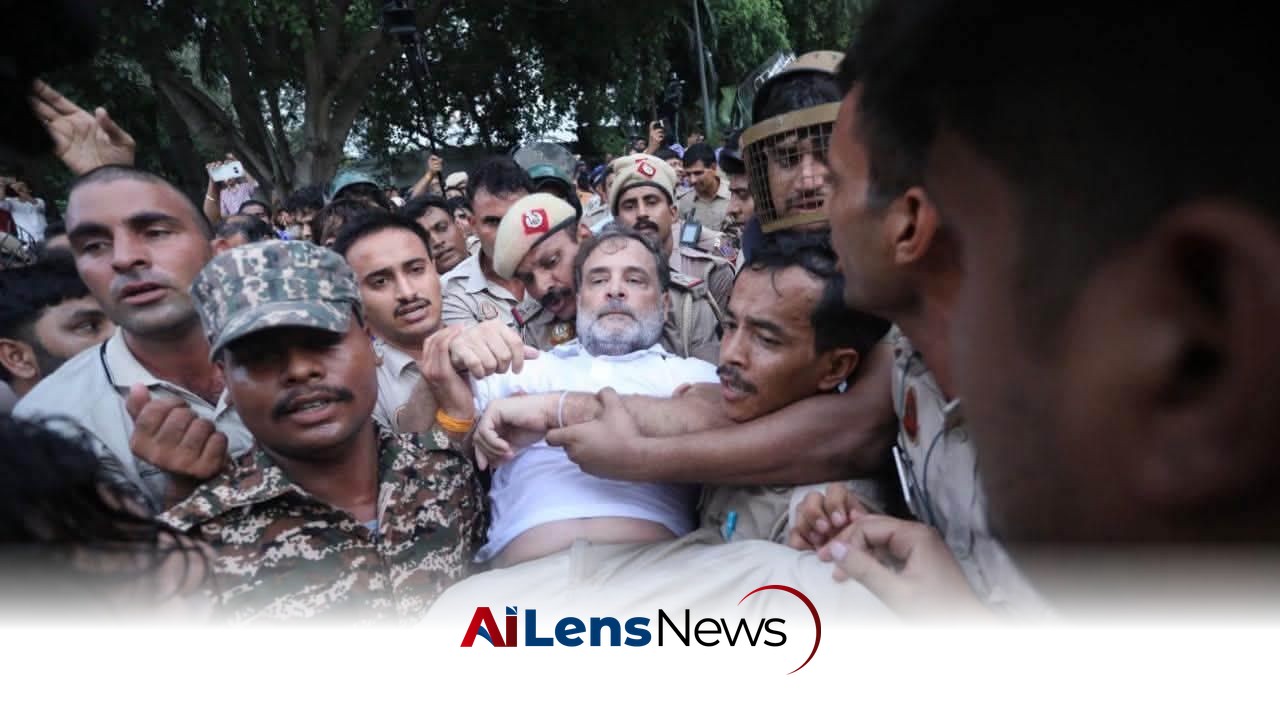


The Congress Committee (APCC) has condemned the detention of Rahul Gandhi, Priyanka Gandhi Vadra, and other leaders, calling it an attack on democracy.
Itanagar, India Jul 22, 2026 ALN: The Congress Committee (APCC) has strongly condemned the detention of Rahul Gandhi, Priyanka Gandhi Vadra, and other senior leaders who were protesting against the NEET paper leakage near Prime Minister Narendra Modi’s residence. This incident has sparked significant controversy and raised questions about the state of democratic practices in India, particularly in the context of political dissent and the role of law enforcement.
The National Eligibility cum Entrance Test (NEET) is a highly competitive examination for students aspiring to enter medical colleges in India. Over the years, the examination has faced scrutiny due to allegations of irregularities, including leaks and malpractices that can severely impact the futures of countless students. The APCC's protest was aimed at drawing attention to these pressing issues, highlighting the need for accountability and reform in the examination process.
In a statement, the APCC demanded the immediate release of the Gandhi family and others, labeling the actions of the Delhi police as illegal, arbitrary, and undemocratic. They described the incident as a glaring manifestation of the authoritarian and dictatorial mindset of Prime Minister Modi and Union Home Minister Amit Shah. This characterization reflects a broader sentiment among opposition parties who view the current government’s approach to dissent as increasingly repressive.
Political analysts have noted that the treatment of political leaders and activists in India has become a focal point of contention, particularly in the wake of various protests over the past few years. The APCC's condemnation of the detentions underscores a growing concern regarding the erosion of civil liberties and the right to peaceful assembly, which are fundamental tenets of a functioning democracy.
Instead of addressing the genuine concerns of students and the nation through democratic dialogue, the BJP Government has resorted to intimidation, arbitrary detention, and the misuse of law enforcement agencies to suppress peaceful democratic dissent, the APCC added. This statement not only calls into question the government's commitment to democratic principles but also highlights the potential ramifications of such actions on the political landscape in India.
“The detention of the Leader of Opposition and senior Congress leaders is not merely an attack on the Indian National Congress; it is a direct assault on India’s parliamentary democracy, the Constitution, the rule of law, and the fundamental rights guaranteed to every citizen,” stated APCC president Bosiram Siram. He asserted that a government that fears peaceful protests and elected representatives raising the voice of the people exposes its own intolerance, insecurity, and disregard for democratic norms. This assertion resonates with many who believe that a healthy democracy thrives on the free exchange of ideas and the ability to question those in power without fear of retribution.
It is deeply unfortunate that while the nation demands accountability for repeated examination irregularities and the uncertain future of lakhs of students, the Modi Government has chosen to silence those seeking justice rather than address the real issues, the APCC lamented. The ongoing debate about examination integrity is not just a matter of academic concern; it has significant implications for the future of the youth in India, who are increasingly vocal about their rights and expectations from the government.
Stating that arrests and police barricades cannot conceal administrative failures, nor can they extinguish the voice of the people, the APCC emphasized that the BJP Government must realize that democracy is sustained by debate, dissent, and accountability, not by fear, repression, and arbitrary police action. This perspective is crucial in understanding the dynamics of governance in contemporary India, where the balance between security and civil liberties is often tested.
The APCC also called for the immediate resignation of Union Education Minister Dharmendra Pradhan, holding him morally and politically responsible for the repeated examination irregularities and the failure to safeguard the future of India’s students. This demand reflects a broader call for accountability among government officials, particularly in areas that directly affect the youth and their aspirations. The role of education ministers in ensuring the integrity of examination processes is critical, and any perceived failure can lead to widespread discontent among students and parents alike.
They demanded a comprehensive discussion in Parliament on examination irregularities, institutional failures, and the Government’s accountability towards the country’s youth. This call for parliamentary discussion highlights the importance of legislative oversight in addressing systemic issues within the education sector. Engaging in a constructive dialogue in Parliament could pave the way for reforms that enhance transparency and integrity in the examination processes.
Additionally, they called for the immediate withdrawal of all FIRs and criminal cases registered against the students in connection with the Delhi protest and an end to the misuse of police and investigative agencies as instruments of political vendetta against the Opposition and democratic voices. This demand underscores the growing concern over the politicization of law enforcement, where actions taken against dissenters are viewed as retaliatory rather than justifiable legal measures.
The APCC urged all democratic forces, civil society organizations, student bodies, and every citizen who believes in the Constitution to unite in defense of democracy and democratic freedoms. This rallying call reflects a broader movement within India advocating for the protection of democratic rights and the need for collective action against perceived authoritarian practices. The response from various sectors of society, including students, activists, and political parties, will be crucial in shaping the future discourse on democracy in India.
In conclusion, the incident involving the detention of Rahul Gandhi and other Congress leaders serves as a significant flashpoint in the ongoing struggle for democratic rights in India. As the nation grapples with issues of governance, accountability, and civil liberties, the response to such events will likely determine the trajectory of political engagement and public sentiment in the coming years. The APCC's stance not only reflects a commitment to democratic values but also calls for a critical examination of the current political climate and the need for reforms that uphold the principles of justice and equality for all citizens.
To learn more about the latest developments in Political Controversies, stay updated with our exclusive reports and analyses on AiLensNews.

