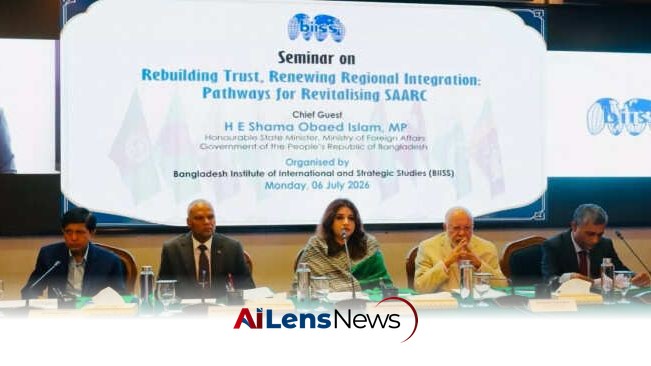


An n diplomat protested a map showing Kashmir as part of Pakistan during a seminar in Dhaka, asserting Jammu and Kashmir's integral status.
New Delhi, India Jul 7, 2026 ALN: A recent diplomatic incident has drawn attention to the sensitive nature of territorial disputes in South Asia, particularly regarding Jammu and Kashmir (J&K). During a seminar in Dhaka, a diplomat from lodged a formal protest after a map was displayed that depicted Jammu and Kashmir as part of Pakistan. This incident unfolded during a presentation by a former ambassador, which immediately elicited objections from the n diplomat. The display of such a map at a diplomatic seminar is not merely an oversight; it touches upon the deeply rooted and highly sensitive territorial disputes that have historically characterized relations between and Pakistan.
The diplomat emphasized that Jammu and Kashmir is an integral part of , reinforcing the country's longstanding position on the territorial dispute. has maintained that Jammu and Kashmir, which it administers as a union territory, is an inseparable part of its sovereign territory. This assertion is deeply rooted in the historical context surrounding the partition of British in 1947. At that time, princely states were given the option to join either or Pakistan. The Maharaja of Jammu and Kashmir initially chose to remain independent but later acceded to following an invasion by tribal militias supported by Pakistan. This accession is contested by Pakistan, which claims the region based on the majority Muslim population in the area.
The former ambassador, however, defended the map, stating that it was intended for representational purposes only and did not reflect any political stance. This defense highlights a common challenge in diplomatic communications, where visual representations can inadvertently convey political messages or imply endorsement of certain narratives. The use of maps in diplomatic discussions is often fraught with implications, particularly in regions where territorial disputes are ongoing. The former ambassador's assertion that the map was not politically motivated may be viewed with skepticism by the n side, given the historical context and the sensitivity surrounding the Kashmir issue.
The seminar was organized by the Bangladesh Institute of International and Strategic Studies (BIISS) and aimed to discuss regional integration and cooperation within the South Asian Association for Regional Cooperation (SAARC). Established in 1985, SAARC comprises eight member states: Afghanistan, Bangladesh, Bhutan, , Maldives, Nepal, Pakistan, and Sri Lanka. The organization aims to promote regional development and cooperation, but historical grievances, particularly those related to Kashmir, often overshadow collaborative efforts. The presence of such a contentious map at a diplomatic event raised eyebrows and highlighted the sensitivities surrounding the Kashmir issue, which remains a major point of contention between and Pakistan.
This incident underscores the ongoing tensions between and Pakistan regarding the status of Jammu and Kashmir, a region that both countries claim but administer differently. 's consistent assertion of sovereignty over the region is a critical aspect of its foreign policy. This position is not only a matter of national pride but also a reflection of the complex socio-political dynamics within , where the Kashmir issue is intertwined with national identity, security, and regional stability. Conversely, Pakistan's claims are rooted in its national narrative and its historical stance on the rights of the Kashmiri people, which it argues should be determined through a plebiscite as per the United Nations resolutions from the late 1940s.
As discussions about regional cooperation continue, the representation of sensitive issues like Kashmir remains a flashpoint in diplomatic relations. The incident serves as a reminder of the complexities involved in addressing historical disputes in international forums. The portrayal of Jammu and Kashmir in maps is not just a technical detail; it is emblematic of the broader geopolitical struggles in South Asia. The Kashmir conflict has led to multiple wars between and Pakistan and continues to be a source of military and political tension in the region.
Moreover, the seminar incident illustrates the broader implications of diplomatic engagements in a region marked by historical grievances. The potential for misrepresentation in such forums can lead to diplomatic rifts and exacerbate existing tensions. In this context, the role of diplomatic protocols and the responsibilities of institutions like BIISS become critical. They must ensure that discussions are conducted with a high degree of sensitivity to the historical and political contexts of the issues at hand. The display of an inaccurate map could be perceived as a lack of neutrality or an endorsement of one side's claims over the other, potentially alienating key stakeholders in the region.
In conclusion, the protest by the n diplomat at the Dhaka seminar reflects the delicate nature of territorial claims in South Asia and the importance of accurate representation in diplomatic discussions. The Kashmir issue remains a contentious topic that can evoke strong emotions and reactions from both sides. As regional dynamics evolve and new challenges emerge, the need for careful navigation of historical disputes becomes ever more crucial. The incident serves not only as a reminder of the past but also as a cautionary tale about the future of diplomatic engagements in a region where history continues to shape the present and future relations among states.
The ramifications of such incidents extend beyond immediate diplomatic relations; they can influence public perception, domestic politics, and international alignments. In , the Kashmir issue is often utilized by political leaders to rally support and assert national unity, while in Pakistan, it is framed as a struggle for the rights of Kashmiris. The narratives constructed around Kashmir are thus not only a matter of territorial claims but also of identity, nationalism, and political legitimacy.
Furthermore, the incident at the Dhaka seminar could have implications for future diplomatic engagements within SAARC. The organization has faced challenges in achieving substantive cooperation due to political tensions among member states, particularly between and Pakistan. This incident may lead to increased caution in how sensitive topics are addressed in future discussions, with member states possibly opting for more neutral or generalized representations to avoid offending any party.
Overall, the seminar incident serves as a microcosm of the broader geopolitical landscape in South Asia, where historical grievances and territorial disputes continue to complicate efforts toward regional cooperation and integration. As the region grapples with various challenges, including economic development, security concerns, and climate change, the need for constructive dialogue and mutual understanding becomes even more critical. Addressing historical disputes with sensitivity and care will be essential in fostering a more stable and cooperative regional environment.
To learn more about the latest developments in Political Controversies, stay updated with our exclusive reports and analyses on AiLensNews.

