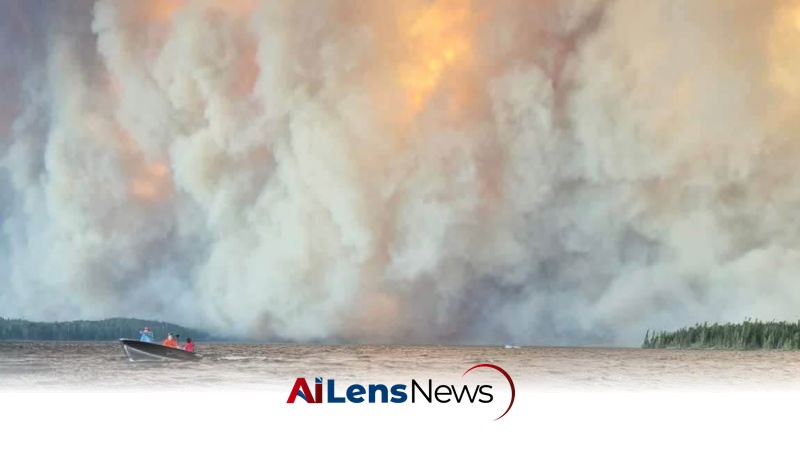


Residents of Namaygoosisagagun First Nation faced a sudden evacuation due to wildfires, despite being assured of safety. The community's destruction raises concerns about wildfire preparedness.
Washington DC, United States Jul 18, 2026 ALN: At first, all Miiyah Paavola could see was a thick wall of smoke.
From her home in Namaygoosisagagun First Nation, located in northwestern Ontario, the smoke appeared alarmingly close. This isolated Indigenous community, also known as Collins First Nation, found itself in a dire situation as wildfires swept through the region. On that fateful Monday, July 13, they were informed by the Ministry of Natural Resources that there was no immediate danger from the flames. However, within hours, the reality of the situation became clear, and residents were forced to flee for their lives.
“It was all very fast-paced. There was not really much time to think about what was happening,” Paavola recounted in an interview. She managed to grab a wet towel before squeezing aboard a small aluminum boat, alongside five other people, three dogs, and a cat. The community, which lacks road access, is only reachable by a railway line and Collins Lake, making their evacuation particularly challenging.
As the boat pulled away from the shore, Paavola struggled to fully comprehend the scale of the danger they were in. “All you could see was orange and gray and it was very dark,” she said. It wasn't until they were a distance from the shoreline that she could see the flames licking at the edge of the land. “When I was going across maybe about the second island, that’s when I watched it. I could just barely see the flames reach the shoreline. And it was a very thick wall of smoke that followed it very quickly.”
“If we had waited any longer, we would have been dead,” she added, highlighting the urgency of their escape.
Only about 25 of the community’s approximately 60 members were present in Collins when the fire approached. Residents believe that this likely saved lives, as those who were not in the village at the time were able to avoid the immediate threat. Many community members crowded into aging aluminum boats, some as small as 12 and 14 feet, powered by motors that were decades old. Tragically, many had to leave their pets behind, a painful decision in the face of life-threatening danger.
The fires that devastated Collins First Nation are part of a broader wildfire emergency that has been unfolding across Canada. As of the night of July 13, the Canadian Wildland Fire Information System reported 889 active fires across the country, with 163 of those fires located in Ontario alone, according to the province’s Ministry of Natural Resources.
Miiyah Paavola's escape was fraught with fear and uncertainty. "It was very scary,” she recalled. “There were quite a few times I felt like we were about to tip.” The boat faced strong waves during the approximately 40-minute journey from the northern part of Collins Lake to the southern end. Shortly after departing, they struck a rock, nearly capsizing the vessel.
At the time of the fire, Chief Helen Paavola, Miiyah’s mother, was not in the village. Earlier, a fire official had assured her that there was no imminent danger, claiming that the smoke residents were witnessing was from a smoldering fire located farther away. The moments of uncertainty were agonizing for Chief Paavola as she tried to reach her children and other community members during the evacuation.
“All I could think was … they’re gone. My children are gone. My community is gone,” she expressed. The relief she felt upon learning that everyone had evacuated safely was immeasurable. However, the damage was already done; her home, like all others in Collins First Nation, was completely destroyed by the fires.
During a press conference with Ontario Premier Doug Ford, government officials acknowledged that the fire had ignited unusually close to the community, leaving little time for a coordinated response. They stated that a review of their response to the situation would take place to prevent such lapses in the future.
The destruction of Collins First Nation has emerged as one of the most striking examples of the devastation wrought by the wildfires. According to Linda Debassige, Grand Council Chief of the Anishinabek Nation in Ontario, more than 30 homes were lost, along with the administration office, school, community center, storage buildings, vehicles, and essential community equipment. This loss represents not only the physical structures but the very fabric of the community.
“If they waited for an emergency response,” Debassige warned, “we would all be on a recovery mission looking for the bodies of children, elderly people, men, and women.” Her comments underscore the critical need for timely and effective emergency responses in Indigenous communities, which often face unique challenges in accessing resources and support during crises.
The Anishinabek Nation, which represents 39 First Nations, including Collins, is currently providing financial assistance for accommodation, meals, and essential supplies for evacuees who are now staying in the nearby city of Thunder Bay. This assistance comes in the absence of timely government support, leading to frustrations regarding the adequacy of the emergency response system.
Debassige pointed out that Collins First Nation has fallen through jurisdictional cracks because it is classified as a “near band,” a community still in the process of attaining full federal recognition. This status complicates access to government resources and support, particularly during emergencies. Compounding the issue, she noted that the community had faced wildfire threats only weeks earlier, yet little was done afterward to implement preventative measures, such as creating fire breaks or improving community readiness.
The catastrophic destruction of Collins First Nation has reignited discussions about the effectiveness of Ontario's wildfire management strategy, particularly in light of increasing fire intensity and frequency due to climate change. Lise Vaugeois, the Member of Provincial Parliament representing Thunder Bay-Superior North, has voiced concerns that at least a dozen communities across northwestern Ontario remain under evacuation or standby orders. This situation raises alarms about the preparedness of both provincial and federal systems to handle the growing threat posed by wildfires.
As climate change continues to exacerbate the conditions that lead to wildfires, there is an urgent need for comprehensive reviews of existing policies and protocols. This includes improving communication between government agencies and Indigenous communities, ensuring that timely and accurate information is disseminated during emergencies. Furthermore, there is a pressing need for better resources and support for Indigenous communities, who often face unique challenges in crisis situations.
The devastating events in Collins First Nation serve as a stark reminder of the vulnerabilities faced by many Indigenous communities in Canada, particularly in the context of climate change. The fires not only destroyed homes and infrastructure but also disrupted the lives of community members, displacing families and creating long-term challenges for recovery. As discussions about wildfire preparedness continue, it is imperative that the lessons learned from this tragedy are applied to prevent future disasters and ensure the safety and well-being of vulnerable communities across the nation.
To learn more about the latest developments in Local & Regional, stay updated with our exclusive reports and analyses on AiLensNews.

