

More
Checking your session
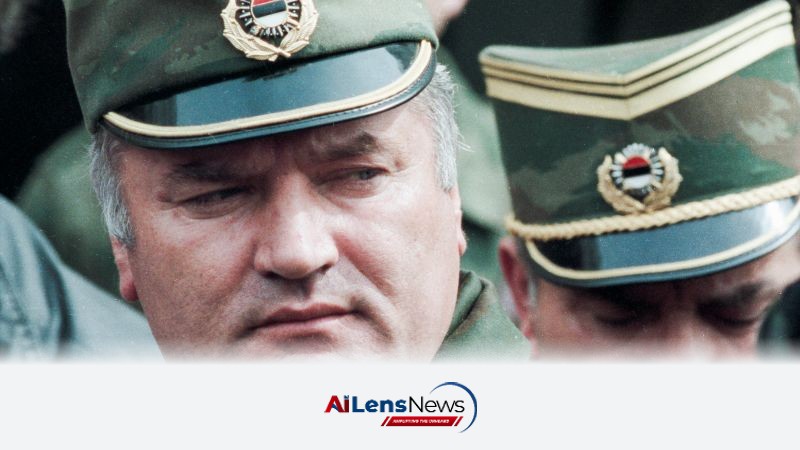



Ratko Mladić, known as the 'Butcher of Bosnia,' has died in prison at the age of 84. He was convicted of genocide and crimes against humanity for his role in the Bosnian War.
Washington DC, United States Aug 28, 2026 ALN: Ratko Mladić, the Bosnian-Serb general who orchestrated the Srebrenica massacre and the siege of Sarajevo during the Balkan wars, has died in prison aged 84. His death marks the end of a long and controversial chapter in the history of the Balkan conflicts, which were characterized by ethnic strife, violence, and severe human rights violations.
Known as the “Butcher of Bosnia,” Mladić was convicted in 2017 by the International Criminal Tribunal for the former Yugoslavia (ICTY) for masterminding a campaign of ethnic cleansing against Bosnia’s non-Serb population in the early 1990s. The tribunal, established in 1993 to bring justice to the victims of the Yugoslav Wars, has been instrumental in documenting the atrocities committed during this turbulent period.
The UN-established court found him guilty of genocide, crimes against humanity, persecution, extermination, murder, terror, unlawful attacks on civilians, and hostage-taking. The verdict was a significant moment not just for the victims and survivors of the Bosnian War, but also for international law, as it underscored the principle that individuals, including military leaders, can be held accountable for war crimes.
At the time of Mladić’s indictment, ICTY Judge Fouad Riad described the actions the former general oversaw as “unimaginable savagery.” This characterization reflects the systematic nature of the violence that occurred under his command, which included not only military operations but also the deliberate targeting of civilians and cultural sites. The court's findings highlighted the scale and brutality of the ethnic cleansing campaign, which aimed to create a Greater Serbia by removing non-Serb populations from contested areas.
Mladić died while serving a life sentence at the UN Detention Unit in The Hague, his lawyer Dragan Ivetić confirmed. He spent just over 15 years in prison, during which time he became a symbol of the struggle for justice in the aftermath of the Yugoslav Wars. Following his conviction, Mladić made multiple appeals and requests for release on medical grounds. The last of these was filed by his lawyers just last week, underscoring the protracted nature of legal proceedings in high-profile war crimes cases.
His legal team had argued for an early release on humanitarian grounds, citing the detention unit’s doctors who claimed that his “overall condition has rapidly declined” and warned that his death “may occur at any time.” However, this request was ultimately denied, reflecting the court's commitment to uphold the rule of law and the principles of justice, even in cases involving high-profile defendants.
Mladić was born on March 12, 1942, in the municipality of Kalinovik in what was then Yugoslavia. His early life was profoundly shaped by the turmoil of World War II; his father, Nedja Mladić, was killed by the Ustasha regime, a Croatian fascist movement that perpetrated genocide against various ethnic groups, including Jews, Serbs, and Roma. This background undoubtedly influenced Mladić's later military and political choices.
He trained at the military academy of the Yugoslav People’s Army in Belgrade, graduating in 1965. After joining the Communist Party, he embarked on a career as a soldier, eventually rising through the ranks to become a key military leader. Following the breakup of Yugoslavia in the early 1990s, Mladić was appointed Commander of the General Staff of the Army of the breakaway Serb Republic in Bosnia, a position that granted him significant power and influence during one of the most violent periods in European history since World War II.
As the army chief, Mladić was the main architect of a brutal campaign of ethnic cleansing, directly overseeing widespread and indiscriminate killings, deportations, and forcible transfers of civilians. His leadership style was characterized by a ruthless approach to military strategy, which often prioritized the elimination of perceived enemies over adherence to international humanitarian law.
While Mladić was found guilty of numerous atrocities, two of his crimes have become synonymous with the terror he inflicted on the Muslim and Croat population of Bosnia during the war: the siege of Sarajevo and the Srebrenica massacre. Under his command, Bosnian Serb forces besieged the city of Sarajevo from higher ground starting in 1992, effectively trapping its residents in the valley below for two long years. The siege involved frequent shelling and sniper attacks against the civilian population, leading to immense suffering and loss of life. More than 10,000 people, including many civilians, lost their lives during this brutal siege, which has been described as one of the most devastating episodes of the Bosnian War.
The Srebrenica massacre, which occurred in July 1995, stands as one of the most horrific events of the conflict. Mladić's forces killed more than 8,000 Bosniak men and boys in a matter of days, an act that was later classified as genocide by international courts. This massacre not only shocked the world but also galvanized international efforts to address war crimes and prevent future atrocities. The events in Srebrenica have since become a focal point for discussions on genocide prevention and the responsibilities of the international community in protecting vulnerable populations.
In the years following the war, the legacy of Ratko Mladić and the crimes committed under his command have continued to evoke strong emotions and divisions within Bosnia and Herzegovina and the broader Balkan region. The trials and convictions of war criminals have played a crucial role in the healing process for many victims and survivors, while also serving as a reminder of the need for accountability and justice in the face of egregious human rights violations.
The death of Ratko Mladić in prison does not erase the scars left by the war, nor does it conclude the discussions surrounding reconciliation and justice in the Balkans. His passing may prompt further reflection on the lessons learned from the Yugoslav Wars and the ongoing challenges related to ethnic tensions, national identity, and the quest for peace in a region still grappling with its past.
To learn more about the latest developments in World News & International Affairs, stay updated with our exclusive reports and analyses on AILensNews.

A new roadmap has been established through international mediation to implement …

Tim Cook announces Apple's donation to aid flood relief and rebuilding efforts i…

The death toll from the devastating floods in Nepal and Tibet has risen to over …

Rescue efforts in Nepal are on hold as officials report rising water levels in a…

Qatar has welcomed the inaugural field verification mission of the Expanded Join…