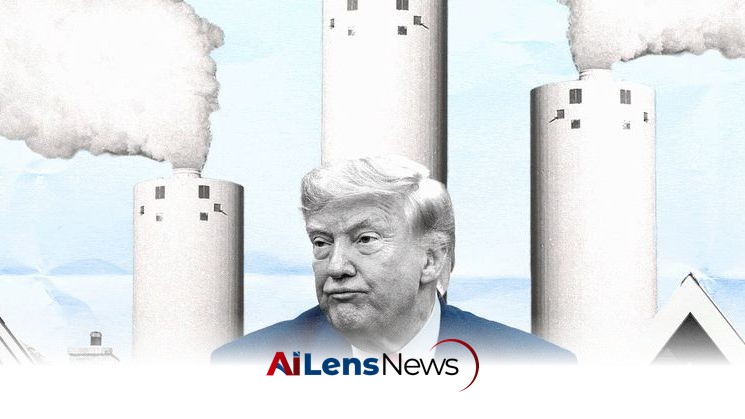


The EPA's new proposal could significantly reduce public engagement in air pollution permitting, benefiting fossil fuel-dependent data centers.
Washington DC, United States Jul 23, 2026 ALN: The Trump administration is quietly considering a rule change that could significantly alter the landscape of public involvement in the permitting process for air pollution sources. This proposed change could facilitate the construction of various facilities, including gas plants and diesel generators that power data centers, with minimal or no notice to the public. The implications of this proposed rule change extend beyond administrative adjustments; they touch on fundamental issues of environmental justice, community rights, and the balance of power between state and federal regulations.
On Wednesday, the Environmental Protection Agency (EPA) held a public hearing to discuss this proposed rule change. The change would grant states the authority to determine the level of public participation in the permitting process for certain new sources of air pollution. This proposal comes at a time when data centers, which are increasingly being scrutinized for their environmental impact, face mounting opposition from local communities. Many of these communities have utilized the existing permitting process as a tool to slow down or halt development that they perceive as harmful to their environment and health. The potential rule change could have far-reaching consequences for how communities are informed about new or expanded polluting facilities in their neighborhoods.
“As someone actively working in communities with data centers, I know this to be fundamentally true: People want to have a say,” said Vanessa Lynch, a Pennsylvania organizer with Moms Clean Air Force, during the EPA hearing. Her statement underscores a growing sentiment among community activists who advocate for greater transparency and public involvement in environmental decision-making processes.
Under the Clean Air Act, facilities that emit air pollution are mandated to obtain permits. These permits are categorized into two primary types: "major" and "minor." Major sources of pollution, which exceed specific thresholds for certain pollutants, undergo a rigorous permitting process that involves both federal and state regulatory review. This process includes extensive requirements that must be met before and after construction, ensuring a higher level of scrutiny and public engagement.
In contrast, minor sources of pollution, which encompass a wide range of facilities from dry cleaners to diesel and gas engines, undergo a less stringent permitting process. The broad scope of what qualifies as a minor source means that many facilities, including those powering data centers, can evade the more rigorous oversight associated with major sources. Companies like xAI and Meta have increasingly used minor source permitting processes to construct gas plants that operate behind-the-meter, further complicating the regulatory landscape.
The Clean Air Act does stipulate that public involvement is necessary in the permitting processes, particularly for major sources of pollution. Congress has mandated several public participation steps, including public hearings. Additionally, EPA regulations require some level of public engagement for minor source permits. However, the actual implementation of these requirements can vary significantly across states due to a patchwork of enforcement laws. This inconsistency raises questions about the effectiveness of public input in the permitting process and whether communities are adequately informed about potential pollution sources.
If the proposed rule is finalized, it would place the onus on state and local agencies—those most familiar with local issues—to determine the extent, timing, and duration of public participation opportunities for proposed new minor sources and modifications. An EPA spokesperson noted that this rule would not alter emissions standards but would shift the decision-making power regarding public engagement to state agencies.
The variability in state laws could lead to significant disparities in public involvement across the country. Keri Powell, an attorney with the Southern Environmental Law Center based in Atlanta, highlighted that her organization often engages in legal actions in states like Georgia, which currently has a more robust public notification and participation process for minor sources. For instance, earlier this month, her group alerted the state utility about construction issues at a data center based on information gleaned from public air permit applications. However, if the EPA removes the federal requirement for public engagement, community and legal groups in states like Georgia could find themselves with little to no advance notice about upcoming projects, effectively shutting them out of the review process.
“Georgia is an example of a place where I can say I’m concerned,” Powell expressed, emphasizing the potential risks of diminished public oversight.
Sara Lips, the director of communications at Georgia’s Environmental Protection Division, stated that the agency is currently assessing whether the proposed federal rule changes would impact the state’s public participation requirements. This uncertainty reflects a broader concern among environmental advocates about how state agencies might respond to changes at the federal level.
In Kentucky, there are also stronger public participation laws for minor source permits. Byron Gary, a senior attorney at the Kentucky Resources Council, mentioned that state agencies have made an informal commitment to maintain their public participation rules, regardless of potential changes from the EPA. However, he cautioned that this commitment could change with future administrations, indicating the precarious nature of regulatory frameworks.
Texas serves as a stark example of what reduced public engagement can look like. The rapid expansion of data centers in the state has driven a substantial increase in the construction of private gas plants, many of which rely on minor pollution permits. The state's lax enforcement of public participation requirements has left communities living near data centers unaware of the extensive fossil fuel infrastructure being established in their vicinity. This lack of transparency can lead to significant community health and environmental risks, as residents are often left in the dark about potential sources of air pollution.
Since taking office, the Trump administration has aggressively pursued policies aimed at promoting artificial intelligence and data center development, removing various regulatory hurdles at the federal level. This includes efforts by the EPA to position the United States as the "AI capital of the world," as stated by an agency spokesperson. The push for data center construction is part of a broader strategy to enhance technological infrastructure, but it raises serious questions about the environmental and community impacts of such rapid development.
Moreover, the financial stakes are high, with companies investing substantial resources into data center construction. Notably, spending on data center construction surpassed spending on public transportation infrastructure for the first time in June. As public opposition to data center projects creates new bottlenecks in development, Powell suggests that the timing of the proposed rule revision is likely not coincidental. She argues that it appears to be part of a broader package of regulatory changes aimed at facilitating the construction of AI data centers.
The potential rule change has ignited a debate about the balance between economic development and environmental protection. Advocates for stronger public participation argue that communities should have a voice in decisions that directly affect their health and environment. Conversely, proponents of the rule change assert that it will streamline the permitting process and promote economic growth by reducing bureaucratic hurdles. As the EPA moves forward with its deliberations, the outcome of this proposed rule change will undoubtedly have lasting implications for public engagement in environmental decision-making and the future of air quality management in the United States.
To learn more about the latest developments in Crime & Law, stay updated with our exclusive reports and analyses on AiLensNews.

