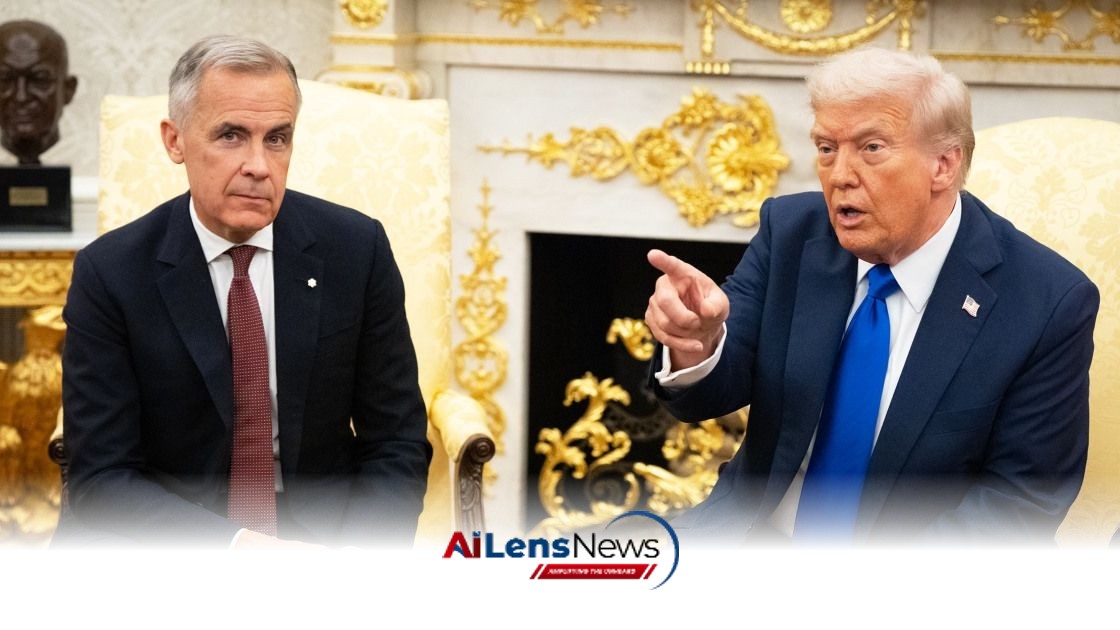



In a significant escalation, Canadian Prime Minister Mark Carney has suspended trade negotiations with the U.S., leading to immediate 50% tariffs on various goods.
Washington DC, United States Aug 22, 2026 ALN: Trade talks between Canada and the United States collapsed late Friday night, resulting in the implementation of steep 50% tariffs on a wide range of Canadian goods. These duties took effect at midnight, marking a significant escalation in trade tensions between the two nations.
Canadian Prime Minister Mark Carney announced that, despite making important progress during negotiations, it was insufficient to meet the objectives for Canadians. "As a result, this evening, I have decided to suspend trade negotiations with the U.S. and have directed Canada’s negotiators to return to Ottawa," Carney stated in an email just before the deadline.
The tariffs will affect approximately $20 billion worth of U.S. imports from Canada, impacting items such as hockey sticks, building materials, liquors, and certain clothing types. Carney emphasized that Canada would retaliate against the U.S., stating, "Canada will match those tariffs dollar for dollar to protect our workers and businesses."
The breakdown of negotiations came after nearly two weeks of intense discussions. This was a dramatic reversal from earlier in the week when U.S. President Trump had paused the tariffs, suggesting that a deal was imminent.
Officials from both countries had expressed optimism about reaching an agreement until the very last moment. On Thursday, Canadian Minister for U.S. Trade Relations, Dominic LeBlanc, met with U.S. Trade Representative Jamieson Greer for several hours, stating, "We’re very close, we continue to make progress and we’re going to stay here and do the work that is necessary until we get to that point." However, negotiations extended into the final hours of Friday without a compromise.
In his statement, Carney criticized last-minute changes to the U.S. proposed terms, calling them "unfair, uneconomic, and called into question the reliability of any deal." He added, "We have recognized from the beginning that America has changed, and that we will not return to our old relationship. Canada has what the world wants. And we will not allow any nation to determine our future."
U.S. Trade Representative Greer stated that Canada declined to finalize the trade deal under the previously agreed terms. He noted that new demands and retractions from Canada had disrupted the balance reached in recent days.
A point of contention was Canada's ongoing retaliation against the U.S., including prohibitions on certain American goods and services. These bans, introduced by Canadian provinces in 2025 in response to earlier tariffs imposed by Trump, have continued to complicate negotiations.
As the discussions unfolded, Carney faced pushback from provincial premiers in Canada. Manitoba Premier Wab Kinew urged the federal government to take a stronger stance against Trump, while Ontario Premier Doug Ford expressed his support for a robust response, stating, "The prime minister has my full support for a strong response—tariff for tariff, dollar for dollar."
Carney had previously indicated that Trump’s threatened tariffs would violate the United States-Mexico-Canada Agreement, which was negotiated during Trump’s first term. The U.S. Chamber of Commerce warned that higher tariffs would harm both economies, increase costs for American families, disrupt supply chains, and jeopardize millions of American jobs dependent on the North American trade pact.
Following Carney's announcement, the Canadian Chamber of Commerce echoed these concerns, calling the tariffs "a body blow to North American competitiveness in this self-defeating trade saga." Candace Laing, president & CEO of the Canadian Chamber of Commerce, warned that Americans would face higher costs, while Canadians would see a decline in customers, investment, and small businesses.
The new tariffs were imposed under presidential authority granted by Section 338 of the Tariff Act of 1930, a provision that has never been utilized before. This law allows the White House to impose duties of up to 50% on any foreign trade partner that discriminates against U.S. commerce.
To learn more about the latest developments in World News & International Affairs, stay updated with our exclusive reports and analyses on AILensNews.

