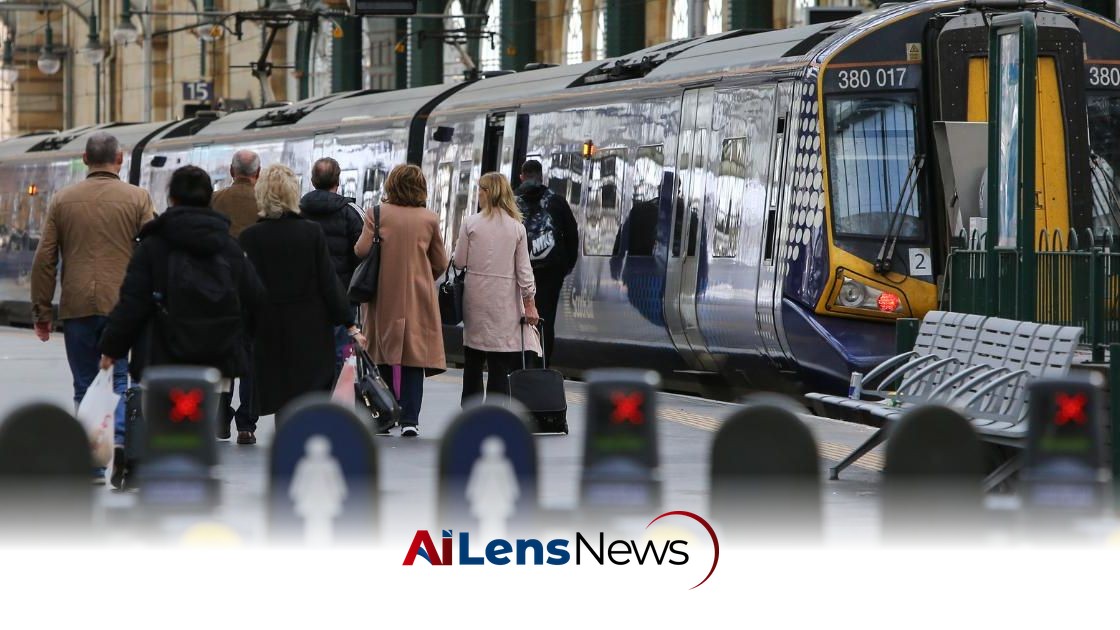



Exploring the challenges and priorities for improving Scotland's public transport system based on public feedback and expert opinions.
London, United Kingdom Aug 3, 2026 ALN: FOR many people, the day‑to‑day reality of Scotland's public transport still falls short of what they need.
From late‑night journeys home from hospitality jobs to eye‑watering rail fares between cities, members of the public describe a network that is vital, increasingly used, but frequently frustrating.
The latest figures from 2023‑24 show total public transport journeys in Scotland (bus, rail, air, ferry) increased by 15% compared with 2022‑23. Driving frequency is edging down with 2024 figures telling us 71% of people aged 17 and older held a full driving licence and 64% drove at least once a week, with 35% driving every day – well below the 43% who drove daily in 2019.
We spoke to both experts and members of the public about what their biggest priority is when it comes to improving Scotland’s public transport.
“I would make late‑night transport a lot better. I work in hospitality, so getting home sometimes is quite difficult, and I don't always want to walk home by myself really late,” one woman who works in hospitality said.
“I think the cost of public transport, particularly buses locally, is quite a lot, especially as they're not that reliable. And I also think train prices across Scotland as well. My family live up in Aberdeen and it's about £70 to get up there, so I don't see them very often.
“I do love the Void bikes, though, I think they're quite good.”
One man praised Scotland’s free bus travel for under-22s.
“I have a younger son who obviously makes use of it,” he said.
As of October 2025, children and young people had made more than 250 million free bus journeys since the under‑22s scheme launched three years earlier. However, some are suggesting tighter controls.
“I think there should be boundaries put on that. There's maybe a sort of slight criminal element with regards to buses being abused, but apart from that I think, you know, it's great.
“I'd maybe like to see more electrification of trains and things like that, doing away with the old diesel trains. Living in East Kilbride, we've been electrified and it makes a massive difference – the train journey's a lot more comfortable, a lot quieter as well.
“Clearly they're [governments and local authorities] trying to encourage us to use public transport more, and it seems to be working.”
Not everyone felt change was necessary. One woman said she was broadly satisfied with the system as it stands.
“Nothing. It's really good,” she said. “We've got an underground system, we've got trains, a really good bus service and for me it's fine.”
Another woman focused on punctuality and better connections for the subway.
“I would make sure that the buses actually came on time,” she said. “And I would also say for the subway to connect to the south better would be so good.”
Bus use in Scotland is highest in our cities, where around 42% of adults use a bus at least monthly.
A second man echoed those concerns about the scale of Glasgow’s underground and linked wider transport to Scotland’s nightlife and hospitality economy.
“I think just the subway being a wee bit bigger, a bit more accessible in different areas of Glasgow,” he said. “It's quite hard to get, especially on the south side, and then parts of the West End are quite cut off. When you look at the subway systems across the UK, ours just lacks a bit. So if it could be a wee bit bigger, that would probably be beneficial to Glasgow.”
Looking across Scotland, he said: "I feel like we're quite good when there's things happening – like when the Fringe is on that there's later trains on – but actually stuff happens all year round that I reckon those trains could be busy, like getting to and from Edinburgh.
“If you're out in Edinburgh you can't really make a night of it because you have to be up the road or on a train for 11 o'clock back to Glasgow. If the transport in Scotland would help that then that could also help the hospitality scene – customers getting home but also staff getting home.”
Professor Adrian Davis, an expert in transport and health, believes the answer to a fluid and reliable public transport system in Scotland’s cities is creating road space for buses to run on time without being hindered by traffic.
“Who has access to the [road] space? We’ve given it to private cars increasingly,” Davis told The National.
“If you want urban areas to work, it’s not going to work by allowing people to just drive around in private cars and cause more and more congestion and slowing bus services down because it then creates a spiral of more people choosing to use a car because the bus service isn’t good enough.”
The Edinburgh Napier University academic said making space for buses to operate fluidly as part of an integrated ticket system would be his biggest priority in improving Scotland’s public transport, having seen how well other European cities function like this.
“You only have to think about when you go abroad to a European city and it’s just socially normal to get on a bus or take the tram. I often point people to Freiburg which has got one of the most extensive tram systems in Europe.
“These cities have got multiple options for people to use public transport. They’ve got buses as a workhorse, light rail and heavy rail. They’ve also got the ability to buy one ticket to all those, so it’s hassle-free.”
Dr Fiona Crawford, a lecturer in transport planning at the University of Glasgow, also agreed that integrated ticketing and prioritising road space for buses in urban areas are key to improving Scotland’s public transport.
“I was travelling back from Paris on the train recently and I got stranded in Edinburgh because there was a problem with the trains. Now there are lots of coaches between Edinburgh and Glasgow but none of that was linked up,” she said.
“If you’re bus gets delayed, you might have to buy a new train ticket even though it’s not your fault you’re late. If we had a more integrated system, I think that flexibility would help a bit with the reliability.”
She is also an advocate for an innovative system that has taken off in some rural areas of Scotland – demand responsive transport.
“Instead of just running a bus on a timetable, it’s more about people going on an app or phoning up and saying ‘I want to go from this little village into the town centre Saturday afternoon’. It will then link up lots of people who want to go in on that day, picking up all the people who requested it. So, it can be a lot more efficient.”
Davis added that prioritising investment in creating road space for buses could have a huge impact on people’s physical and mental health, especially in deprived areas.
“If you’re out in the evening in the Gyle [Edinburgh] and you’re coming into the centre on a bus that’s going to cost you £5, that’s a significant part of disposable income after you’ve paid for the necessities,” he said.
“Then it becomes about ‘well can I actually afford to travel by bus?’ which means ‘do I limit things that I can do?’ and some of those might be important, like going to a GP.
“There’s also the physical activity aspect which we should not belittle. If you walk to the stop, back to the stop and walk around in between, you’re doing a fair amount and physical activity is the closest thing we’ve got to a wonder drug.”
To learn more about the latest developments in Transport & Mobility, stay updated with our exclusive reports and analyses on AILensNews.

