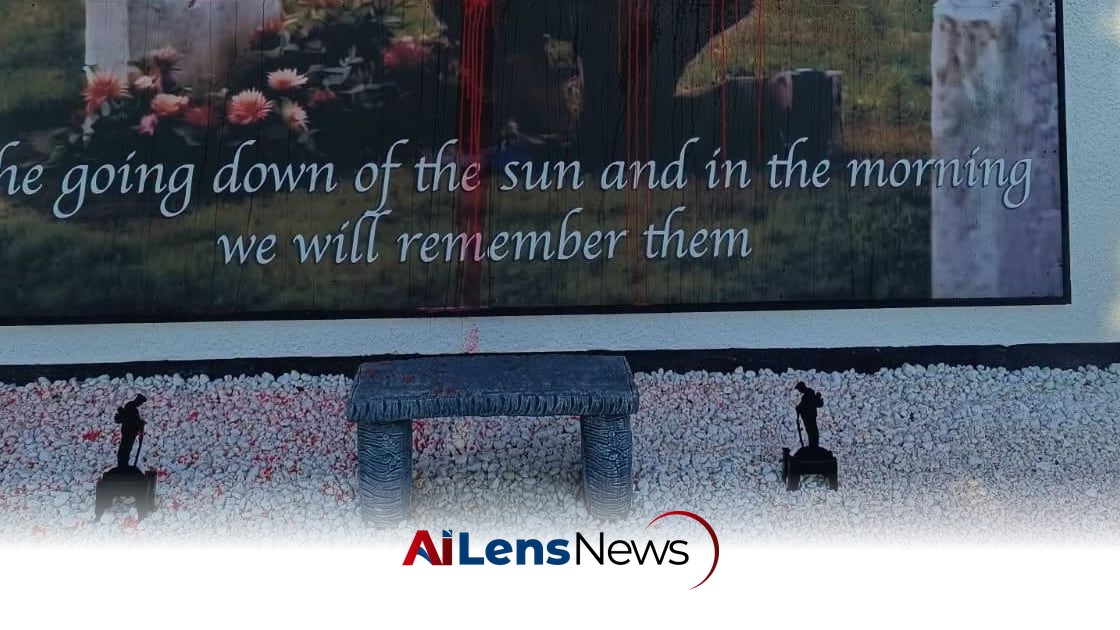


A mural in Newtownabbey, deemed offensive by the PSNI, was vandalized in a paint attack by a group protesting against its message.
London, United Kingdom Jul 16, 2026 ALN: A Co Antrim mural described by the PSNI as “offensive” has been targeted in an overnight paint attack. This incident underscores the ongoing tensions surrounding community relations in Northern Ireland, particularly in areas such as Newtownabbey, which has a complex history influenced by sectarian divides and cultural expressions. The mural in question was erected in Newtownabbey at the beginning of May, but has not yet been removed after police stated they were conducting "enquiries and engagement" with the local community, indicating a careful approach to a sensitive issue.
The mural located on the Doagh Road features an AI-generated image of a war veteran being shadowed by hooded figures carrying flags that partially resemble the national flag of Pakistan. The imagery and symbolism within the mural have drawn criticism and support alike, with the group behind the mural asserting that it serves as a protest against what it refers to as the ‘Islamification’ of the local area. This claim has sparked significant backlash from various community groups and activists, leading to a polarized discourse surrounding the mural's message.
Social media videos that emerged on Thursday morning show a number of hooded figures approaching the mural and throwing paint over it, a clear act of defiance against the mural's message. A group which claimed to have carried out the paintbomb attack stated it acted in response to the “racist” banner in the Cloughfern area, highlighting the deeply entrenched divisions and the active resistance against perceived hate speech. The socialist republican group Lasair Dhearg claimed responsibility for the actions, positioning itself as a defender of community values against what they view as discriminatory expressions.
The attack on the mural is emblematic of the broader societal challenges faced in Northern Ireland, where issues of identity, race, and community relations are fraught with complexity. The act of vandalism not only signifies opposition to the mural's message but also reflects a growing movement among certain community factions to challenge what they perceive as hate speech and xenophobia. This incident is not an isolated occurrence but part of a larger pattern of responses to controversial expressions of identity in a society still grappling with its past.
The group that created the mural later claimed it had been attacked by “immigrants,” which further complicates the narrative surrounding the mural and its implications. The language used reflects the broader societal tensions regarding immigration and integration within Northern Irish communities. Additionally, two men were cautioned at the scene of the mural last month for causing criminal damage and for “displaying offensive material” under the Public Order Act, illustrating the legal ramifications of such controversial expressions.
Despite the ongoing controversies, rather than the mural being removed by the PSNI, the group behind it later organized an open day in which it stated “everyone [was] welcome.” This initiative appears to be an attempt to foster dialogue and community engagement, although it may also be perceived as a provocative move by those who oppose the mural. Police have also stated they are investigating threats made to a local councillor who had spoken out against the erection of the mural, indicating that the tensions surrounding this issue are not only social but also political.
The PSNI issued new guidance to officers earlier this year detailing how officers should take a more proactive approach to dealing with offensive flags, emblems, and displays. This move came in response to public criticism over perceived failures to remove offensive material in a timely manner. Deputy Chief Constable Bobby Singleton informed the Policing Board in February that the new guidance was intended to remind officers of their “clear obligation to act” on offensive displays. However, he emphasized that the primary responsibility for the removal of such displays still rests with the land or property owner, which in this case is understood to be private property.
The complexity of the situation is further highlighted by the fact that the mural is attached to private property, raising questions about the balance between freedom of expression and the community's right to be free from hate speech. The PSNI's approach reflects a broader societal challenge in Northern Ireland, where expressions of identity and political sentiment can often lead to conflict. The police's handling of such incidents is critical, as it can either exacerbate tensions or help to alleviate them, depending on the public's perception of their actions.
In the weeks following the Newtownabbey mural's installation, several other anti-Islam displays have emerged, including a replica mosque that appeared on top of a bonfire in Moygashel, Co Tyrone. Such displays have sparked outrage among various community members and advocacy groups, further escalating tensions. The ongoing nature of these incidents highlights the precarious state of community relations in Northern Ireland, where historical grievances and modern socio-political issues intersect.
The responses to these displays, whether through vandalism, public protests, or political statements, reflect a society grappling with its identity and the implications of multiculturalism. The reactions from both supporters and opponents of the mural and similar displays reveal the deep divisions that still exist within communities, as well as the challenges faced by local authorities in managing these conflicts. The increasing visibility of such incidents may also indicate a growing willingness among certain groups to openly challenge and confront expressions of intolerance.
As these incidents continue to unfold, they serve as a reminder of the fragility of peace and the importance of fostering dialogue within communities. The implications of such actions extend beyond the immediate locality, affecting perceptions of Northern Ireland as a whole and its ongoing journey towards reconciliation. The narrative surrounding the mural and its subsequent vandalism is reflective of the broader cultural and political landscape in Northern Ireland, where the legacies of the past continue to shape contemporary issues.
In conclusion, the paint attack on the Newtownabbey mural is not merely an isolated incident but a reflection of broader societal issues. It encapsulates the challenges of living in a diverse society where differing views on identity, religion, and culture can lead to conflict. The responses from community groups, law enforcement, and local politicians will be crucial in shaping the future of community relations in Northern Ireland as they navigate these complex dynamics. The need for constructive dialogue and mutual understanding has never been more pressing, as communities strive to find common ground amid ongoing tensions.
To learn more about the latest developments in Crime & Law, stay updated with our exclusive reports and analyses on AiLensNews.

