

More
Checking your session
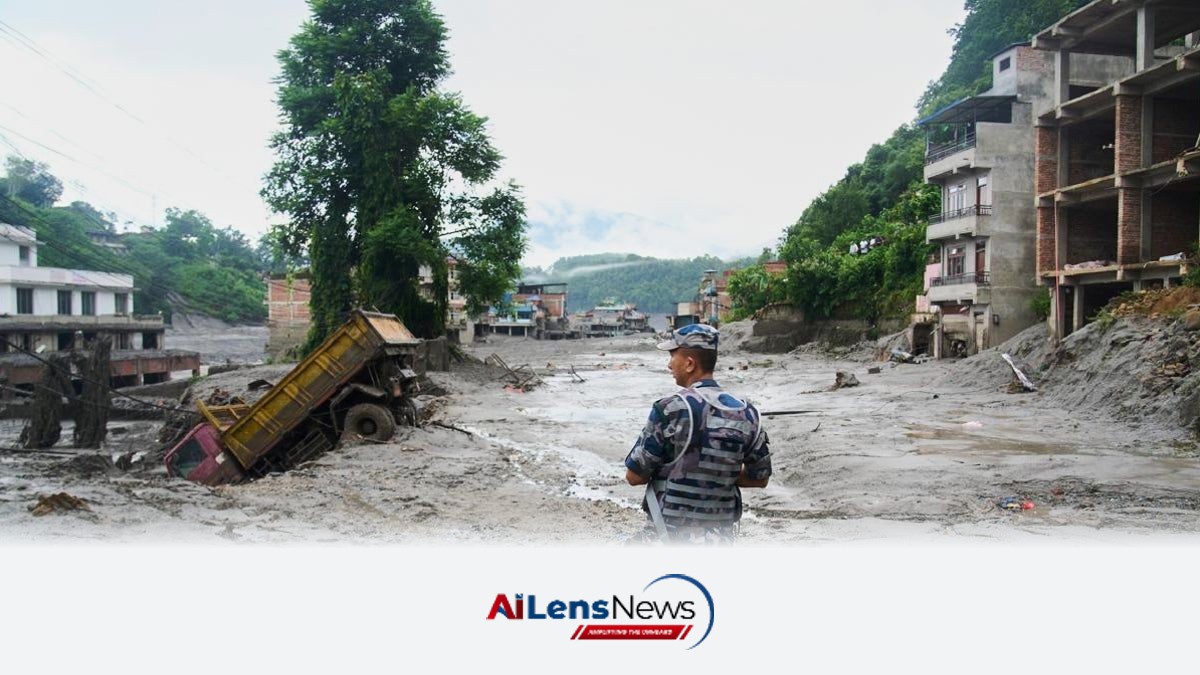



Rescue teams in Nepal are racing against time as a second wave of flash floods threatens to exacerbate the devastation already caused by recent disasters.
London, United Kingdom Aug 28, 2026 ALN: A second wave of deadly flash flooding could arrive in Nepal within days, authorities have warned, as rescue teams raced against time to find survivors of a catastrophe that has already killed at least 469 people.
A lake of rising water has formed along the Bhotekoshi river and Nepalese disaster authorities, fearing that it may burst its banks, have urged people and rescuers along the lower banks to move to safe areas.
Monitors have also warned that a section of the Trishuli river may have been blocked by debris during Wednesday’s floods, creating a landslide dam that could burst “imminently”.
The fast-moving situation has complicated rescue efforts, with almost 1,000 people still unaccounted for, including almost 650 foreigners and 33 British tourists.
The UK offered £5m to help Nepal deal with what the prime minister called a “very distressing and devastating situation”.
“It’s a devastating picture that is emerging from what has happened in Nepal,” Andy Burnham said. “Obviously, there are a number of British nationals who currently are thought to be missing and we will be providing all the support we can to their families in what is a very distressing and devastating situation.”
Two teenagers – a 13-year-old girl and a 14-year-old boy – are among the British nationals believed to be unaccounted for.
Authorities were using helicopters to search for survivors and drop emergency supplies on Thursday after water and mud swept through the Rasuwa, Nuwakot and Dhading districts.
The president of the Nepal Centre for Disaster Management, Dr Bishal Nath Upreti, said the situation on the ground was so dire that entire villages had been “wiped out”.
“It was such a huge amount of water,” he said. “You can imagine it is 20 million cubic metres excess water on the river, and it was like a tsunami from the sky.”
The National Disaster Risk Reduction and Management Authority said that satellite information from China indicated that the Bhote Koshi river had been blocked, creating a risk of a second flood.
In a post on social media, it suggested the lake was in the process of rising and there was a danger of it bursting.
Keshav Prasad Baral, a 68-year-old survivor being treated in a Nepali hospital, said: “It was a huge gush of mud coming straight towards us. As it got closer, it kept rising higher and higher. When I saw it enter our home, I tried to grab my wife’s hand and take her to the terrace. But she was swept away by the mud.”
A helicopter ferried him to safety four hours later. “My wife is still somewhere beneath the mud,” he told Reuters. “She's gone.”
Rescue teams on the Nepali side said on Thursday that they had so far found 25 Chinese workers and around 100 Indian visitors, but 910 people were still missing. That figure included over 400 foreigners who were among 579 tourists, 44 soldiers and 28 police officers missing. Neighbouring India had the highest number of missing people at 178, the Nepali tourism industry said.
The Red Cross said entire villages had been destroyed and that impassable roads and bridges had left communities cut off. The full scale of the disaster remained unclear, it added.
Unicef reported that at least 17,000 children had been affected by the floods and at least 14 had been killed.
“Children across Rasuwa and Dhading saw their lives being literally washed away in front of their eyes in a very short span of time, with homes, classrooms, and medical facilities damaged,” said Alice Akunga, Unicef’s representative to Nepal. “Too many lost their lives and loved ones. With the death toll still rising, we know this tragedy is far from over.”
Meteorologists on the Chinese side warned of possible floods, landslides and other secondary disasters in the coming days, affecting Gyirong County.
David Simon, a professor of development geography at Royal Holloway, University of London, told The depressions that seasonally filled up with water could create secondary disasters during periods of flooding. That could entail filling up and overtopping like dam overflows, or the force of the water rupturing part of the rim, he said.
“What they will hopefully be doing is starting to monitor those sources very carefully,” he said, “and crucially starting to evacuate people and get as much of the infrastructure out of the way as possible. Given the remoteness, the topography, and so on, it’s very unlikely that they will be able to get large enough pumps to pump stuff out and prevent the catastrophe that way.”
Prof Simon said the Himalayas had not experienced flooding on such a scale before, and warned that it was only likely to continue as glaciers thin and summers continued to bring “extraordinary” weather.
Scientists say climate change is creating conditions that can destabilise high-mountain rock and ice, increasing the likelihood of disasters like this.
Benjamin Horton, dean of the School of Energy and Environment at the City University of Hong Kong, told Reuters that Wednesday’s disaster could be a classic example of a “compound event”. That happens when an earthquake interacts with climate-driven changes, such as glacier loss, thawing permafrost, and slope instability, to “create a more complex and damaging disaster than would occur from any one factor alone.”
To learn more about the latest developments in World News & International Affairs, stay updated with our exclusive reports and analyses on AILensNews.

A new roadmap has been established through international mediation to implement …

Tim Cook announces Apple's donation to aid flood relief and rebuilding efforts i…

The death toll from the devastating floods in Nepal and Tibet has risen to over …

Rescue efforts in Nepal are on hold as officials report rising water levels in a…

Qatar has welcomed the inaugural field verification mission of the Expanded Join…