

More
Checking your session
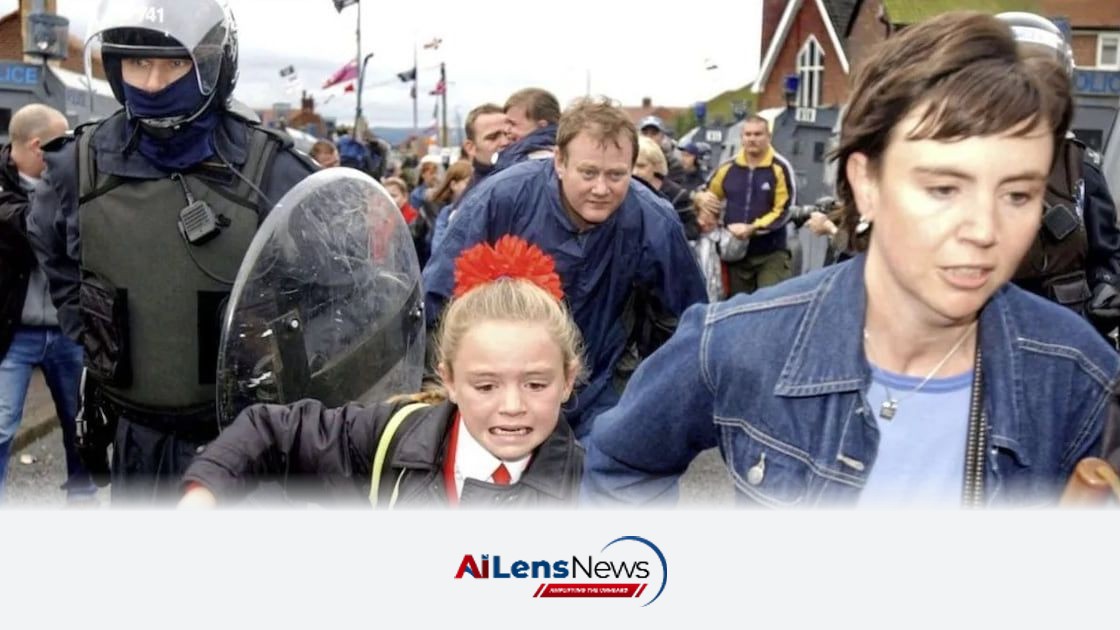



The Holy Cross School protest in 2001 highlighted deep-rooted sectarian tensions in Northern Ireland, as parents faced hostility while escorting their children to school.
London, United Kingdom Aug 24, 2026 ALN: “It was absolutely terrifying... the scariest thing I ever did,” says Elaine Burns as she recalls walking to school with her children along the Ardoyne Road in the autumn of 2001.
What ordinarily was an everyday routine became the centre of global media attention, as young children and their parents walked a gauntlet of hate where they were subjected to sectarian abuse, pelted with missiles, including balloons filled with urine, and even had a blast bomb thrown at them.
The root causes of the Holy Cross protest, in which loyalists vociferously and violently objected to parents from nationalist Ardoyne escorting their children to school, are perhaps as complex as Northern Ireland’s history itself.
The school, by an accident of history and shifting demographics, is an outpost situated in the overwhelmingly Protestant Glenbryn area.
Throughout the Troubles, parents had taken their children to school, largely without incident. However, in the summer of 2001, three years after the signing of the Good Friday Agreement, tensions in the area escalated.
Mrs. Burns, a former pupil at Holy Cross girls’ school and an advice worker in Ardoyne who served on the school’s board of governors, believes that already fraught community relations deteriorated noticeably with the arrival of families displaced from the Shankill during the UVF-UDA feud the previous year.
Before this influx, she says, Glenbryn’s population was ageing and many houses lay empty.
“People here shared all the same shops and the Post Office,” she says.
“I think there was a lack of understanding when they moved into an area which is very fluid, and schoolchildren come and go. They weren’t accustomed to living cheek by jowl with people from the other side.”
Professor Peter Shirlow, who was conducting research along the interface in the run-up to the dispute, also highlights the arrival of members of the UDA’s C-Company but he also recalls attacks on Protestant children in a playpark and incidents of verbal intimidation.
“The decline in nearby Protestant communities in Oldpark and Manor Street also led to a sense of being forced out and that Upper Ardoyne would be next,” he says.
Whereas the school had been attacked and burned on a number of occasions, and previously flags had been flown from lampposts and kerbstones painted nearby, in the run-up to the 2001 Twelfth, it was felt the actions of the loyalists became increasingly antagonistic.
The then school principal Anne Tanney says “there was always a feeling that we were aliens in their territory.”
Nevertheless, there were ongoing mutual efforts to build and maintain relations with staff and pupils at nearby Wheatfield Primary School, while the Holy Cross’s educational ethos placed a strong emphasis on the Christian values of tolerance and respect.
Inside the entrance hall of the school a quote sourced from an old copy of Readers’ Digest is displayed: “If we’d been born where they were born, we’d believe what they believe.”
“We had done a lot of cross-community work and believed that helped the situation but people whipped up hatred and fear, which is an awful shame,” says Mrs. Tanney.
An incident in late June, prior to the summer holidays, in which it’s claimed a loyalist putting flags on lampposts was knocked off a ladder, is often cited as the trigger for what followed.
Over the coming days, loyalists blockaded the school and at night there were violent clashes on the interface, with petrol bombs hurled and shots fired.
For the final days of term, the fraction of children who went to school took a detour that involved crossing a playing field and entering the school at the rear through a gap cut in the perimeter fence.
Sinn Féin MLA Gerry Kelly acknowledges that the Glenbryn residents had some legitimate grievances, though not all related to their proximity to Ardoyne.
“But those grievances did not equate to or in any way give legitimacy to the actions that were taken,” he says.
“Nobody could have convinced me to protest outside a girls’ school. I just wouldn’t have. You would’ve just known straight away to catch yourself on.”
The veteran republican says there was a lack of leadership on the unionist side. Nigel Dodds had become the area’s MP weeks earlier, while other prominent politicians included Nelson McCausland of the DUP, who was a councillor at the time, then-Ulster Unionist MLA Fred Cobain, and Billy Hutchinson of the UVF-aligned Progressive Unionist Party.
“Without naming names, they didn’t lead; they were led by the emotional voice in the room,” Mr. Kelly says.
Elaine Burns also identifies a leadership vacuum among the Glenbryn residents: “To take their frustration out on young children was not the right thing to do.
“There was a lack of leadership within their community that would’ve enabled them to articulate what their needs were and what was the best way to get those needs met.”
Fr. Aidan Troy had arrived at the Holy Cross Monastery from Rome during the summer along with Fr. Gary Donegan. He was elected chairman of the Holy Cross community during the crisis, working tirelessly to mediate between the conflicting parties.
The events surrounding the Holy Cross School protest remain a poignant reminder of the sectarian divisions that have historically plagued Northern Ireland, highlighting the urgent need for dialogue and understanding in a community still healing from its past.
To learn more about the latest developments in World News & International Affairs, stay updated with our exclusive reports and analyses on AILensNews.

World leaders express condolences and offer assistance as flash floods in Nepal …

In response to devastating floods in Nepal, India has dispatched a second flight…
Qatar has condemned Israel's raid on a UNRWA centre in East Jerusalem, calling i…

A recent analysis by the US Geological Survey reveals that the devastating flash…

India has dispatched a second flight with 37.5 tonnes of humanitarian supplies t…