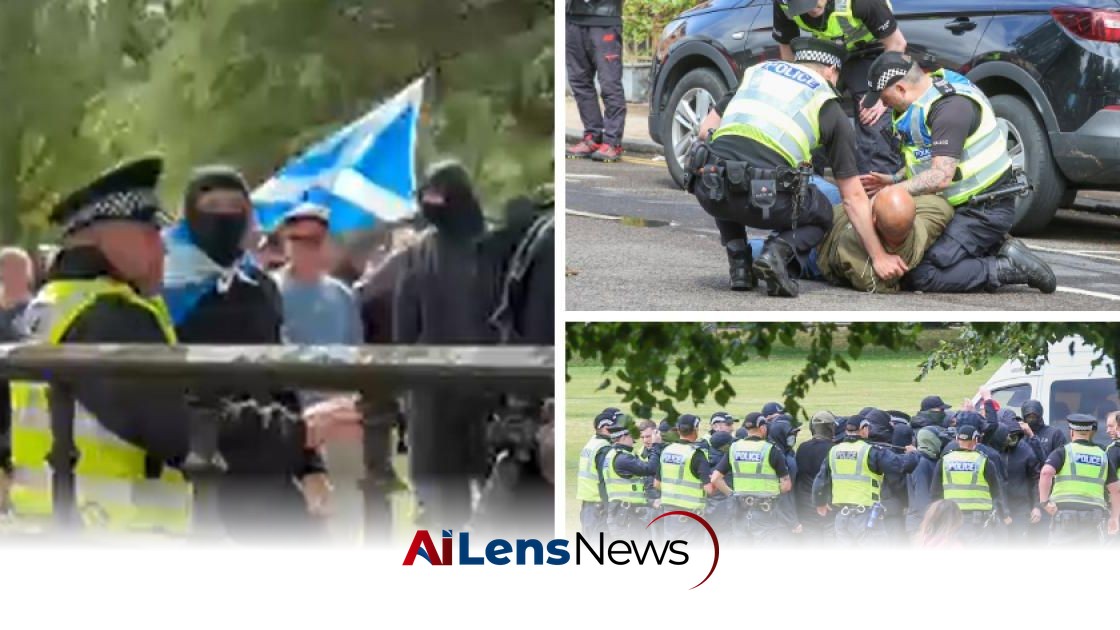


Footage reveals far-right demonstrators clashing with police in Glasgow, as anti-racism campaigners gather to counter a rally organized by Unite the Clans.
London, United Kingdom Jul 25, 2026 ALN: In a series of violent confrontations in Glasgow, tensions escalated between far-right demonstrators and anti-racism protesters during a rally organized by the anti-immigration group Unite the Clans. Footage from the event captured scenes of far-right supporters hurling bottles and wooden objects at police officers, highlighting the intense atmosphere surrounding the demonstrations. The clashes occurred on a Saturday, marking a significant moment in the ongoing debate over immigration and racism in Scotland.
At least 1,000 anti-racism campaigners gathered at Glasgow Green to counter the Unite the Clans rally, which aimed to voice concerns about immigration and asylum seekers. This counter-protest was organized by a coalition that included Stand Up To Racism (SUTR) and Women Against The Far Right, with support from various organizations such as the University College Union and Refuweegee. The presence of these groups underscores the growing mobilization against far-right ideologies in Scotland, reflecting a broader national and international trend of resistance to hate and intolerance.
The anti-racism protest began an hour before the Unite the Clans rally, assembling at the McLennan Arch at 11 AM in anticipation of the noon gathering by far-right supporters. This strategic timing indicates a well-planned effort to create a strong opposition to the far-right agenda, aiming to drown out their message and demonstrate solidarity among those who advocate for inclusivity and diversity.
In preparation for the potentially volatile situation, Police Scotland had announced a dedicated operation focused on minimizing disruption and ensuring public safety. Chief Superintendent Emma Croft confirmed that officers would be deployed to support lawful protest while maintaining order. The police presence was a crucial element, as past events involving far-right groups have often led to violence and unrest. The authorities' approach reflects a commitment to balancing the right to protest with the need for public safety, a challenging task in the face of rising tensions.
Unite the Clans, previously known as Aberdeen Against Illegal Migration, has been vocal in its opposition to immigration policies, framing its Glasgow rally as an opportunity for supporters to express their concerns. They urged followers to "stand united" to "protect women and children," a narrative that has been criticized for exploiting fears around immigration and safety. The rally followed a series of smaller anti-immigration demonstrations across Scotland, including in neighborhoods like the Gorbals, Castlemilk, and Cranhill in Glasgow, as well as in Aberdeen. This pattern of mobilization suggests a concerted effort by far-right groups to gain traction in Scottish communities, capitalizing on societal anxieties surrounding immigration and its perceived impact on local safety and culture.
The promotional materials for the rally, including posters that featured emblems of the neo-fascist group Britain First, have drawn significant criticism. These associations raise alarms about the ideological underpinnings of Unite the Clans, with links to members of the Patriotic Alternative in Scotland further complicating their public image. Stand Up to Racism has characterized Unite the Clans as a fascist organization intent on building a street movement that opposes not only migrant rights but also the rights of LGBT+ individuals, women, and Palestinian communities. Such characterizations highlight the broader implications of far-right activism, which often intersects with various forms of discrimination and intolerance.
Scottish First Minister John Swinney expressed his disapproval of the far-right agenda, emphasizing the importance of peaceful protest while condemning the hateful rhetoric often associated with such demonstrations. He stated, "I disagree with the far-right agenda, I disagree with the intolerance perpetuated." His comments reflect a political stance that seeks to promote inclusivity and reject divisive narratives that can lead to societal harm. Swinney also underscored the responsibility of Police Scotland to manage the situation effectively, emphasizing that hate crimes and hateful messages would not be tolerated in Scotland.
Amidst the protests, Zamard Zahid of Women Against Far-Right Scotland accused the rally organizers of "weaponizing women's safety and violence against women" by staging their protests in the wake of recent sexual assault allegations. This accusation points to a critical intersection of gender issues and the far-right's rhetoric, suggesting that such groups may exploit societal fears to further their own agendas. This perspective raises important questions about the motivations behind anti-immigration sentiments and how they are framed in public discourse.
The violent clashes in Glasgow are part of a larger narrative regarding the rise of far-right movements across Europe and their impact on social cohesion. As political climates shift and economic uncertainties persist, far-right groups have gained visibility and, in some cases, legitimacy, often capitalizing on public fears surrounding immigration and cultural change. The events in Glasgow serve as a reminder of the ongoing struggle between those advocating for inclusivity and those promoting exclusionary ideologies.
In the wake of these protests, there are broader implications for Scottish society and its approach to immigration, diversity, and social justice. The response from political leaders, law enforcement, and community organizations will play a crucial role in shaping the future discourse around these issues. As Scotland navigates its identity in an increasingly globalized world, the conversations sparked by these clashes will likely continue to resonate within communities and influence policy decisions moving forward.
The situation in Glasgow also reflects a growing trend of organized counter-protests against far-right demonstrations, which have become more common in recent years. These counter-protests serve not only as a means of opposition but also as a platform for marginalized voices to be heard. The solidarity demonstrated by anti-racism groups in Glasgow indicates a commitment to challenging hate and fostering a more inclusive society, even in the face of violence and aggression.
As the aftermath of the Glasgow protests unfolds, it will be essential for all stakeholders, including government officials, community leaders, and law enforcement, to engage in constructive dialogue aimed at addressing the root causes of division and hostility. Understanding the complexities of immigration, social justice, and community safety will be vital in moving toward a more cohesive and harmonious society. The events in Glasgow may serve as a catalyst for further discussions and actions aimed at promoting understanding and combating hatred in all its forms.
To learn more about the latest developments in Crime & Law, stay updated with our exclusive reports and analyses on AiLensNews.

