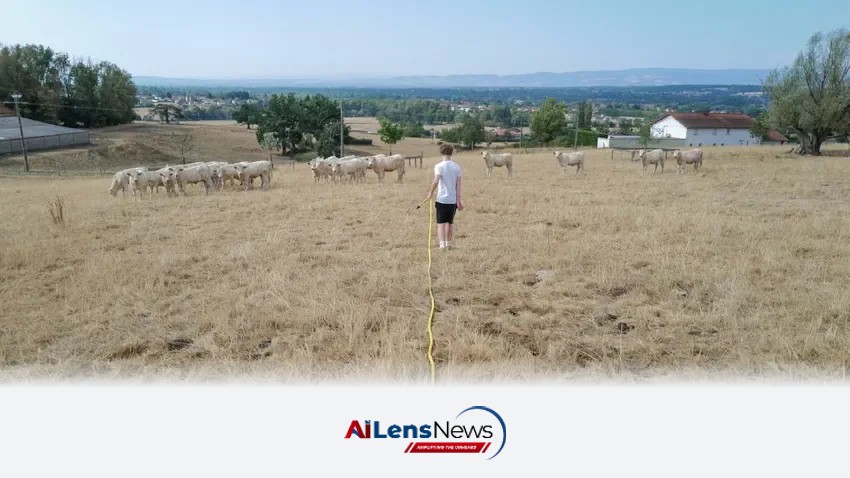



A severe drought in France threatens to escalate food prices and disrupt agricultural production, leading to a potential crisis for farmers and consumers alike.
London, United Kingdom Aug 23, 2026 ALN: Looking out from my garden in the Norman hills, I can see a corner of a Europe-wide catastrophe unfold. My village resembles the Oklahoma dust bowl circa 1936.
Normandy is celebrated for camembert, calvados, and rain. This summer, however, rain is just a memory. The green hills, forests apart, have turned yellow and then grey.
A week ago, the large field across the valley was still dark with maize. It is now a dusty yellow like the rest. My farming neighbor, Yves, was forced to harvest his maize two months early.
The meadows on which his dairy cows normally graze all summer have shriveled to stubble. The animals had to go indoors, as the maize was needed to feed them.
Come November, the cows will have eaten their winter food. Yves, like farmers all over Normandy, France, and Europe, will be forced to buy in winter fodder, if any exists.
A great farming crisis is coming. So is a great food price crisis.
Much has been written about the extreme heat this summer. Attention is just turning in the French and European media to the great drought of 2026. The combination of repeated heatwaves with temperatures in the high 30s Celsius and an almost complete absence of rain has been calamitous.
My own precious garden was fried by late June. The lawn turned to sand. My crop of potatoes and onions was cut by two-thirds. The salads fainted. Only the tomatoes and cucumbers thrived, thinking they were living in a greenhouse.
Taking July alone, Météo-France recorded a 67 percent deficit of rain across France—the third highest deficit since 1959. The only greater recent droughts were in 2020 and 2022.
The absence of rain is often regional in France. If the south suffers, the west gets wet. This year, the drought, like the extreme heat, has been universal, not just in France but throughout Europe, save Ireland, Scotland, and Scandinavia.
The great European rivers are drying up. The River Orne in the valley below our village is the second biggest river in Normandy, after the Seine. It has been reduced to a muddy ditch.
The Rhine, as reported by the Financial Times, has never been so low. Barges carrying chemicals, oil, and other goods to Rotterdam are being filled to 30 percent capacity to prevent grounding.
The shortage of water is so acute that even a very rainy winter may not restore the normal water levels in streams and rivers and deep in the soil before next spring. There is every likelihood of another dry, hot summer in Europe in 2027 and most summers after that.
A permanent shortage of water will not just be an agricultural problem. Apart from water needed for human consumption, nuclear power stations in France and elsewhere need river water for cooling. Some are operating at reduced capacity this summer.
The exploding data-storage facilities demanded for artificial intelligence also need huge amounts of water to cool their equipment. Water wars are coming.
In the short term, the pain will be felt by farmers and consumers.
The French wheat and barley harvest was early—late June in Normandy instead of late July—but the quantity and quality were poor. Crops usually turned into silage for the winter are being eaten by hungry animals straight from the field.
French vegetable production has collapsed: 25 percent down for courgettes, 35 percent for lettuces, 40 percent for peas, 60 percent for broccoli, and 50 to 100 percent for artichokes.
Farmers, who have just received one much-delayed state aid package, are already saying that they will need a multi-billion Euro subsidy program to survive the winter.
The weather has also scorched French economic growth and tax income. Three governments have fallen in two years trying to pass a state budget. Work on the 2027 budget starts in two weeks’ time. Good luck with that.
The price of fresh food is already climbing and will soon begin to rocket. A state aid package for consumers? Forget it.
All of this lingering pain will coincide with the most significant presidential election campaign in the country’s post-war history. The effects are likely to be perverse. Electorates blame governments for their suffering, not oppositions.
The calamities of this summer—the stifling heatwaves, the worst forest fires in French history, and the third great drought in six years—should make climate change a central issue of the campaign. It will do so but as a quarrel about symptoms, not causes.
Marine Le Pen and the Far Right, along with parts of the traditional Right, should be punished for their persistent denial or minimization of global warming. More likely, they will benefit from public anger about high food prices and spending cuts.
The Left and Greens should theoretically benefit from their strong positions on climate issues. They may, at the margins, but not enough to sway the outcome.
As I wrote already, voters’ attitudes toward global warming are dishonest. They know “something must be done.” They don’t believe politicians can change the weather, and they don’t want to make sacrifices to appease the weather gods.
Anyway, I am going to forget politics for a week. Like the Oklahomans of the 1930s, I am going to pack up my car and flee the Norman dustbowl. I am off to Brittany. Rain is forecast. Hooray.
To learn more about the latest developments in Crime & Law, stay updated with our exclusive reports and analyses on AILensNews.

