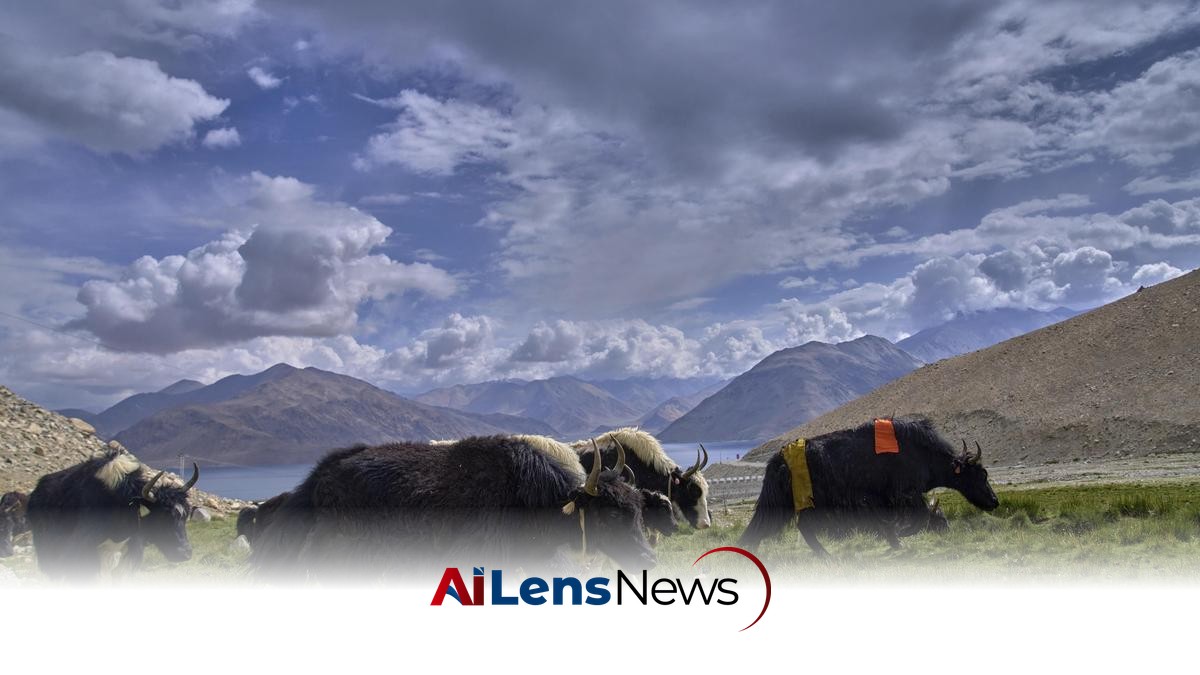


A new IoT-based health tracker for yaks aims to enhance livestock management in the challenging Himalayan terrain.
New Delhi, India Jul 8, 2026 ALN: A team of scientists has developed an Internet of Things (IoT)-based smart system to monitor the health of high-altitude yaks and keep tabs on their movement near the inter-border in the Himalayas. This innovative technology aims to enhance the management of yaks, which are a crucial resource for the communities residing in these challenging terrains.
The Indian yak (Bos grunniens), often referred to as the ‘ship of the Himalayas’, plays an integral role in the economy of mountain dwellers, who depend on it not only for meat and milk but also for transportation. These robust animals are uniquely adapted to thrive at altitudes exceeding 8,000 feet, showcasing remarkable resilience in extreme conditions. The 20th Livestock Census indicates that India is home to approximately 58,000 yaks, with nearly half of this population residing in the Union Territory of Ladakh. The remaining yaks are distributed across the northeastern states of Arunachal Pradesh, Sikkim, Himachal Pradesh, and Uttarakhand.
Monitoring the health of yaks across the expansive and rugged Himalayan landscape has traditionally posed significant challenges. Yak specialists and local farmers, known as brokpas, encounter difficulties due to the unpredictable movement of livestock in remote areas that are often hard to access, especially near the inter-border regions. The harsh environmental conditions, coupled with the geographical barriers, complicate the task of ensuring the health and well-being of these animals.
The newly developed technology—a device attached to an animal collar—aims to alleviate these challenges. Mihir Sarkar, director of the Indian Council of Agricultural Research’s Research Centre on Yak (NRC-Y) located in Dirang, Arunachal Pradesh, has been instrumental in the development of this device. He is one of four NRC-Y scientists involved in this project, alongside Mokhtar Hussain, Vijay Paul, and Dinamani Medhi. Their collaboration extends to researchers from Assam Don Bosco University, including Rupesh Mandal, Nupur Choudhury, Gitu Das, and Jyoti Kumar Barman.
The scientists have articulated that this IoT-based smart system is designed for geo-fencing and monitoring the health of yaks, as well as predicting the stress levels these animals may experience. This technology aims to specifically address the challenges associated with yak management in remote, high-altitude regions, where continuous physical monitoring is often impractical due to the rugged terrain.
The Internet of Things (IoT) refers to a network of physical objects embedded with sensors, software, and connectivity technologies. This allows devices to collect and exchange data, enabling them to act autonomously without human intervention. Geo-fencing, a key component of this technology, involves the use of GPS, Wi-Fi, or cellular data to create virtual boundaries around specific geographical locations. This capability can alert farmers when yaks stray beyond designated areas, thus enhancing herd management.
“Yaks are a vital livelihood resource for communities living in the high-altitude Himalayan region. However, yak farmers often face issues in tracking animal movement, detecting health problems at an early stage, and managing herds spread across vast grazing landscapes, often wandering to areas difficult to access,” Mr. Sarkar explained. The challenges faced by yak farmers are not merely logistical; they also have significant implications for animal welfare and the economic stability of the communities that depend on these animals.
The newly developed technology can assist farmers by providing timely information on animal health, stress levels, and movement patterns. This data enables better decision-making in day-to-day herd management and ensures that timely veterinary interventions can be made whenever necessary. The ability to monitor yaks in real-time can help prevent potential health crises and enhance the overall productivity of yak farming.
The integration of IoT technology into yak husbandry is not only a technological advancement but also a reflection of the growing recognition of the importance of sustainable livestock management practices. As climate change continues to impact agricultural practices worldwide, innovations such as these can potentially lead to more resilient farming systems that can withstand environmental stressors.
Furthermore, the use of IoT in agriculture is gaining traction globally, with various applications being developed to enhance livestock management, crop monitoring, and resource allocation. The successful implementation of this technology for yaks in the Himalayas could serve as a model for similar initiatives in other regions, particularly in areas where livestock farming is challenged by environmental and geographical factors.
In addition to improving herd management, the data collected through this IoT system could contribute to broader research initiatives aimed at understanding the health and behavior of yaks in high-altitude environments. This knowledge could inform conservation efforts and help ensure the sustainability of yak populations in the face of changing climatic conditions.
The implications of this technology extend beyond the immediate benefits to yak farmers. By enhancing the health and productivity of yaks, communities can experience improved livelihoods, which can have a ripple effect on local economies. Increased productivity in yak farming can lead to greater availability of yak-derived products, such as milk, meat, and wool, which are not only vital for local consumption but also for trade.
Moreover, the development of such technologies aligns with global efforts to leverage innovation for sustainable development. The integration of IoT in agriculture is a step towards modernizing traditional practices, ensuring that they can meet the demands of the future while preserving cultural heritage and biodiversity.
As this project progresses, it will be essential to monitor its implementation and evaluate its effectiveness in real-world settings. Engaging with local farmers and communities will be crucial to ensure that the technology meets their needs and to facilitate the adoption of these innovations. Training programs may also be necessary to help farmers understand and utilize the new system effectively.
In conclusion, the development of an IoT-based health tracker for high-altitude yaks represents a significant advancement in the field of livestock management. It not only addresses the unique challenges faced by yak farmers in the Himalayas but also contributes to the broader goals of sustainable agriculture and rural development. The success of this initiative could pave the way for future innovations that enhance the resilience and productivity of livestock farming in challenging environments worldwide.
To learn more about the latest developments in Science & Environment, stay updated with our exclusive reports and analyses on AiLensNews.

