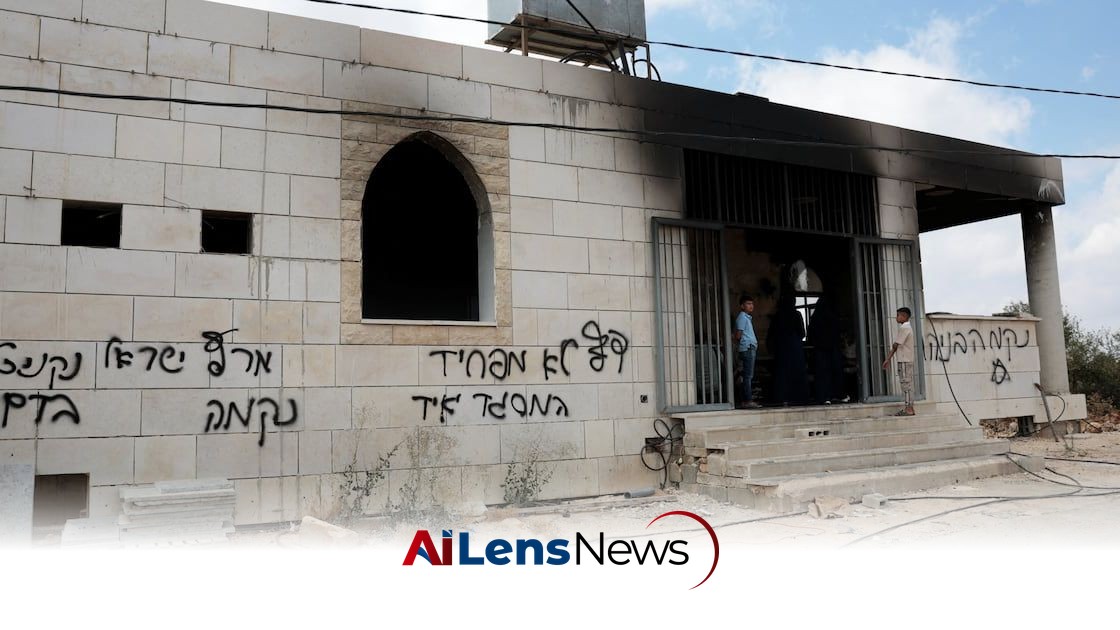


Recent attacks by Israeli settlers in the West Bank have led to the arson of two mosques, coinciding with military operations and land seizures.
Riyadh, Saudi Arabia Jul 27, 2026 ALN: The recent escalation of violence in the West Bank has drawn international attention and condemnation, as Israeli settlers and military forces have engaged in a series of aggressive actions that have left communities reeling. On a single day, Sunday, a wave of attacks was reported, which included arson against mosques, mass arrests, and land seizures. This uptick in violence follows a particularly deadly incident that occurred just days prior, where four Palestinians and two Israelis lost their lives in what Israeli authorities described as a Palestinian attack on settlers near the town of Tel.
The context of these events is deeply rooted in the ongoing Israeli-Palestinian conflict, which has seen periodic escalations of violence over the decades. Tensions in the region often flare up due to a combination of factors, including land disputes, settlement expansion, and military operations. The West Bank, which has been under Israeli occupation since the 1967 war, is home to numerous Israeli settlements that are considered illegal under international law, though Israel disputes this characterization.
In response to the violence, the Israeli military has increased its presence in the West Bank, implementing lockdowns in various areas and launching what officials have termed a "major counter-terrorism operation." This military operation is part of a broader strategy that aims to quell unrest and prevent further attacks against Israeli citizens, particularly in areas that have seen significant violence. However, these operations often result in heightened tensions and further violence, as Palestinian communities face increased military presence and restrictions on their movements.
On Saturday, prior to the Sunday violence, Israeli forces conducted a large-scale raid in Tel, resulting in the detention of at least 80 Palestinians. This operation was accompanied by reports of settler assaults in surrounding areas, including the village of Jit, where the local village head reported that hundreds of settlers attempted to break into and burn property. Such incidents have become increasingly common, as settlers often take matters into their own hands, leading to violent confrontations with Palestinian residents.
Sunday morning marked a particularly alarming turn of events, as settlers targeted places of worship. In two separate incidents, a mosque under construction in Qusra, located south of Nablus, was set ablaze, and parts of a mosque in the village of Kur, south of Tulkarm, were also torched. In the latter attack, racist slogans were reportedly sprayed on the walls of the mosque. The mayor of Qusra described the destruction of the Al Rahma Mosque, stating that wooden materials and equipment were consumed by the fire. The Ministry of Awqaf and Religious Affairs condemned these attacks, labeling them as part of a systematic campaign against Palestinian religious sites, and called upon the international community to intervene to protect these sacred spaces.
The violence did not stop at religious sites. In Beit Furik, east of Nablus, settlers set fire to a Palestinian home and left behind slogans that called for revenge against Arabs. Meanwhile, in the Ein Samia area of Kafr Malik, east of Ramallah, settlers attacked a stone-cutting center at dawn, injuring several workers and setting heavy equipment ablaze before retreating. These acts of violence contribute to a climate of fear and insecurity for Palestinian residents, who often find themselves caught in the crossfire of escalating tensions.
The recent wave of violence has drawn condemnation from various quarters, including the Gulf Cooperation Council, whose Secretary General Jasem Al Budaiwi referred to the attacks on mosques as a "heinous crime" that fits within a broader pattern of violations targeting the Palestinian people and their holy sites. Such statements reflect growing concern in the international community about the impact of Israeli settlement expansion and military operations on Palestinian communities.
Israeli Prime Minister Benjamin Netanyahu, during a cabinet meeting on Sunday, refrained from addressing the violence directly but hinted at future military operations. He stated that Israeli forces are "prepared to operate on a broader scale against the terrorist nests," a comment that underscores the ongoing military posture of the Israeli government in the region. This rhetoric often raises fears among Palestinians of further violence and displacement, as military operations can lead to significant casualties and damage to civilian infrastructure.
In addition to the immediate violence, there are ongoing issues related to land and access for Palestinian communities. Settlers have established a new outpost on lands belonging to Umm Safa, located northwest of Ramallah, where tents have been pitched in the Wadi Al Zaytoun area. The village council head reported that Umm Safa is now nearly completely cut off, with most of its land appropriated for settlement expansion, leaving only the built-up areas around residents' homes. This encroachment on Palestinian land is a significant aspect of the conflict, as it not only affects the livelihoods of residents but also contributes to the fragmentation of Palestinian territories.
In the northern Jordan Valley, settlers have been reported to block herders in Khirbet Samra from accessing grazing pastures, further exacerbating the challenges faced by Palestinian farmers and herders. This pattern of violence and land appropriation is not new; the Colonisation and Wall Resistance Commission has documented a staggering 3,488 settler attacks in the first half of this year alone. Such statistics highlight the scale and persistence of the violence faced by Palestinian communities as they navigate the complexities of life under occupation.
As Israeli military operations continue, they are largely concentrated in the northern regions of the West Bank. Reports indicate that forces detained 24 Palestinians across the Nablus governorate, with 12 of those arrests occurring in the town of Tel. Additionally, the military has taken measurements of the home of Farouq Ramadan, a Palestinian who was killed by soldiers and settlers on Friday, sealing the house in preparation for a planned demolition. This practice of home demolitions is a contentious issue, often viewed by Palestinians as collective punishment that exacerbates tensions and resentment towards the Israeli authorities.
The ongoing cycle of violence, land seizure, and military operations in the West Bank raises critical questions about the future of the region and the prospects for peace. As the situation continues to evolve, the international community watches closely, with many advocating for a renewed focus on dialogue and negotiations to address the underlying issues at the heart of the Israeli-Palestinian conflict. However, as violence escalates and tensions remain high, the path to a lasting resolution appears increasingly fraught with challenges.
To learn more about the latest developments in Crime & Law, stay updated with our exclusive reports and analyses on AiLensNews.

