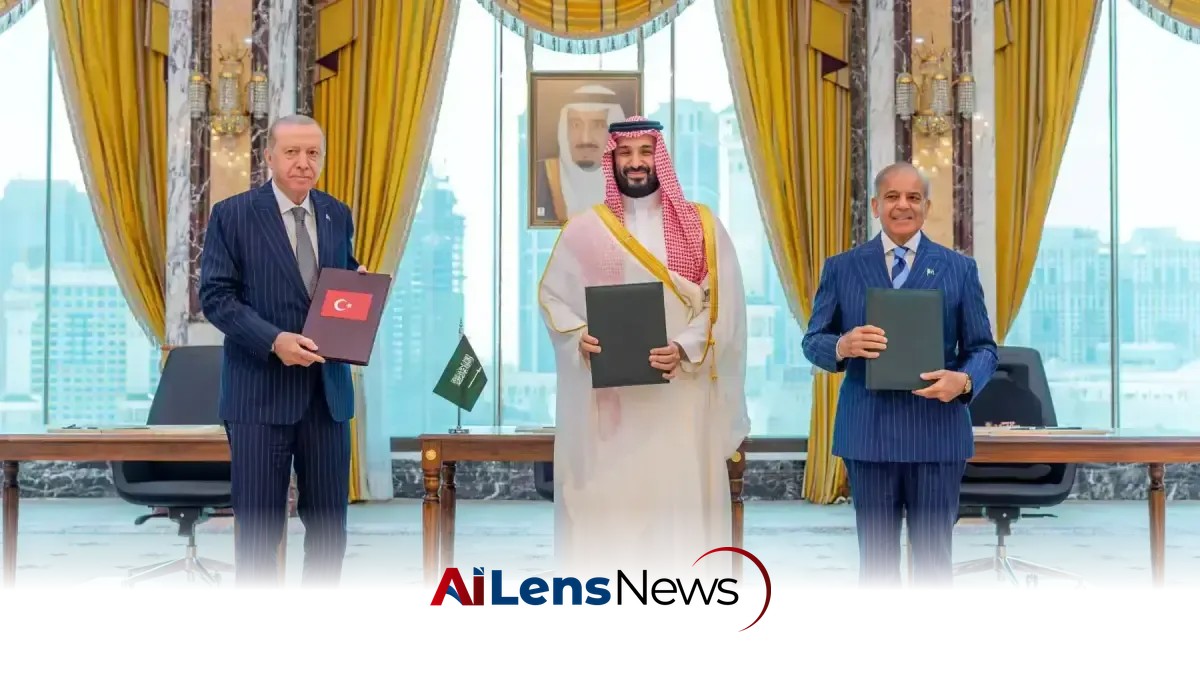


President Trump expressed his support for the Makkah Joint Defence Agreement, emphasizing its significance for regional security and cooperation.
Islamabad, Pakistan Aug 17, 2026 ALN: United States President Donald Trump expressed his satisfaction on Sunday regarding the recent signing of a defense pact between Pakistan, Saudi Arabia, and Turkiye. He highlighted the importance of this agreement, known as the Makkah Joint Defence Agreement, in fostering unity and security in the Middle East.
“Very happy to see that Saudi Arabia, Turkiye, and Pakistan have recently, and finally, signed the Makkah Joint Defence Agreement,” Trump stated on his Truth Social platform. He emphasized, “It shows how the Middle East is coming together, and how countries will finally be able to defend themselves in a more meaningful way,” referring to the pact as a “BIG, BOLD, IMPORTANT FIRST STEP.”
In response to Trump's remarks, Prime Minister Shehbaz Sharif of Pakistan expressed his gratitude for the support shown by the U.S. leader. He stated, “Together, with the brotherly Kingdom of Saudi Arabia and the Republic of Turkiye, Pakistan will continue to play a constructive role in ensuring the defense of our own countries as well as the entire region.”
Sharif also took the opportunity to commend Trump for his “courageous and decisive leadership, which helped avert a nuclear catastrophe in South Asia and saved millions of lives,” referencing the tensions that arose during last year’s brief military conflict with India. He added, “Durable peace is the most essential prerequisite for a bright and prosperous future for our peoples.”
The three-way agreement, signed on August 7, comes at a time of heightened tensions in the region, particularly amid ongoing conflicts involving the U.S. and Iran, which have led to increased violence, including Houthi rebel attacks. The geopolitical landscape in the Middle East has been increasingly complex, with various state and non-state actors vying for influence, and this pact is seen as a strategic alignment in response to perceived threats.
The joint defense agreement aims to enhance collective deterrence, allowing the signatory states to regard an attack on one as an attack on all. This principle of collective defense is reminiscent of NATO's Article 5 and underscores the seriousness with which these countries view regional security challenges. According to Turkiye’s defense ministry, the pact will facilitate the establishment of political and military mechanisms among Pakistan, Turkiye, and Saudi Arabia, while also deepening cooperation in the defense industry, potentially leading to joint military exercises, intelligence sharing, and collaborative defense projects.
Both Prime Minister Shehbaz Sharif and Deputy Prime Minister and Foreign Minister Ishaq Dar have reiterated that the pact is defensive in nature. Dar mentioned that the agreement is “open to any country in the region” that is willing to uphold its fundamental principles. This openness indicates a potential for broader regional cooperation, although it also raises questions about how such an agreement might be perceived by other regional powers, particularly Iran, which has historically been wary of military alliances that could encircle it.
Following the signing of the agreement, Turkish Foreign Minister Hakan Fidan indicated that Turkiye anticipates Egypt joining the pact “in the next stage,” noting that only “a few technical issues” remain. However, Egypt has yet to comment on the agreement or Fidan’s remarks. The inclusion of Egypt could significantly alter the strategic balance in the region, given its size and influence in Arab affairs.
Turkish President Recep Tayyip Erdogan also expressed hope that more countries would join the defense agreement. He stated, “Our vision for it is not limited to the three countries,” adding, “Rather we aspire for it to grow, and perhaps appropriate conditions will emerge one day for all countries of the region to gather under its umbrella.” This ambition reflects a broader vision of regional integration and collaboration, though it may also face challenges from countries that feel threatened by such alliances.
Additionally, countries such as Kuwait, Bahrain, and Somalia have welcomed the agreement, indicating a potential shift towards a more unified security framework in the region. Iran has also reacted positively, emphasizing its commitment to pursuing “security mechanisms based on cooperation between regional countries.” This reaction from Iran is noteworthy, as it suggests a willingness to engage in dialogue and cooperation, despite the ongoing tensions that have historically characterized its relationships with Saudi Arabia and other Gulf states.
The Makkah Joint Defence Agreement could have significant implications for the security dynamics in the Middle East. As countries navigate their relationships with one another in an increasingly multipolar world, the establishment of such pacts may lead to a reconfiguration of alliances and enmities. Moreover, the focus on collective defense may prompt other nations in the region to reconsider their own security strategies, potentially leading to a cascade of new alliances or defense agreements.
In conclusion, the Makkah Joint Defence Agreement represents a significant development in Middle Eastern geopolitics. By fostering cooperation among Pakistan, Saudi Arabia, and Turkiye, the pact aims to enhance regional security and deter aggression. While the immediate implications of the agreement are still unfolding, its long-term effects on the balance of power in the region will be closely watched by analysts and policymakers alike.
To learn more about the latest developments in World News & International Affairs, stay updated with our exclusive reports and analyses on AiLensNews.

