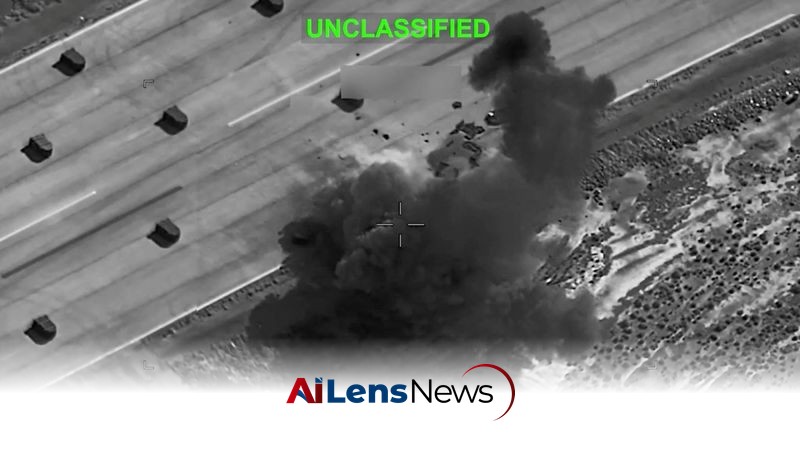


As the conflict in Iran escalates, US military weapon stockpiles are significantly depleted, raising concerns about future military readiness.
Washington DC, United States Jul 12, 2026 ALN: The ongoing conflict between the United States and Iran has raised significant concerns regarding the depletion of key U.S. military weapon stockpiles. As President Donald Trump declared the ceasefire in the conflict to be "over," military experts warn that the current rate of military engagement could exacerbate the already strained resources of the U.S. armed forces. This situation is particularly alarming, as it could hinder the military's readiness for potential future confrontations with nations such as China and North Korea.
The conflict, referred to as Operation Epic Fury, has seen the U.S. military utilize a substantial amount of its arsenal, including long-range precision missiles and air defense systems. Analysts have noted that thousands of missiles have been expended during the initial phase of the conflict, significantly impacting stockpiles. Mark Cancian, a retired Marine Corps colonel and defense analyst at the Center for Strategic and International Studies (CSIS), highlighted that if the current rate of military engagement continues, the U.S. could face a "new, higher level of risk" in the Indo-Pacific region, a critical area of U.S. strategic interest.
By April, when full-scale fighting between the U.S. and Iran was expected to cease, the Pentagon had reportedly used up at least half of its Terminal High Altitude Area Defense (THAAD) ballistic missile interceptors, nearly half of its Patriot air defense interceptors, and around 30% of its Tomahawk land-attack missiles. This depletion of resources raises questions about the military's capacity to respond effectively to other global threats, particularly in the context of rising tensions with China and North Korea.
The ceasefire that followed the initial conflict provided a temporary reprieve for U.S. stockpiles, as subsequent low-intensity strikes required fewer missiles. However, the replenishment rates for critical missile systems remain low. According to current fiscal year delivery schedules, the Pentagon can expect to receive only about 15 new Tomahawk missiles and 20 new Patriot missiles per month. Alarmingly, there are no THAAD deliveries forecasted for 2026, and CSIS estimates suggest that it could take three or more years to rebuild these inventories to pre-conflict levels.
Elaine McCusker, a senior fellow at the American Enterprise Institute and former deputy and acting comptroller at the Pentagon, emphasized that the timeline for replenishing munitions is likely to be measured in years, with estimates ranging from two to five years for most systems. This prolonged timeline poses a significant challenge for U.S. military readiness, especially as global security dynamics continue to evolve.
John Ferrari, a retired Army two-star general and defense acquisition expert, pointed out that Congress has not appropriated any funds to replace missiles since the conflict began, leaving the Pentagon reliant on the "normal, slow yearly peacetime process" for replenishment. This slow pace raises concerns about the military's ability to maintain a robust defensive posture in the face of escalating threats.
In response to these challenges, the White House has formally requested supplemental funding from lawmakers to cover the costs associated with the Iran conflict, among other programs. However, the proposal faces a difficult path through Congress, where budgetary constraints and competing priorities can complicate defense funding efforts.
To address the urgent need for increased production capacity, the Pentagon has committed to expanding the defense industrial base. President Trump invoked the Defense Production Act in June to expedite missile production by removing regulatory barriers. The Defense Department has also entered into agreements with manufacturers to enhance their production lines, aiming to meet the growing demand for military armaments.
Despite these efforts, experts like Cancian remain skeptical about the immediate impact of these initiatives, noting that expanding production capacity takes time and may not yield quick results. Additionally, licensing agreements allowing countries like Germany and Ukraine to produce Patriot interceptor missiles domestically could help alleviate some pressure on U.S. production lines. However, such agreements are often slow to materialize; for instance, Japan took three years to establish its Patriot factory, and Germany has yet to produce a Patriot missile despite beginning work on its production line in 2022.
While some missile inventories, such as those for the Precision Strike Missile and the Joint Air-to-Surface Standoff Missile, are expected to rebound more quickly, reaching pre-war levels by mid-to-late 2027, the overall situation remains precarious. Cancian pointed out that the potential for conflict with China is not the only concern; military planners must also consider the implications of a potential conflict with North Korea, which could require a significant amount of U.S. missiles for both offensive operations and defense against large-scale attacks from Pyongyang.
In the face of these challenges, Chief Pentagon spokesperson Sean Parnell reiterated the strength of the U.S. military, asserting that it remains the most powerful military force in the world and possesses the necessary capabilities to respond at the President's discretion. Parnell emphasized that the military has successfully executed multiple operations across combatant commands while ensuring a robust arsenal to protect U.S. interests.
However, experts like O'Hanlon from the Brookings Institution caution that while the U.S. military's current capabilities may not have suffered significantly yet, there is a risk that deterrence could weaken over time. The timing and nature of such a shift are difficult to quantify, as they depend largely on adversaries' perceptions and psychological factors. As the conflict with Iran continues, the implications for U.S. military readiness and global security remain a pressing concern.
In conclusion, the depletion of U.S. military stockpiles amid the ongoing conflict with Iran presents a complex challenge for the Pentagon. As the military grapples with the need to replenish its arsenal while preparing for potential future conflicts with other nations, the effectiveness of U.S. deterrence strategies may be tested. The coming months will be crucial in determining how the U.S. navigates these challenges and maintains its military readiness in an increasingly volatile global landscape.
To learn more about the latest developments in World News & International Affairs, stay updated with our exclusive reports and analyses on AiLensNews.

