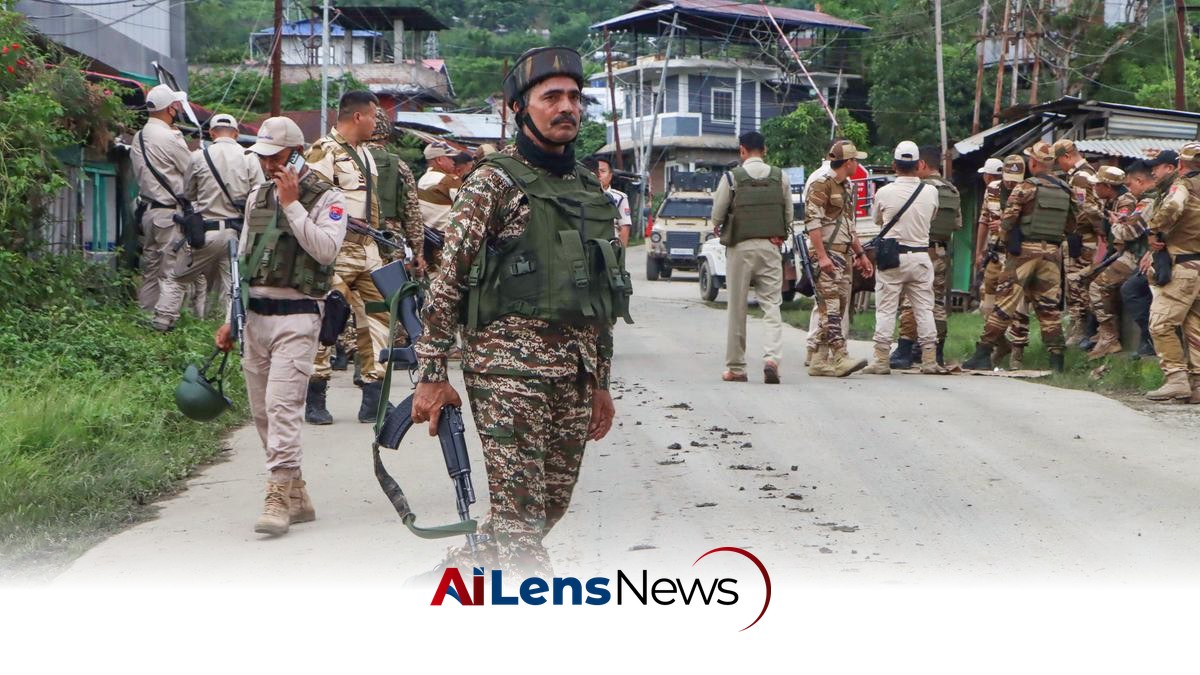


Security forces in Manipur prevent a potential clash between ethnic groups, thwarting a mob’s advance and containing violence.
New Delhi, India Jul 12, 2026 ALN: Ethnic conflict-scarred Manipur came close to a ‘communal clash’ on Saturday, July 11, 2026, when a mob, allegedly from the Kuki-dominated hilly Kangpokpi district, attempted to descend on a village characterized by largely abandoned houses in the Meitei-majority Imphal West district. The tensions in this region have been escalating over the past few years, driven by historical grievances, land disputes, and competition for political power among the various ethnic groups residing in Manipur.
A combined team of security forces successfully thwarted a bid by approximately 600 individuals to advance towards the Kanto Sabal area, which is situated in the “buffer zone” between the Kangpokpi and Imphal West districts, as reported by the Manipur Police. This area has been a flashpoint for ethnic tensions, with residents of both communities often clashing over territorial claims, resources, and political representation. The historical context of these tensions is rooted in the colonial legacy, where arbitrary borders and administrative divisions exacerbated existing ethnic divides.
The crowd of “600 to 700” individuals reportedly attempted to target what was described as an “illegal block” set up by “another community,” according to a separate statement issued by the Indian Army. This phrase reflects the deep-seated mistrust and animosity that has developed over the years between the Kuki and Meitei communities, exacerbated by the ongoing ethnic conflict that has claimed numerous lives and left many more injured. Such incidents not only highlight the immediate threats of violence but also reveal the underlying issues that continue to fuel these ethnic rivalries, including competition for land and resources, as well as the struggle for political representation in a rapidly changing socio-political landscape.
“The security forces intervened promptly and prevented a potential communal clash,” the police stated on a social media platform. They added that an attempt by the miscreants to set fire to abandoned houses was swiftly contained. However, locals claimed that the mob succeeded in burning down at least three abandoned houses before the security forces managed to push its members back. This incident underscores the volatility of the situation in Manipur, where tensions can quickly escalate into violence, often with devastating consequences for local communities.
In a related development, Meitei and Naga residents from the Imphal Valley attempted to approach the site of the clash, but security forces allegedly prevented them from advancing by using force. This intervention highlights the challenges faced by law enforcement in managing the complex dynamics of ethnic conflict in the region. The presence of security forces is often a double-edged sword; while they are tasked with maintaining peace, their actions can sometimes provoke further unrest among local populations, as communities may perceive them as biased or as instruments of oppression rather than protectors of peace.
This incident marks a significant moment in the ongoing ethnic conflict in Manipur, which has seen a shift in hostilities from the valley to the hills, particularly between the Kukis and the Nagas. The conflict, which began in May 2023 between the Kuki-Zo and the Meiteis, has roots that extend far deeper into the history of the region, where colonial legacies, migration patterns, and socio-political dynamics have all played a role in shaping inter-community relations. The historical context is crucial for understanding the current tensions; the Kukis have often felt marginalized by the Meitei-dominated political landscape, leading to a sense of disenfranchisement and a demand for greater autonomy.
In light of the recent violence, Chief Minister Yumnam Khemchand Singh has pledged that the State government will take all necessary steps to ensure justice for the families of the six Liangmai Nagas who were abducted and killed. The victims were from Leilon Vaiphei village in Kangpokpi district, an area that has witnessed significant strife in recent months. The Chief Minister's commitment to justice reflects the government's acknowledgment of its role in addressing the grievances of affected communities and restoring order in a region plagued by violence. This pledge is essential not only for the families of the victims but also for rebuilding trust among communities that have been deeply fractured by ongoing violence.
Members of the victims’ families have identified five individuals allegedly involved in the abduction and murder of the six Liangmai Nagas, leading to the arrest of two suspects on Friday, July 10, 2026. Mr. Singh emphasized the responsibility of the government and law enforcement agencies to apprehend all those involved in the crime, stating that necessary instructions have been issued to ensure a thorough investigation and accountability. This focus on accountability is critical in a region where impunity has often exacerbated tensions and hindered peace efforts.
The chain of violence in Manipur began on May 13, 2023, when unidentified gunmen ambushed and killed three church leaders in Kangpokpi district. This incident marked a turning point in the conflict, as it incited retaliatory violence and further escalated tensions between the Kukis and Nagas. Just hours after the ambush, 28 Kukis and 20 Nagas, including 18 from Leilon Vaiphei, were abducted from various locations across the State, illustrating the pervasive cycle of violence that has gripped the region. The interconnectedness of these violent events underscores the fragility of peace in Manipur, where a single incident can trigger widespread retaliatory actions and deepen divisions among communities.
In a rare moment of potential reconciliation, on May 15, Kukis and Nagas released 14 members of each other’s communities. However, the fragile peace was short-lived, as the Nagas released the remaining 14 Kukis only on June 9. The complexities of these negotiations reflect the intricate web of alliances and enmities that characterize the ethnic landscape of Manipur. Such exchanges, while hopeful, also reveal the underlying mistrust that persists, making reconciliation efforts particularly challenging.
Tragically, the following day, security forces discovered the mutilated bodies of the six missing Nagas in Kangpokpi district. The discovery of these bodies triggered a wave of violence in the Naga-dominated Senapati district, where Naga and Meitei organizations sought vengeance against those they believed were responsible for the killings. This cycle of violence has not only resulted in loss of life but has also deepened the divisions between communities, making any path to peace increasingly difficult. The implications of this cycle are profound, as each act of violence not only affects immediate victims but also sows the seeds of future conflict, perpetuating a cycle that can be hard to break.
The ongoing ethnic conflict in Manipur serves as a stark reminder of the challenges faced by multi-ethnic societies in managing diversity and fostering coexistence. As the situation continues to evolve, the role of government, civil society, and local communities will be crucial in addressing the underlying issues that fuel such conflicts. The need for dialogue, reconciliation, and justice remains paramount if Manipur is to heal from the wounds of its past and build a more inclusive future for all its residents. Without concerted efforts from all stakeholders, the potential for further violence remains high, underscoring the urgent need for a comprehensive approach to conflict resolution that prioritizes the voices and needs of all communities involved.
To learn more about the latest developments in Crime & Law, stay updated with our exclusive reports and analyses on AiLensNews.

