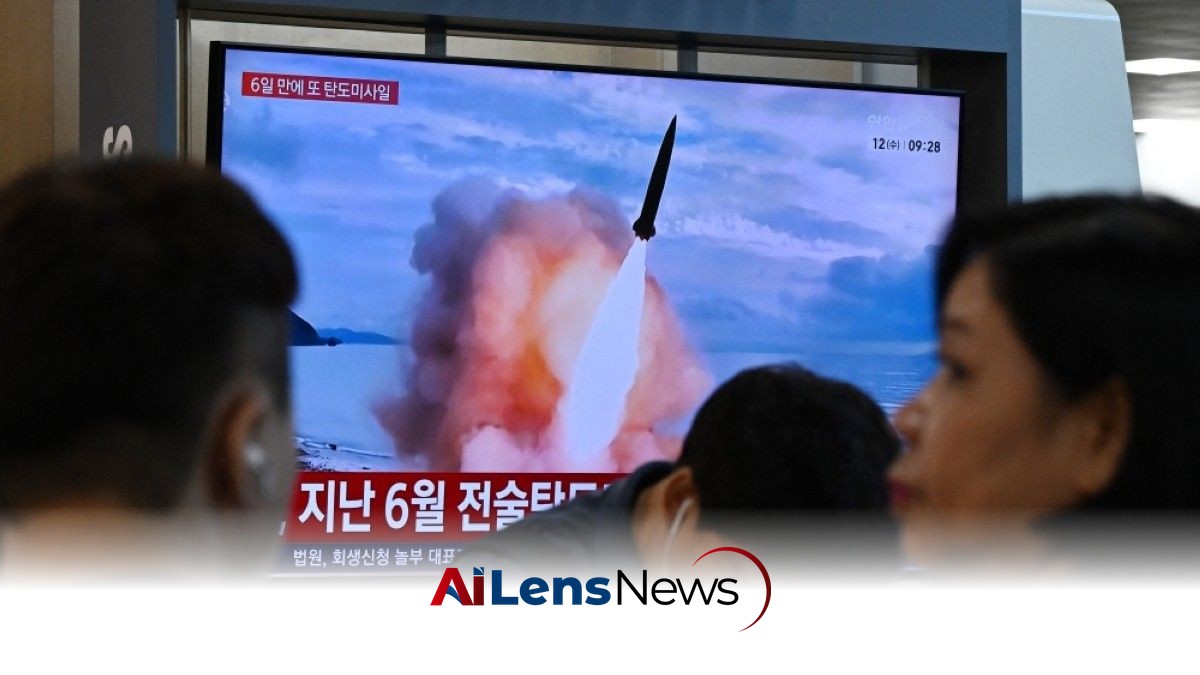



North Korea fired a ballistic missile towards Japan, coinciding with upcoming US-South Korea military exercises, raising regional tensions.
Kuwait City, Kuwait Aug 13, 2026 ALN: North Korea fired a ballistic missile off its east coast towards Japan early on Wednesday, Seoul’s military reported, just days before the planned start of massive US-South Korea joint drills. The 11-day exercises, set to begin on Monday, are a regular fixture of the summer calendar, aimed at preparing the United States and South Korea for defense against the nuclear-armed North. This missile launch underscores the ongoing tensions in the region and the complex interplay of military posturing among North Korea, South Korea, and the United States.
Pyongyang has previously labeled these drills as rehearsals for an invasion and has conducted missile launches before and after them. “Our military detected at around 6 am (2100 GMT on Tuesday) a ballistic missile launched by North Korea from the Wonsan area towards the East Sea,” Seoul’s Joint Chiefs of Staff stated in a message to reporters. The missile reportedly flew more than 700 kilometers (435 miles) over the body of water, also known as the Sea of Japan, with Seoul and Washington currently analyzing its specifications. This type of missile test is not uncommon as North Korea often seeks to demonstrate its military capabilities, especially in the context of perceived threats from joint military exercises conducted by the US and South Korea.
Japan’s defense ministry described the object as a suspected ballistic missile, noting it was thought to have “already fallen,” without providing further details. “North Korea has never simply let a South Korea-US joint military exercise pass without a response,” Lim Eul-chul, a North Korea expert at Kyungnam University, told AFP. This statement reflects a broader pattern of behavior from North Korea, which often uses missile launches as a means of signaling its discontent with military activities involving its adversaries.
“This is a message that Pyongyang is closely watching the upcoming drills and could stage a provocation if it deems one necessary.” This claim is particularly relevant given the historical context of North Korea’s military strategy, which often involves conducting tests or demonstrations in response to perceived threats or provocations from the US and its allies. The timing of the missile launch, just days before the joint drills, suggests a calculated effort by North Korea to assert its military presence and challenge the narratives of its adversaries.
Japan’s Defense Minister Shinjiro Koizumi condemned Wednesday’s launch as a “threat to peace and security in our region” and stated that Tokyo had “lodged a strong protest” with North Korea through diplomatic channels in Beijing. Recently, North Korea has been vocal in its criticism of Japan, which it views as a former colonial power, particularly regarding what Pyongyang describes as Japan’s remilitarization. This historical animosity complicates diplomatic relations and contributes to the ongoing cycle of tension in Northeast Asia.
Conflict Experience
Japan has traditionally maintained a pacifist stance but has been increasing military spending, enhancing defense pacts, and deploying missile launchers to its outer islands. Koizumi emphasized last week that Japan needed to bolster its military with a “sense of urgency and crisis.” This shift in Japan’s defense policy reflects a broader regional trend in which countries are reassessing their military strategies in light of North Korea's nuclear ambitions and increasing military provocations. Following this, North Korea fired a short-range ballistic missile off its eastern coast, according to Seoul’s military. Tokyo’s governor recently announced plans to convert a 13,000-square-meter (140,000-square-feet) subterranean carpark into an underground missile shelter near Tokyo Station, indicating a growing concern over the potential for missile attacks.
In the past, North Korean missiles have flown over Japan, triggering sirens, smartphone alerts, and special programming on television. As of April 2025, there were 61,142 shelters across Japan, but less than seven percent were underground, according to government data. This limited infrastructure raises concerns about Japan's preparedness for a potential missile strike and highlights the urgency with which the Japanese government is approaching its defense strategy.
South Korea’s national security office convened an emergency meeting on Wednesday, where participants labeled the recent launches as “provocative acts” and demanded that Pyongyang “immediately halt them.” The South Korean government’s response reflects a commitment to regional stability and a desire to deter further provocations from the North. North Korea has been increasingly active in international conflicts, notably supporting Russia in its invasion of Ukraine, which adds another layer of complexity to the geopolitical landscape.
Ukraine accused Russia on Tuesday of launching North Korean missiles in an attack that resulted in 10 fatalities and numerous injuries. Ukrainian President Volodymyr Zelensky has also warned—without providing evidence—that Moscow has been receiving additional ballistic projectiles and troops from Pyongyang. This potential military cooperation between North Korea and Russia raises alarms in the international community, particularly as it may embolden North Korea and provide it with additional resources for its military ambitions.
Experts suggest that North Korea has gained financial and military benefits from Moscow in exchange for its support. Its troops have also acquired crucial experience on modern battlefields. This relationship between North Korea and Russia could have significant implications for global security, particularly if it leads to an escalation of military capabilities on both sides.
The upcoming US-South Korea “Ulchi Freedom Shield” drills will involve 18,000 South Korean troops alongside 28,500 US personnel stationed in the country. A spokesperson indicated that the drills would prepare soldiers for potential confrontations with North Korean troops, who are battle-hardened from their deployment in Europe. Colonel Ryan Donald, spokesman for the US and South Korean Combined Forces Command, stated on Monday, “Our training accounts for that threat,” as he addressed reporters. The scale of these drills underscores the seriousness with which the US and South Korea approach the North Korean threat and their commitment to maintaining a robust defense posture in the face of increasing provocations.
In summary, North Korea's recent missile launch serves as a stark reminder of the ongoing tensions in the region and the complex interplay of military strategies among the involved nations. As the US and South Korea prepare for their joint military exercises, the international community will be closely monitoring North Korea's actions, which could have far-reaching implications for regional security and stability. The situation remains fluid, and the potential for further provocations from North Korea cannot be discounted as the geopolitical landscape continues to evolve.
To learn more about the latest developments in World News & International Affairs, stay updated with our exclusive reports and analyses on AILensNews.

