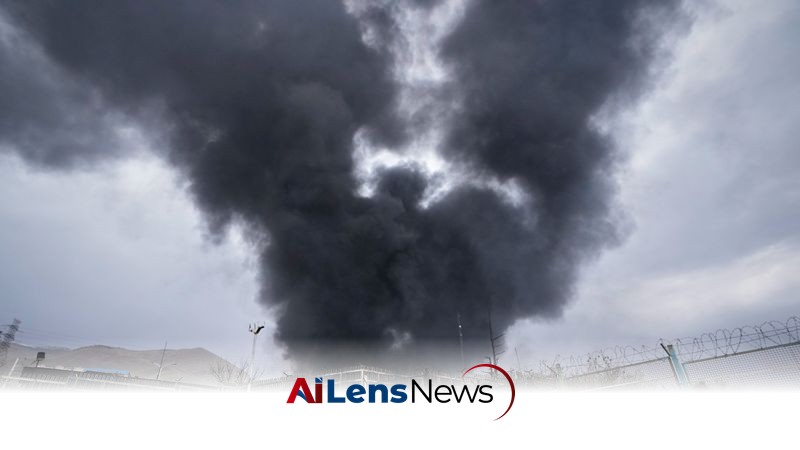


In response to recent attacks on American troops in Jordan, the US has launched a series of strikes targeting Iranian Revolutionary Guard facilities, escalating regional tensions.
New Delhi, India Jul 30, 2026 ALN: The United States has intensified its military actions against Iran following a series of attacks on American troops stationed in Jordan. President Trump had previously vowed a "very hard retaliation" for these provocations, leading to a fresh wave of strikes aimed at Revolutionary Guard command centers, missile, and drone facilities.
The strikes, which occurred overnight, represent a significant escalation in the ongoing tensions between the two nations. US officials stated that the targeted facilities were directly linked to the recent attacks on American forces, which had raised alarms about the safety of troops in the region. This military action comes amid a backdrop of heightened hostilities between the US and Iran, which have been exacerbated by various geopolitical factors, including Iran's nuclear ambitions and its involvement in regional conflicts.
According to military sources, the strikes were carefully planned to minimize civilian casualties while maximizing damage to Iranian military capabilities. The US military utilized precision-guided munitions to hit key installations, aiming to disrupt Iran's ability to launch further attacks. This strategy reflects a broader military doctrine that emphasizes the importance of minimizing collateral damage while achieving specific operational objectives. The choice of targets indicates a focus on crippling Iran's command and control capabilities, which are essential for coordinating military operations.
The choice of targets in these strikes is indicative of a larger strategic approach by the US military. By focusing on Revolutionary Guard command centers and missile facilities, the US aims to dismantle the infrastructure that Iran relies upon for its military operations. The Revolutionary Guard has been a central figure in Iran's military and political landscape, often involved in both direct military engagements and proxy operations across the Middle East. By targeting these facilities, the US seeks to undermine Iran's ability to project power in the region.
The strikes have drawn mixed reactions across the Middle East. While some regional allies of the US, particularly those in the Gulf Cooperation Council, have expressed support for the actions, others have condemned them as an aggressive escalation that could lead to further conflict. Nations such as Saudi Arabia and the United Arab Emirates have historically viewed Iran as a regional adversary and may perceive US actions as a necessary step to counter Iranian influence.
Conversely, countries with closer ties to Iran, including Iraq and Lebanon, have criticized the strikes, viewing them as an infringement on sovereignty and a provocation that could destabilize the region further. Iranian officials have vowed to retaliate, warning that the US will face severe consequences for its actions. This rhetoric is consistent with Iran's historical approach to military confrontations, where it has often engaged in asymmetric warfare tactics, leveraging proxy groups and militias across the region to respond to perceived threats.
The regional dynamics are complex, as various countries have differing relationships with both the US and Iran. For instance, while the Gulf states may support US actions, they also fear the potential for Iranian retaliation that could spill over into their territories. The situation is further complicated by the presence of various militia groups in Iraq and Syria, some of which are backed by Iran and could respond to US strikes on behalf of Tehran.
The safety of American troops in the region remains a top priority for the Pentagon. Following the strikes, additional security measures have been implemented to protect personnel and facilities. Military leaders are closely monitoring the situation, prepared to respond to any Iranian retaliation. The presence of US forces in the Middle East has been a contentious issue, with debates surrounding their role and the risks involved in maintaining a military footprint in a volatile region.
As US forces are deployed in various capacities across the Middle East, their safety is a paramount concern. The Pentagon has implemented enhanced security protocols in response to the strikes, including increased surveillance and intelligence-gathering operations. Additionally, military leaders are evaluating the potential need for further reinforcements in the region should the situation escalate. The potential for Iranian retaliation raises concerns about the safety of not only US troops but also the broader civilian population in the region.
Military analysts suggest that Iran may seek to employ indirect methods of retaliation, such as cyber attacks or supporting militant groups that target US interests. Such actions could lead to an escalation of hostilities, further complicating the security landscape in the Middle East. The unpredictability of Iranian responses poses a challenge for US military planners, who must prepare for a range of possible scenarios that could unfold in the wake of these strikes.
The international community is watching the developments closely, with calls for restraint from various countries. Diplomatic efforts to de-escalate tensions have been initiated, but the situation remains precarious as both sides prepare for potential further confrontations. The United Nations and various humanitarian organizations have expressed concern over the potential for civilian casualties and the broader implications for regional stability.
Countries like Russia and China, which have historically supported Iran, may also weigh in on the situation, potentially complicating diplomatic efforts. Their involvement could lead to a more polarized international response, as these nations may seek to counter US influence in the region. The dynamics of international relations are further complicated by the ongoing negotiations surrounding Iran's nuclear program, which remain a point of contention between Iran and Western powers.
The potential for a broader conflict raises significant concerns for global stability, particularly given the interconnected nature of international relations today. The ramifications of military actions in the Middle East can have far-reaching effects, influencing global oil markets, international security alliances, and diplomatic relations between nations.
As the situation evolves, the US administration faces pressure to balance military action with diplomatic solutions to prevent a broader conflict in the region. This balancing act is particularly challenging given the domestic political landscape, where calls for a strong response to Iranian aggression may conflict with the desire for a diplomatic resolution. The administration's approach will likely be scrutinized by both supporters and critics, who may have differing views on the appropriate response to Iran's actions.
Public opinion in the US regarding military engagement in the Middle East has been historically contentious. Many Americans are wary of entanglement in prolonged conflicts, particularly in light of the experiences from previous wars in Iraq and Afghanistan. As such, the administration must navigate these sentiments carefully, balancing the need for a decisive response to perceived threats with the desire to avoid further military commitments in the region.
In conclusion, the recent strikes against Iran mark a significant moment in US-Iran relations, highlighting the fragile state of peace in the Middle East and the potential for further escalation. The ongoing cycle of retaliation and counter-retaliation underscores the challenges of achieving a lasting resolution to the conflicts in the region. As both sides navigate this complex landscape, the implications for regional security, international relations, and the safety of military personnel remain critical considerations that will shape future actions and policies.
To learn more about the latest developments in Crime & Law, stay updated with our exclusive reports and analyses on AiLensNews.

