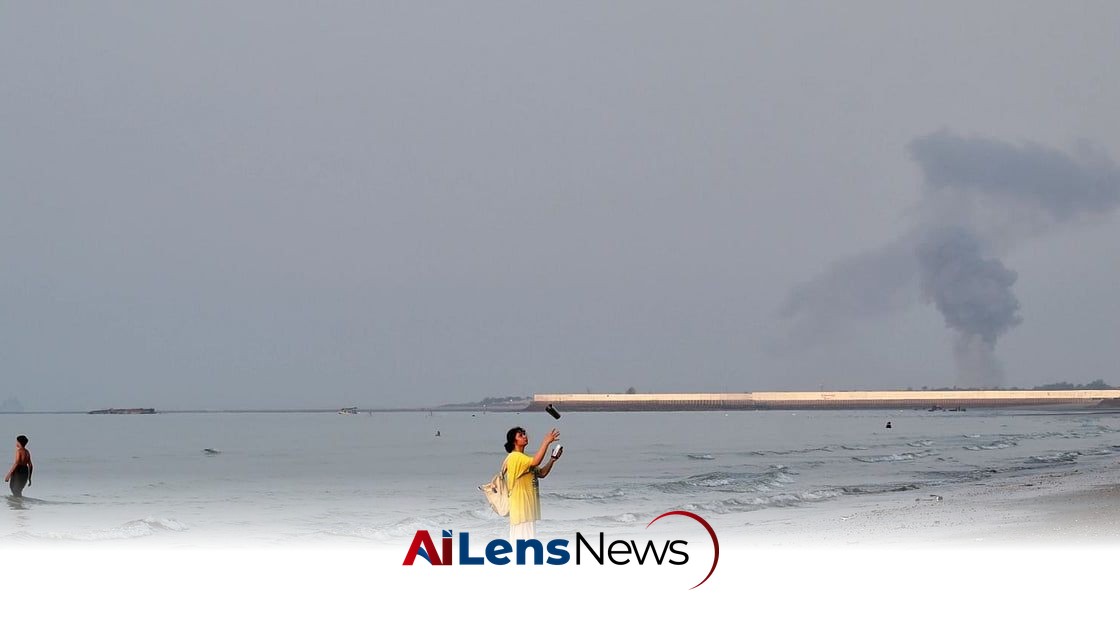


The United States has ramped up airstrikes in northern Iran, targeting military sites and a ship accused of breaching a naval blockade, escalating tensions in the region.
New Delhi, India Jul 16, 2026 ALN: The United States intensified its strikes targeting Iran early Thursday, hitting targets further north as American forces also fired into a ship it accused of trying to break its naval blockade on the Islamic Republic. This marked a significant escalation in the ongoing conflict between the two nations, which has seen a series of retaliatory actions and heightened military presence in the region.
Iran retaliated with missile and drone fire targeting Bahrain and Kuwait before dawn, signaling its willingness to engage in military action beyond its borders. The back-and-forth strikes by the US and Iran across the Middle East, coupled with renewed threats to the vital Strait of Hormuz, have shredded the interim deal aimed at de-escalating the situation and could potentially tip the region back into all-out war. Iranian officials have reported that US strikes have killed more than 35 people and wounded over 300 others, with the strikes reaching areas around Iran's capital, Tehran, for the first time in this latest round of violence.
The ongoing conflict has its roots in a complex history of US-Iran relations, characterized by mutual distrust and a series of confrontations since the 1979 Iranian Revolution. The US has imposed various sanctions on Iran over its nuclear program and regional activities, which it deems destabilizing. The tension escalated dramatically when the US withdrew from the Joint Comprehensive Plan of Action (JCPOA) in 2018 under the Trump administration, leading to increased hostilities.
When the US and Israel launched the war on Iran on February 28, Tehran effectively closed the Strait of Hormuz to shipping traffic, a strategic move that significantly impacted global oil markets. The Strait of Hormuz is a critical chokepoint through which a substantial percentage of the world's oil supply is transported. The closure sent the price of oil, fertilizer, and many other goods soaring far beyond the region, giving Iran major leverage in negotiations and increasing its bargaining power in the face of international sanctions.
The rising prices of commodities, particularly oil, pose a particular challenge to US President Donald Trump and his Republican Party, which hopes to retain control of Congress in elections scheduled for November. As the conflict escalates, the US has struggled to successfully reopen the waterway, leading to Trump reimposing the naval blockade on Wednesday. The blockade aims to restrict Iranian oil exports, which are a critical source of revenue for the Iranian government.
Iran's parliament speaker and lead negotiator, Mohammad Bagher Qalibaf, indicated that Iran was prepared for a fuller military confrontation if the US does not adhere to the terms of the interim deal. This statement underscores the precarious nature of the negotiations and the potential for further escalation. Additionally, Iran's paramilitary Revolutionary Guard has threatened to halt all energy exports from the Middle East in response to the blockade, stating, “The export of oil and gas from the region will be either for everyone or for no one.” This declaration reflects Iran's strategic position and its willingness to leverage its influence over global energy supplies.
Trump has maintained that Iran is ready to strike a peace deal, although he did not provide specific details on what such a deal would entail. During a speech at the US Army War College in Pennsylvania, he remarked, “They don't like what we're doing, and they do want to settle. We'll find out whether or not we settle with them, or we just finish it off,” highlighting the uncertainty surrounding the potential for diplomatic resolution.
The US strikes early Thursday reportedly hit around Tehran, as confirmed by state media. The attacks also targeted Semnan province, known to be home to Iran's ballistic missile production and space program, indicating a clear focus on Iran's military capabilities. The US military has increased the tempo of its operations, with strikes occurring during daylight hours, a shift from previous tactics that often favored night operations.
On Wednesday, the US resumed striking Iran, further demonstrating its commitment to countering Iranian military actions. The attack on Greater Tunb Island, a strategic point in the Strait of Hormuz, targeted Iranian defense and missile sites, according to Central Command. This location is significant not only for its military value but also for its role in controlling maritime traffic in the Strait.
In a notable incident, the US military opened fire on the Curacao-flagged oil tanker Belma as it sailed toward Kharg Island, Iran's main oil export terminal in the Persian Gulf. After the ship allegedly ignored multiple warnings, a US aircraft disabled the vessel by firing a missile into its smokestack, illustrating the heightened tensions and the willingness of US forces to engage directly with vessels perceived as violating the blockade.
Another American strike on Wednesday targeted a barracks for Iran's 388th Mechanized Infantry Brigade, which operates tanks and armored vehicles, in Sistan and Baluchestan province. Iranian state television reported that the attack resulted in at least 13 missile strikes, with seven soldiers confirmed dead, including both conscripts and career soldiers, and several others wounded. This attack further exemplifies the direct nature of US military operations against Iranian assets.
The latest round of fighting is focused on the strategically vital Strait of Hormuz. The US has faced significant challenges in its efforts to reopen the strait since Iran initially choked it off in the early days of the war. The Strait serves as a critical artery for global oil shipments, and any disruption can have far-reaching implications for the global economy.
During the interim deal, some ships began moving through the passage using a route near Oman, overseen by the US military, which is outside Tehran's control. This route provided a temporary workaround for shipping traffic, but recent Iranian attacks on vessels using this route have escalated tensions further, leading to a cycle of retaliatory strikes.
The US has threatened to reopen the strait by force if necessary, but military experts caution that doing so would require a much larger naval presence and potentially tens of thousands of ground troops. The implications of such an escalation could be severe, not only for regional stability but also for global economic markets.
As the situation continues to evolve, oil prices are on the rise, with Brent crude oil trading above $85 a barrel on Thursday — more than 15 percent higher than the price before the war but still below the nearly USD 120 reached at the height of the conflict. The increasing prices reflect the anxiety surrounding the conflict and its potential to disrupt global energy supplies.
In conclusion, the intensification of airstrikes by the US and the retaliatory actions by Iran have created a volatile environment in the Middle East. The Strait of Hormuz remains a focal point for military operations, and the potential for further escalation looms large. As both nations navigate this complex and dangerous landscape, the implications for regional and global stability are profound, and the prospect of a diplomatic resolution appears increasingly distant.
To learn more about the latest developments in World News & International Affairs, stay updated with our exclusive reports and analyses on AiLensNews.

