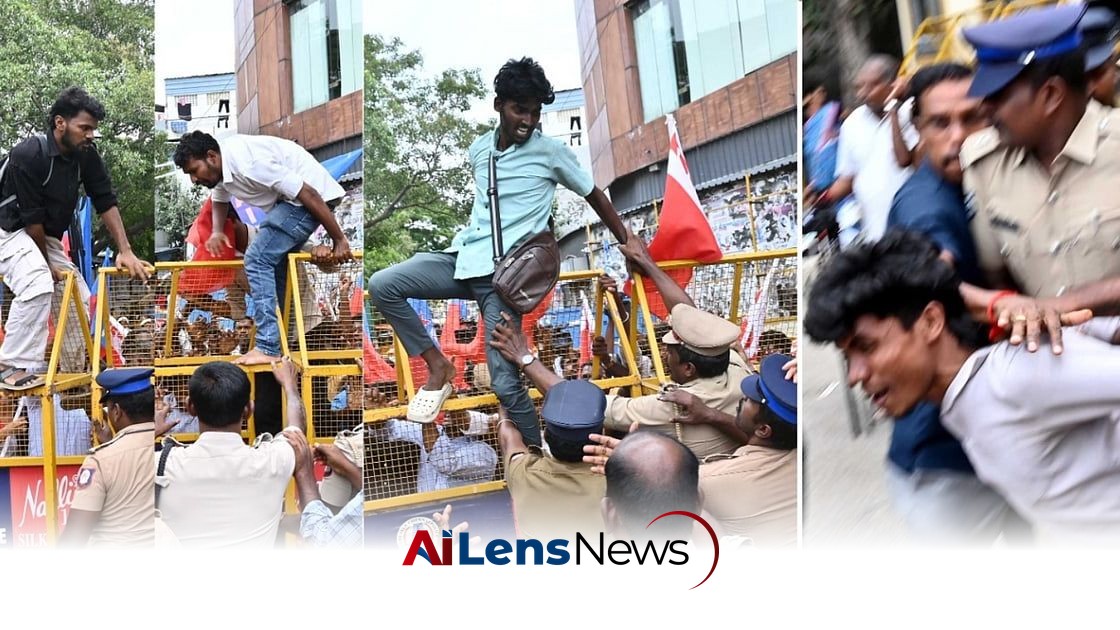


Police detained over 200 members of AISF and AIYF in Chennai as they protested against NEET, demanding its abolition and equitable admission processes.
Chennai, India Jul 26, 2026 ALN: Over 200 members of the All India Students' Federation (AISF) and the All India Youth Federation (AIYF) were detained by the police on Sunday after they attempted to march towards Lok Bhavan in Chennai, demanding the abolition of the National Eligibility-cum-Entrance Test (NEET).
The AISF and AIYF staged a protest near Panagal Maligai in Guindy, raising slogans against NEET and calling on the Union government to scrap the medical entrance examination. More than 200 students and youth participated in the demonstration, alleging that the examination had adversely affected students and demanding a uniform and equitable admission process.
When the protesters attempted to breach police barricades and march towards Raj Bhavan, police personnel stopped them and took them into preventive custody. The detainees were later shifted to nearby marriage halls and police vehicles.
Addressing the gathering before their detention, the organisers claimed that sustained student protests across the country had forced the Union government to accept the resignation of Union Education Minister Dharmendra Pradhan. They said the agitation would continue until the Centre abolishes the NEET examination.
Police maintained tight security in and around Lok Bhavan and adjoining roads to prevent the protesters from entering the high-security zone. The protest led to brief traffic disruptions in parts of Guindy.
The National Eligibility-cum-Entrance Test, commonly known as NEET, is a highly contentious examination in India. It serves as a standardized entrance test for students seeking admission to undergraduate medical programs in government and private medical colleges across the country. Introduced in 2016, NEET was designed to streamline the admission process and eliminate the discrepancies that arose from multiple entrance exams conducted by various states and institutions.
However, NEET has faced significant criticism from various quarters, particularly from student bodies and regional political parties. Critics argue that the exam places undue pressure on students and disproportionately affects those from economically disadvantaged backgrounds or rural areas. They contend that the focus on a single high-stakes exam can lead to an inequitable admission process, where students' fates hinge on their performance in a single test rather than their overall academic capabilities.
Protesters have expressed concerns that the NEET examination system exacerbates existing inequalities in the education system. Many students from rural or underprivileged backgrounds may lack access to quality coaching and resources that can significantly boost their chances of success in such competitive exams. As a result, there is a growing demand for a more holistic approach to admissions that considers a broader range of student achievements and capabilities.
The AISF and AIYF have been at the forefront of the anti-NEET movement, organizing protests and rallies across various states to raise awareness about the issues surrounding the examination. Their demands are not limited to the abolition of NEET but also include calls for reforms in the education system that would ensure equitable access to higher education for all students, regardless of their socio-economic status.
This recent protest in Chennai is part of a larger trend of student activism across India. In recent years, student-led movements have gained momentum, addressing various issues including educational reforms, social justice, and government accountability. The ability of these movements to mobilize large numbers of participants reflects a growing dissatisfaction among youth regarding the current state of the education system and governance.
In response to the protests, the government has indicated that it is open to dialogue with stakeholders regarding the NEET examination. However, many protesters feel that their voices are not being heard adequately, and they fear that their concerns will continue to be sidelined in favor of maintaining the status quo.
The situation surrounding NEET is emblematic of broader issues within India's education system. The introduction of NEET was intended to standardize medical admissions and reduce the prevalence of corruption and malpractice associated with multiple entrance exams. However, the unintended consequences of this centralization have led to widespread discontent among students, particularly those from diverse socio-economic backgrounds.
Critics of NEET argue that it has created a highly competitive atmosphere that favors students who can afford extensive coaching and preparation, often available only in urban centers. This has raised concerns about the fairness of the examination process, as students from rural areas or lower-income families may not have the same access to resources that can enhance their performance. As a result, many advocates for educational reform are calling for a more inclusive approach that takes into account the diverse backgrounds of students.
Furthermore, the protests in Chennai and other cities reflect a growing awareness among students regarding their rights and the need for accountability from the government. The AISF and AIYF have been instrumental in mobilizing support, not only for the abolition of NEET but also for broader educational reforms that address systemic inequalities. Their activism underscores a generational shift in how young people in India are engaging with political and social issues.
As the protests continue, the implications for the education system in India could be significant. If the government decides to engage with the demands of the protesters, it may lead to a reassessment of the NEET examination or even a broader overhaul of the admission process for medical colleges. On the other hand, if the government remains resistant to change, it could lead to further unrest and mobilization among students and youth organizations.
The political landscape in India adds another layer of complexity to the situation. Education has become a key issue in electoral politics, with political parties often leveraging the sentiments of students to gain support in upcoming elections. The current protests could influence political narratives and campaign strategies, particularly in regions where student activism is prevalent.
In summary, the detention of over 200 protesters in Chennai highlights the ongoing tensions surrounding the NEET examination and the broader issues of educational equity in India. The protests reflect a growing demand for change in the education system, driven by concerns over fairness and accessibility. As the situation develops, it will be important to observe how the government responds to the mounting pressure from student organizations and the implications this may have for future educational policies.
Ultimately, the outcome of these protests could shape the future of medical education in India, impacting not only the admission process but also the overall approach to education equity and access. The ongoing dialogue between the government and student organizations will be critical in determining how these issues are addressed moving forward.
To learn more about the latest developments in Crime & Law, stay updated with our exclusive reports and analyses on AiLensNews.

