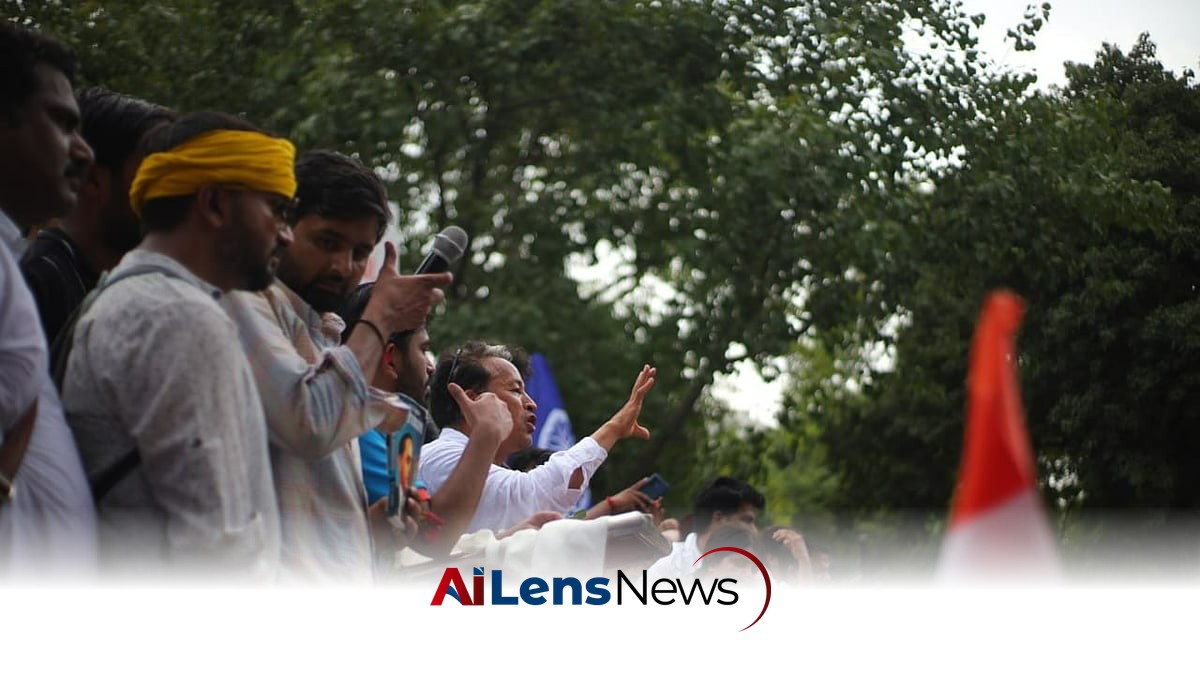


Activist Sonam Wangchuk was hospitalized after 21 days of hunger strike at Jantar Mantar, demanding accountability for examination irregularities.
New Delhi, India Jul 18, 2026 ALN: On 18 July 2026, prominent activist Sonam Wangchuk was hospitalized after 21 days of an indefinite hunger strike at Jantar Mantar, a significant site for protests in New Delhi. His hospitalization followed a noticeable decline in his health, raising alarms among supporters and the public. Wangchuk, alongside his supporters, was demanding the resignation of Union Education Minister Dharmendra Pradhan, citing alleged irregularities in the National Eligibility cum Entrance Test (NEET-UG) examination process. This protest was organized by the Cockroach Janta Party, a political group that has emerged as a voice for various social justice issues in India, and it garnered considerable public and political attention, particularly with a planned march to Parliament scheduled for 20 July.
The hunger strike, which began on 20 June, aimed to draw attention to what Wangchuk and his supporters described as systemic failures in the education sector, particularly in examination processes that they believed compromised fairness and transparency. The NEET-UG examination controversy has been a longstanding issue in India, with accusations of corruption, mismanagement, and a lack of accountability from the Ministry of Education. Wangchuk's protest was part of a broader movement advocating for educational reform and greater accountability from government officials.
As reported by The Indian Express, despite his deteriorating health, Wangchuk expressed a strong commitment to his cause, stating his intention to “stay alive at any cost” until the planned march took place. His physician noted that while he was experiencing mild dehydration and significant weight loss, he remained mentally alert. Health professionals, including government doctors, were closely monitoring his condition, following directives from the Delhi High Court, which had mandated daily health assessments of Wangchuk due to the critical nature of his protest.
According to The Hindu, the decision to shift Wangchuk to the hospital was made on expert medical advice and in compliance with court orders. The police intervened amid reports of a commotion at the protest site, where Wangchuk’s supporters were attempting to prevent his transfer. Authorities stated that they exercised restraint during the operation, emphasizing the need for medical care. However, the situation escalated, leading to the detention of Abhijeet Dipke, the founder of the Cockroach Janta Party, and restrictions on access to Jantar Mantar.
In the aftermath of Wangchuk's hospitalization, tensions at Jantar Mantar intensified. Protesters, many of whom were students and civil society members, expressed outrage at the police's actions. Dipke alleged that police used excessive force to remove Wangchuk from the protest site, while police maintained that the transfer was purely for medical reasons and that they had urged protesters to vacate the area peacefully. The All India Students’ Association reported that other hunger strikers remained at the site, with some forming a human chain to prevent police action, illustrating the solidarity among the protesters.
“As per orders of Hon’ble High Court and on expert medical advice due to the deteriorating health condition of Sh. Sonam Wangchuk, he has been shifted to the hospital for essential medical care,” the police stated, highlighting the legal framework within which they operated.
Coverage from Hindustan Times revealed that Wangchuk had lost nearly 20% of his body weight, dropping to 56.55 kg, raising concerns among his supporters and health professionals alike. His vital signs were under close observation, with doctors warning that his condition was critical. The Delhi High Court had emphasized the importance of every citizen's life, mandating that Wangchuk receive continuous medical supervision during the protest.
“The life of every citizen is precious,” the High Court order stated, reinforcing the legal obligation to protect the health and well-being of activists engaged in peaceful protest.
As police requested protesters to vacate Jantar Mantar following Wangchuk’s removal, the planned march to Parliament gained traction. The protest aimed to hold the government accountable for the NEET-UG examination controversy, which had sparked outrage among students and parents alike. Many viewed the examination as a critical gateway to medical education in India, and any perceived irregularities could have far-reaching implications for aspiring medical students.
Officials confirmed that the police acted on medical advice and court orders, stating that a minor commotion occurred as protesters attempted to obstruct Wangchuk's transfer. Authorities reiterated their request for a peaceful resolution to the agitation at Jantar Mantar. The heavy police presence at the protest site was indicative of the state's heightened concern over the potential for unrest, especially given the significant public interest in Wangchuk's demands.
Eyewitness accounts described heated exchanges as Wangchuk was escorted to the hospital, with videos circulating on social media capturing the intensity of the moment. Support for Wangchuk’s demands continued to grow, with various groups rallying behind him and calling for reforms in the education system. The implications of this protest extend beyond Wangchuk's personal health; they touch upon broader issues of governance, accountability, and the role of civil society in advocating for change.
Wangchuk's situation raises important questions about the efficacy of hunger strikes as a form of protest in contemporary India. While hunger strikes have historically been a powerful tool for activists seeking to highlight injustices, the response from authorities in recent years has often been to prioritize health and safety over the demands of protesters. This dynamic reflects a complex relationship between the state and civil society, particularly in an era marked by increasing scrutiny of government actions and policies.
In conclusion, the ongoing protest led by Sonam Wangchuk and the Cockroach Janta Party underscores the critical intersection of education, governance, and activism in India. As the situation develops, the eyes of the nation remain on Wangchuk's health and the broader implications of his struggle for accountability in the education sector.
To learn more about the latest developments in Health & Public Safety, stay updated with our exclusive reports and analyses on AiLensNews.

