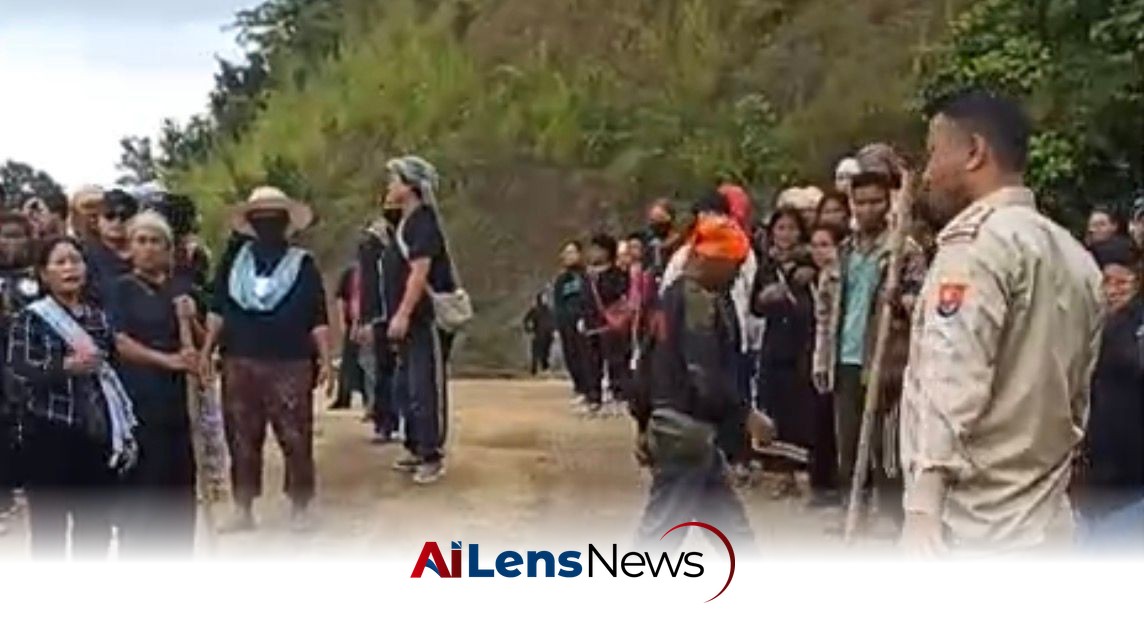


Tensions along the Imphal-Ukhrul route have intensified after Kuki groups imposed a blockade in response to the seizure of goods from commuters. The situation escalated when escorted vehicles were forcibly stopped at Shangkai village.
Gangtok, India Jul 27, 2026 ALN: Ukhrul: Fresh tensions have been reported along the Imphal-Ukhrul route following escorted vehicles from Ukhrul being forcibly stopped and goods seized from commuters at Shangkai, a Kuki village near Litan Police Station, located along the National Highway 202 on Monday.
According to sources, the incident occurred around 10 am when escorted vehicles, including passenger vehicles and private cars, were forcibly stopped. The disruption has sparked renewed concerns over the ongoing ethnic tensions in Manipur, which have been simmering for several months amid a backdrop of political instability and social unrest.
In a widely circulated video, goods and commodities carried by commuters were allegedly offloaded by womenfolk at Shangkai village after they forcefully stopped the escorted vehicles. The security forces, including Manipur police, were also seen at the scene, but their presence did not prevent the blockade from taking place. However, no official statement from the security agencies is available at the time of this report, leaving many to speculate about the potential repercussions of this incident.
Meanwhile, the Kuki CSO Working Committee (WCKCSOs)-Ukhrul has enforced a counter economic blockade on NH-202, effective from midnight of 26 July 2026 following consultations with Kuki-Zo civil society organisations of Ukhrul and Kangpokpi. This blockade is an escalation of tensions that have been brewing between the Kuki-Zo communities and other ethnic groups in the region, particularly the Meitei community, which has historically held significant political power in Manipur.
In a statement, the Kuki CSO Working Committee (WCKCSOs)-Ukhrul noted that this is not a decision born out of choice, but out of compulsion. The Kuki-Zo people, who primarily inhabit the hills of Manipur, have expressed frustration over what they perceive as systemic neglect and discrimination by the state government. The WCKCSOs articulated their grievances, stating that for months, the Kuki-Zo people of Ukhrul, Kamjong, and Kangpokpi have endured the continued obstruction of essential commodities while the Government watched in silence.
“We submitted memoranda, held meetings, accepted assurances, exercised restraint, and gave the authorities every opportunity to act. Every promise faded into empty words, while our people continued to bear the consequences,” they said. This statement highlights the deep-seated frustration felt by the Kuki-Zo communities, who have seen little action from the government to address their needs or concerns.
Having exhausted every peaceful avenue, the Kuki CSO Working Committee (WCKCSOs)-Ukhrul stated that it resolved to enforce a counter economic blockade on NH-202 from Sunday midnight onwards. The blockade will remain in force until the Government ensures the free movement of essential commodities through concrete action, not mere assurances. This declaration underscores the desperation of the Kuki-Zo people as they seek to assert their rights and demand accountability from the authorities.
During the blockade, medical emergencies, passenger vehicles, travelers proceeding to catch flights, and Security Forces will be allowed after due inspection to ensure that no goods are transported. All government and private institutions within the jurisdiction of the 14 Kuki-Zo villages will also remain closed until further notice, it stated. This aspect of the blockade reflects an effort to balance the need for protest with the recognition of essential services, although the ramifications of such a blockade could be significant for the local economy and daily life.
The WCKCSOs further expressed regret for the inconvenience that the decision may cause. However, it maintained that a people denied their basic necessities cannot be expected to remain silent indefinitely. The responsibility for this situation rests solely with the authorities whose prolonged inaction has left us with no option but to resort to this democratic form of protest, it stated. This sentiment resonates with many in the Kuki-Zo community, who feel marginalized and unheard in the political discourse of Manipur.
The situation in Manipur is further complicated by historical grievances among the various ethnic groups in the region. The Kuki-Zo communities have often felt sidelined in favor of the Meitei majority, particularly in matters of governance and resource allocation. This has led to a sense of alienation and resentment, which is now manifesting in increasingly assertive actions such as the current blockade.
WCKCSOs also urged all Kuki-Zo blockade enforcers to remain vigilant and come fully prepared, as past experience has repeatedly shown that the Governments of Manipur and India invoke the full might of the State only when the Kuki-Zo people demand justice through democratic means, while displaying remarkable indifference towards similar blockades enforced by Meitei and Naga groups, it added. This observation points to a perceived double standard in how different ethnic groups are treated by the authorities, exacerbating tensions and distrust among communities.
The implications of these developments are significant, not just for the Kuki-Zo communities but for the broader social fabric of Manipur. As tensions rise, the potential for violence increases, particularly if the government fails to respond adequately to the demands of the Kuki-Zo people. The blockade could also disrupt supply chains, affecting not only the Kuki-Zo villages but also neighboring areas that rely on the same routes for essential goods.
In the larger context, the situation in Manipur reflects ongoing struggles for autonomy and recognition among various ethnic groups in Northeast India. The region has a complex history of ethnic conflict, with various groups vying for political representation and resources. The current tensions in Manipur could serve as a flashpoint for broader unrest if not addressed through meaningful dialogue and engagement by the government.
As the situation develops, it will be crucial for all stakeholders, including the government, civil society, and community leaders, to engage in constructive dialogue to address the underlying issues at play. Failure to do so may result in further escalation of tensions, with potentially dire consequences for peace and stability in the region.
To learn more about the latest developments in Crime & Law, stay updated with our exclusive reports and analyses on AiLensNews.

