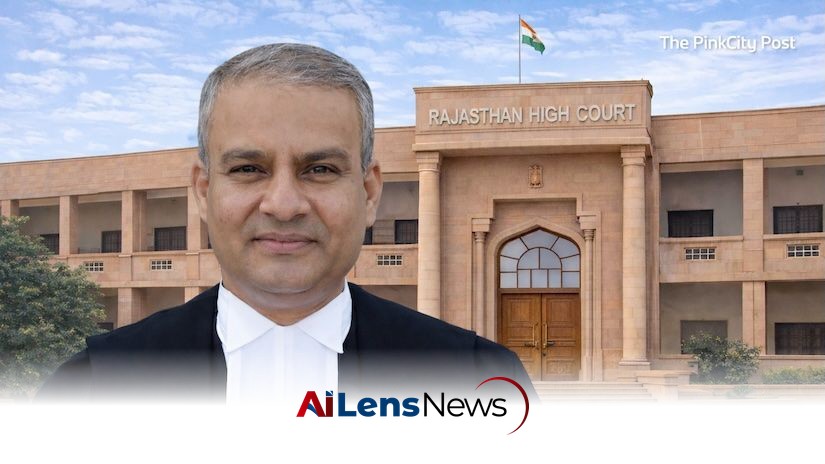


The Rajasthan High Court has quashed criminal charges against a senior Hindustan Zinc officer, emphasizing that designation alone does not imply culpability in industrial accidents.
New Delhi, India Aug 3, 2026 ALN: Jaipur: The Rajasthan High Court has quashed criminal proceedings against a senior officer of Hindustan Zinc Limited over an alleged escape of poisonous sulphur gas from the company’s plant near Chittorgarh in 2005, holding that a person cannot be exposed to criminal prosecution merely because he occupies a superior administrative position in a company, unless the statute specifically engrafts vicarious liability or the material collected during investigation demonstrates active participation, consent, connivance or culpable negligence.
Justice Farjand Ali observed that the trial court as well as the revisional court committed a manifest error in overlooking the mandatory ingredients of Section 16 of the Environment (Protection) Act, 1986 and in proceeding on the erroneous assumption that the petitioner’s senior position within the company, by itself, constituted sufficient ground to frame charges against him.
“Every industrial mishap cannot automatically translate into criminal prosecution of every officer occupying a higher echelon in the corporate hierarchy. Acceptance of such a proposition would virtually obliterate the distinction between administrative accountability and criminal culpability, thereby converting every senior executive into an accused whenever any untoward incident occurs within the industrial premises. Criminal law does not countenance such sweeping presumptions,” the Court observed.
The Court was hearing a petition under Section 482 Cr.P.C. filed by Jai Raj — who occupied the office of Senior Vice-President/President of Hindustan Zinc Limited — and the company through its nominee, seeking quashing of the order dated Nov 15, 2016 passed by the Additional District Judge No.1, Chittorgarh dismissing Criminal Revision No.56/2011 and affirming the order dated Sep 26, 2011 of the Additional Chief Judicial Magistrate No.2, Chittorgarh framing charges under Sections 278, 285, 287, 290 and 336 IPC read with Sections 15 and 16 of the Environment (Protection) Act, 1986.
The complainant had alleged that on Nov 9, 2005, a leakage of poisonous sulphur gas occurred from the plant situated near Village Putoli, Chittorgarh, as a result of which nearby residents suffered coughing, breathing difficulties and other ailments. FIR No.327/2005 was registered the next day at Police Station Chanderiya, and upon completion of investigation extending over more than a year, the police filed a charge-sheet on Dec 22, 2006 against only one officer allegedly concerned with the operational functioning of the plant, consciously refraining from implicating the present petitioner.
The complainant thereafter served a notice dated Jan 17, 2008 purporting to invoke the Environment (Protection) Act upon the Rajasthan State Pollution Control Board, which informed him that the matter was already under police investigation. He then instituted a private complaint on May 5, 2008 before the Magistrate, who took cognizance on Jun 2, 2008 against all the accused including the senior officers of the company. An earlier order of the High Court deciding the petition was set aside by the Supreme Court on Jan 25, 2018, and the matter was remitted for fresh consideration on merits.
The petitioner submitted that the institution and continuation of the complaint proceedings were wholly unsustainable in law, being contrary to the mandatory provisions of the Environment (Protection) Act, 1986, the material collected during investigation, and the settled principles governing criminal prosecution.
Examining Section 16 of the Act, the Court held that the expression “person in charge of and responsible to the company for the conduct of its business” has consistently received strict interpretation and contemplates a person who exercises actual operational control over the affairs resulting in commission of the offence, and not every officer drawing a higher salary or occupying a superior administrative office. The complaint, it noted, nowhere pleaded that the petitioner was directly supervising the acid plant, controlling the process from which the alleged leakage occurred, or that the occurrence resulted from his consent, connivance or neglect. The Court made reference to Sanjay Dutt v. State of Haryana (2025 SCC OnLine SC 32) and Maharashtra State Electricity Distribution Co. Ltd. v. Datar Switchgear Ltd. ((2010) 10 SCC 479), wherein the Supreme Court held that vicarious liability is not automatic and the complaint must contain specific averments demonstrating the personal role of the officer sought to be prosecuted.
The Court further found the prosecution’s own scientific material mutually destructive. While the Scene of Occurrence Report of the Regional Forensic Science Laboratory attributed the incident to escape of sulphur trioxide (SO₃) gas consequent upon mechanical failure of the acid loading pump, the Chemical Examination Report of the very same laboratory recorded that the liquid samples collected from the spot emitted smell of alcohol and did not give positive tests for the presence of any acid. “It is difficult to reconcile how an alleged escape of sulphur trioxide, sufficiently serious to cause widespread irritation and atmospheric contamination, would simultaneously leave no detectable acidic residue in the samples forwarded for forensic examination,” the Court remarked, adding that no contemporaneous medical evidence of injuries attributable to sulphur trioxide exposure was placed on record.
Noting that the occurrence report itself recorded that the acid plant was stopped at about 7:45 p.m. upon detection of heating in the acid loading pump, the Court held that immediate stoppage prima facie indicated an attempt to prevent further consequences rather than reckless indifference towards public safety, and invoked the underlying principle of the doctrine of vis major — that consequences of unforeseen and unavoidable events cannot ordinarily attract penal consequences in the absence of culpable negligence.
On maintainability, the Court held that Section 19 of the Environment (Protection) Act imposes a mandatory embargo on cognizance and that mere expiry of sixty days after issuance of notice does not entitle a complainant to institute prosecution as a matter of course, particularly where the subsequent complaint merely duplicates an investigation already undertaken by the police on the very same occurrence without any fresh material. Reliance was placed on Pratap Lal Teli v. State of Maharashtra (2019 SCC OnLine Bom 4274) and Vivek Kumar v. State of Jharkhand (2015 SCC OnLine Jhar 5011). The Court also noticed that by virtue of the Jan Vishwas (Amendment of Provisions) Act, 2023, the scheme of prosecution under Sections 15 and 16 of the Act has been replaced by a regime of civil penalties, reflecting the legislative policy of decriminalization.
Holding that “the prosecution has sought to substitute presumptions for proof and designation for culpability, a course wholly impermissible under criminal law”, the Court, by its judgment pronounced on Jul 28, 2026, allowed the petition, quashed the orders dated Sep 26, 2011 and Nov 15, 2016 as well as all consequential criminal proceedings against the petitioners, while clarifying that the findings shall not affect any independent civil rights or remedies, including proceedings for compensation or damages, arising out of the alleged occurrence.
Title: Jai Raj & Anr. v State of Rajasthan & Anr.
Case No.: S.B. Criminal Miscellaneous (Petition) No. 532/2017
Citation: [2026:RJ-JP:31845]
Counsel for petitioners: Senior Advocate Manish Sishodia assisted by Akhilesh Rajpurohit, Hardik Vyas, Harshwardhan Singh Rathore, Kuldeep, Saurabh Sirvi and Tararam Sirvi
Counsel for respondents: N.S. Chaudhary, Dy.G.A.; S.S. Shaktawat
To learn more about the latest developments in Crime & Law, stay updated with our exclusive reports and analyses on AiLensNews.

