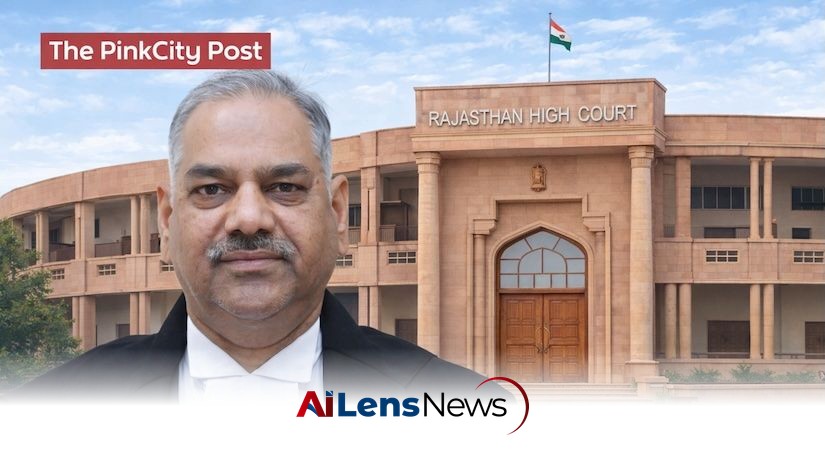


The Rajasthan High Court has ruled that insurance companies cannot assume a driving licence is fake without verifying it through the licensing authority.
New Delhi, India Jul 19, 2026 ALN: Jaipur: The Rajasthan High Court has recently delivered a significant ruling concerning the validity of driving licenses in the context of insurance claims. The court upheld a Motor Accident Claims Tribunal award against the National Insurance Company Ltd., asserting that an insurer cannot unilaterally declare a driver's license as fake solely based on its investigator's report without summoning the relevant licensing authority for verification.
This ruling comes from the case involving two connected appeals, S.B. Civil Miscellaneous Appeal No. 2830/2006 and S.B. Civil Miscellaneous Appeal No. 2880/2006, which were filed by the National Insurance Company against a common judgment and award issued on June 21, 2006, by the Additional District Judge (Fast Track) No. 1 and Motor Accident Claims Tribunal in Sikar. The Tribunal had previously awarded compensation to the claimants in two separate claim petitions, namely, Claim Petition Nos. 397/2005 (Sultan Singh & Ors. v. Mahavir & Anr.) and 398/2005 (Parmeshwar v. Mahavir & Anr.).
The background of this case is rooted in a motor vehicle accident that resulted in claims for compensation by the victims. The Insurance Company contested the claims, arguing that the driver of the vehicle involved in the accident, identified as respondent-Mahavir, did not possess a valid driving license at the time of the incident. The insurer based its argument on the findings of its investigator, who claimed that the license presented by Mahavir was supposedly issued by the District Transport Office (DTO) in Guwahati. However, the investigator's inquiry allegedly found that the DTO in Guwahati had not issued such a license.
In its appeal, the Insurance Company contended that this constituted a breach of policy conditions, which, according to them, absolved them of liability to fulfill the award. The crux of the appeal rested on the assertion that the driver was operating the vehicle without a valid license, thus violating the terms of the insurance policy.
On the other hand, counsel representing respondent-Mahavir opposed the appeals, emphasizing that it is well established in legal precedent that an insurance company bears the burden of proving that a driving license was not issued by the competent authority and is indeed fake. They argued that such a conclusion cannot be drawn merely from the insurer's investigator's statements without substantial evidence. The counsel cited a prior decision by a Coordinate Bench of the High Court in the case of United India Insurance Company Ltd. v. Moda Ram & Ors., which reinforced the principle that without evidence, no fact can be presumed.
In reviewing the case, Justice Ashutosh Kumar noted that it was an uncontested fact that the Insurance Company had not made any effort to summon the licensing authority in Guwahati to provide verification regarding the authenticity of the license in question. The court highlighted that applying the principle established in the Moda Ram case, it could not assume that the license held by the respondent-driver was fake in the absence of corroborating evidence from the licensing authority. The court also remarked that the Insurance Company's counsel was unable to counter the legal principle established in the earlier case.
The implications of this ruling extend beyond the immediate case at hand. It underscores the necessity for insurance companies to adhere to due process when contesting claims based on the validity of driving licenses. This ruling serves as a reminder that insurers cannot solely rely on internal investigations or reports without corroborating evidence from relevant authorities. The court's decision reinforces the principle that the burden of proof lies with the party making a claim or assertion, in this case, the insurance company.
Additionally, this ruling may have broader implications for the insurance industry in India. It emphasizes the need for insurers to conduct thorough investigations and engage with relevant authorities when disputing claims, particularly those related to the validity of driving licenses. This could lead to more rigorous internal protocols and a more comprehensive approach to claims management, ultimately benefiting all parties involved in the insurance process.
Moreover, this ruling highlights the importance of protecting the rights of individuals involved in motor accidents. By upholding the compensation awarded by the Tribunal, the court has reinforced the principle that victims of motor vehicle accidents should not be denied their rightful claims based on unsubstantiated assertions regarding the validity of a driver's license.
As the legal landscape surrounding insurance claims continues to evolve, this case may serve as a precedent for future disputes involving the validity of driving licenses. It illustrates the critical role of due process and evidentiary support in ensuring fair outcomes in insurance claims and reinforces the judiciary's commitment to uphold justice in such matters.
In conclusion, the Rajasthan High Court's ruling in this case not only addresses the specific claims of the parties involved but also contributes to the broader discourse on the responsibilities of insurance companies in the context of motor vehicle accidents. It emphasizes the importance of evidence, due diligence, and the protection of individual rights within the framework of insurance law.
This case also sheds light on the larger implications of how driving licenses are verified and the responsibilities of both drivers and insurance companies in ensuring that claims are processed fairly. The ruling serves as a reminder that in a system where road safety and insurance claims are intertwined, it is essential for all parties to act with transparency and integrity.
The court’s decision is particularly relevant in the context of the increasing number of vehicles on Indian roads, which has led to a corresponding rise in accidents and claims. With the complexities surrounding motor vehicle accidents and the ensuing insurance claims, this ruling may encourage a more robust framework for evaluating the authenticity of driving licenses and the processes involved in claims management.
Furthermore, this ruling could lead to enhanced scrutiny of internal practices within insurance companies, prompting them to develop better mechanisms for verifying the authenticity of driving licenses before contesting claims. This may ultimately result in quicker resolutions for claimants and a reduction in the number of disputes that reach the courts.
In a broader sense, the ruling reinforces the idea that the judicial system plays a crucial role in maintaining the balance of power between individuals and corporations, especially in matters where individuals may be vulnerable, such as in the aftermath of motor vehicle accidents. By ensuring that insurance companies are held accountable for their claims processes, the court is fostering a more equitable environment for all parties involved.
Title: National Insurance Company Ltd. v. Parmeshwar & Anr. (connected with National Insurance Company Ltd. v. Sultan Singh & Ors.)
Case No.: S.B. Civil Miscellaneous Appeal No. 2830/2006 (connected with S.B. Civil Miscellaneous Appeal No. 2880/2006)
Citation: [2026:RJ-JP:26893]
Counsel for appellant: Ms. Sunita Choudhary
Counsel for respondent: Mr. Sanjay Mehla with Ms. Sunita Mehla
To learn more about the latest developments in Crime & Law, stay updated with our exclusive reports and analyses on AiLensNews.

