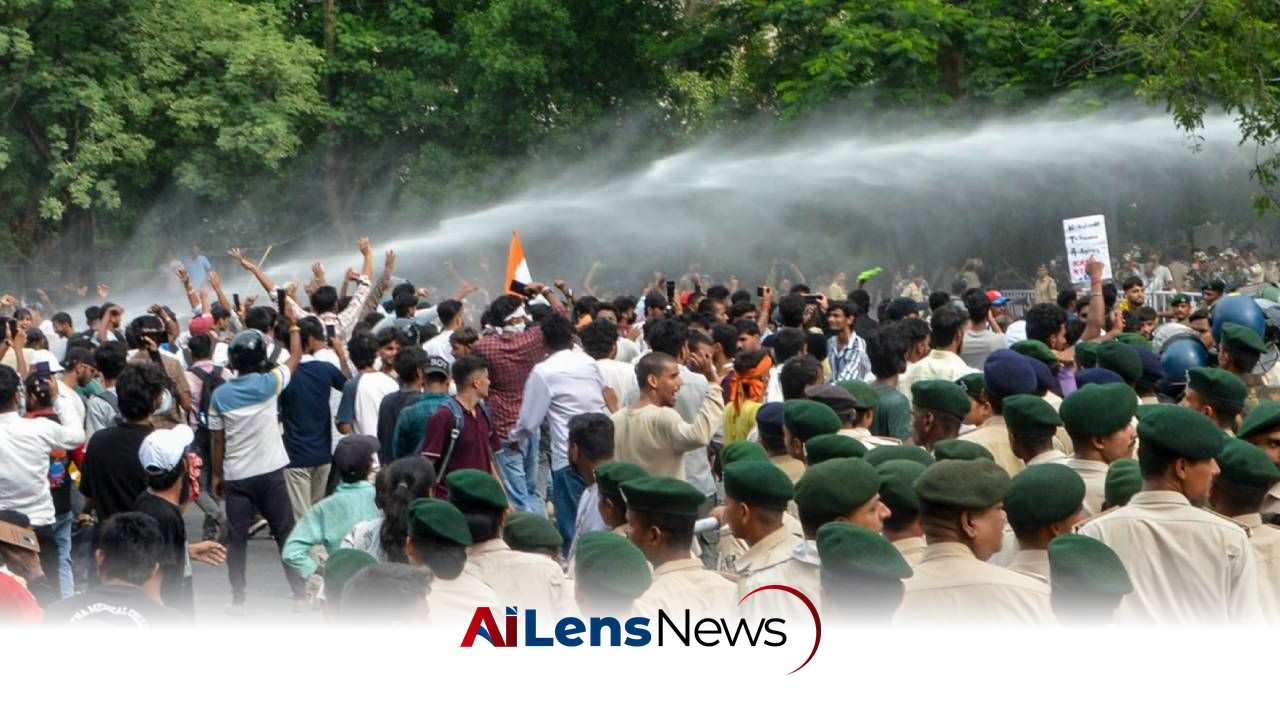


Protests in Patna turned violent as students clashed with police, demanding the resignation of Union Minister Dharmendra Pradhan following a NEET exam paper leak. Over 20 police personnel were injured in the unrest.
New Delhi, India Jul 22, 2026 ALN: Bihar’s capital Patna experienced intense and violent clashes on Wednesday as hundreds of student activists, primarily from the All India Students' Association (AISA), took to the streets demanding the resignation of Union Minister Dharmendra Pradhan. This protest was sparked by allegations of a leak in the National Eligibility cum Entrance Test (NEET) exam paper, a crucial examination for aspiring medical students in India. The situation escalated quickly as police attempted to disperse the crowd using tear gas, water cannons, and batons, leading to confrontations that resulted in injuries to over 20 police personnel and the sealing of assembly premises.
Patna, a city known for its rich historical significance and as a hub of educational institutions, found itself in the midst of chaos. The protests began around 11 am when a large number of student activists gathered at Gandhi Maidan, expressing solidarity with similar demonstrations taking place in New Delhi. The students were particularly vocal about their dissatisfaction with the government's handling of the NEET exam, which has been a contentious issue in recent years due to allegations of corruption and mismanagement.
The protestors, many of whom were affiliated with AISA, voiced their demands not only for Pradhan's resignation but also for the resignation of Union Home Minister Amit Shah. They accused the government of failing to prevent the NEET exam paper leaks, which they argue undermines the integrity of the examination process and the future of countless students. "We seek the resignation of Pradhan for his failure to prevent NEET exam paper leaks. We also demand the resignation of Union Home Minister Amit Shah, on whose orders the Delhi Police brutally tried to repress the Jantar Mantar agitation earlier this week," stated Paliganj MLA Sandeep Saurav, a prominent figure in the protests.
The police response to the protests was swift and forceful. As the demonstrators approached Lok Bhavan, a key government building, they were met with barricades and heavy police presence. The police's use of tear gas and water cannons aimed to disperse the crowd, but this only fueled tensions. Stone-pelting ensued from both sides, with reports indicating that some journalists covering the events were also attacked. The situation escalated further when protestors redirected their march towards the state BJP headquarters, resulting in property damage and increased police intervention.
Witnesses reported a significant traffic jam at Dak Bungalow crossing, a major thoroughfare in Patna, as police attempted to contain the crowd. The chaotic scene included police officers resorting to lathi charges to manage the protestors, who were determined to make their voices heard. The police's actions drew criticism from the protestors, who claimed they were being treated violently despite their peaceful intentions. "We are all marching peacefully, but the police are indiscriminately roughing up boys and girls only because they are being seen in groups of four to five. This shows the anti-democratic character of the BJP, which rules the Centre as well as the state," Saurav claimed.
As the protest progressed, the police were forced to seal off the assembly premises, fearing that the demonstrators would reach vital installations. The operation was overseen by IG, Patna Zone, Jitendra Rana, who arrived on the scene as tensions peaked. Reports indicated that some police vehicles were damaged by stones thrown by protestors, further escalating the conflict. A large contingent of central paramilitary forces was also deployed to restore order in the area.
In the aftermath of the clashes, many protestors were detained and taken to local police stations for further action. The exact number of arrests and the charges filed against the protestors remained unclear as officials continued to assess the situation. Senior Superintendent of Police Kartikeya K Sharma confirmed that more than 20 police personnel had sustained injuries during the clashes, with some requiring hospitalization. "At least 22 police personnel have received injuries. Some of them have been discharged after first aid. Those with major injuries are still undergoing treatment at hospitals. Cases are being lodged. We expect the total number of FIRs to be in excess of 15. The number of students detained or arrested by us will be known in due course," he stated.
The protests not only disrupted daily life in Patna but also caught the attention of political leaders. Members of the ruling National Democratic Alliance (NDA) were taken aback by the scale of the protests, remaining locked inside the assembly compound for about an hour after proceedings concluded. This unexpected turn of events highlighted the growing discontent among the youth in Bihar and raised questions about the government's handling of student issues. Former BJP MLA Haribhushan Thakur Bachol characterized the protests as a "conspiracy to unleash anarchy in Bihar and elsewhere in the country by the opposition, which is frustrated at the undiminished popularity of Prime Minister Narendra Modi."
The protests also led to a walkout by opposition members in the state legislative council, following heated exchanges regarding police actions against students. The incident reflects the broader political tensions in Bihar, where student activism has a long history of influencing political discourse and policy. The NEET exam, which has faced scrutiny over issues of fairness and accessibility, remains a focal point of contention, particularly among students from marginalized backgrounds who feel disadvantaged by the current system.
This incident in Patna is indicative of a larger trend of student activism in India, where young people are increasingly vocal about their rights and the integrity of educational institutions. The NEET paper leak allegations add another layer of complexity to an already fraught relationship between the government and students, potentially leading to more widespread protests in the future. As the situation unfolds, it will be crucial to monitor how the government responds to these demands and whether any substantive changes will be made to address the concerns raised by the student community.
To learn more about the latest developments in Crime & Law, stay updated with our exclusive reports and analyses on AiLensNews.

