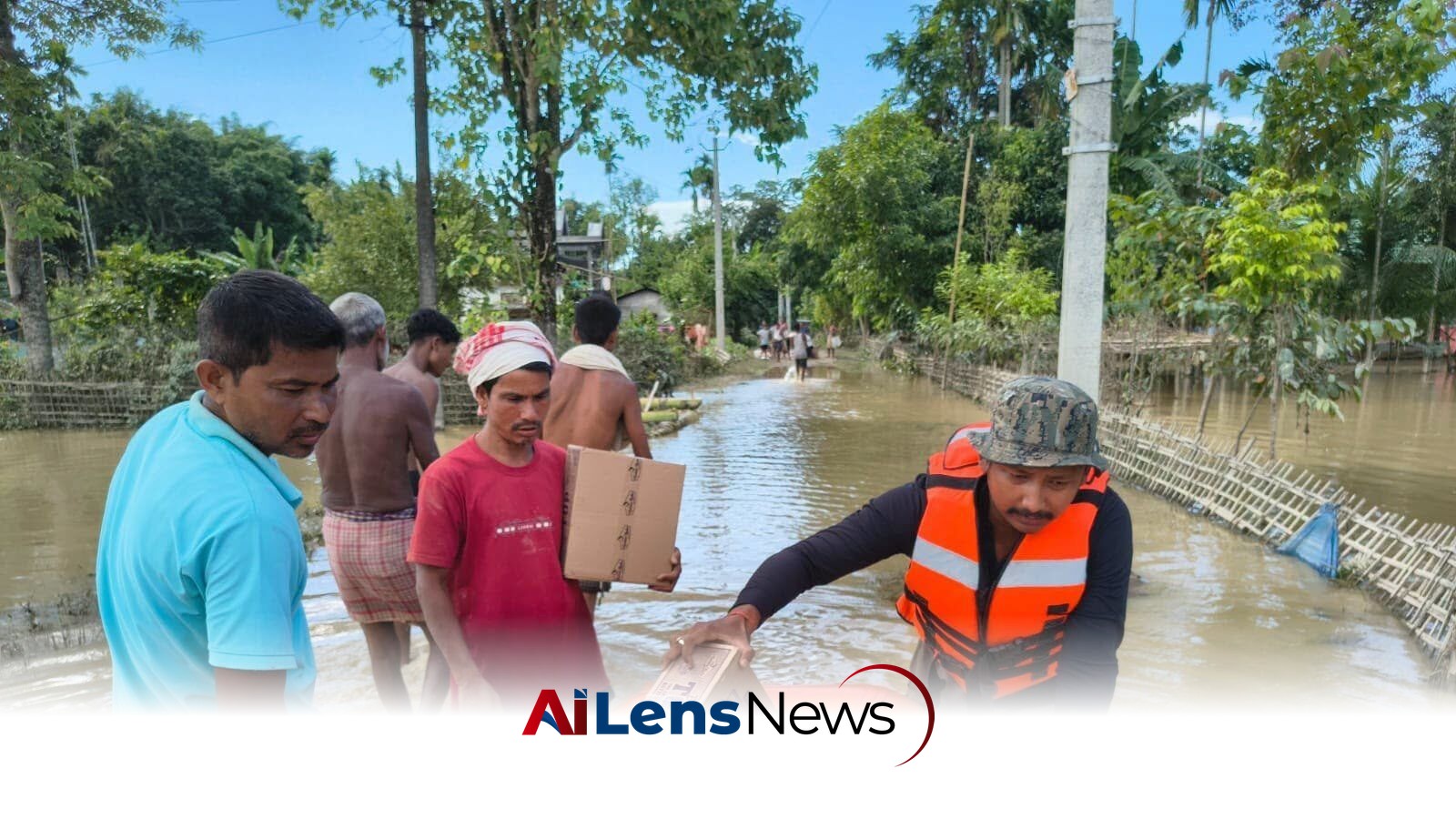


Relief operations in flood-hit Upper Assam face significant challenges as mud-covered roads hinder access to thousands in Nazira and Sivasagar.
Imphal, India Jul 24, 2026 ALN: Relief operations are continuing across flood-ravaged Upper Assam, but authorities are facing major challenges in reaching thousands of stranded people in Sivasagar and Charaideo because of thick layers of mud, damaged roads and inaccessible villages, Chief Minister Himanta Biswa Sarma said on Friday.
Addressing a press conference at the Lok Sewa Bhawan after chairing a meeting with officials to review flood fighting efforts, Sarma said relief has reached every affected village in Charaideo, but nearly 30 percent of Nazira Assembly constituency in Sivasagar remains inaccessible. This situation has emerged as a significant concern for the government and relief agencies, as the impact of the floods continues to disrupt normalcy in the region.
"Although floodwaters have receded in many places, roads are covered with thick layers of mud. Vehicles cannot move and people cannot even walk through several stretches. These areas remain virtually disconnected," he said. The Chief Minister's remarks highlight the dual nature of the disaster: while the immediate threat of flooding may be diminishing, the aftermath presents its own set of challenges that complicate relief efforts.
The Chief Minister estimated that nearly 50,000 people in Nazira and another 30,000 people in other parts of Sivasagar are yet to receive regular relief because of the difficult terrain. These figures underscore the scale of the humanitarian crisis unfolding in the region, as many families are left without access to essential supplies and services.
To overcome the logistical challenges, the government has begun transporting relief materials from Tinsukia, Dibrugarh, and Kamrup Metropolitan while deploying additional country boats for last-mile delivery. The use of boats, which are more adaptable to the flooded and muddy conditions, represents a strategic pivot in the government's approach to disaster management. "NDRF rubber boats are primarily meant for rescue operations and cannot carry large quantities of relief materials. Therefore, we are using country boats to transport food and other essentials," Sarma said.
Relief kits currently include rice, pulses, milk, biscuits, drinking water, sanitary napkins, bleaching powder, halogen tablets, and candles. These items are crucial for survival in the aftermath of flooding, where access to clean water and food can be severely compromised. However, the Chief Minister acknowledged that clothing has emerged as one of the biggest unmet needs. "The government cannot immediately provide clothes. We can provide financial assistance so that affected families can purchase them. At present, clothing and baby food are among the most urgent requirements," he said. This admission reflects the complexity of disaster relief, where immediate needs often overshadow longer-term considerations such as clothing and educational supplies for children.
The government also experimented with drones and air-dropping relief supplies but found them unsuitable. "When relief packets are dropped from drones or aircraft, they often burst on impact. Unless people know how to receive the packets safely, this method is not effective. Traditional delivery methods remain more reliable," Sarma said. This insight emphasizes the importance of local knowledge and infrastructure in disaster response, as well as the potential limitations of high-tech solutions in certain contexts.
To prevent disease outbreaks, the government has deployed mobile medical units, National Health Mission teams, and doctors from Jorhat Medical College in the affected districts. The deployment of healthcare professionals is critical in mitigating the health risks associated with flooding, which can lead to waterborne diseases and other health crises. The Chief Minister said electricity supply has been temporarily suspended in several areas as a safety measure because transformers remain submerged. "Nearly 40,000 consumers are without electricity, although mobile connectivity is functioning relatively well," he said. This loss of electricity further complicates the situation, as it hampers communication and access to information, which are vital during emergencies.
Sarma added that the government has asked the Agriculture, Animal Husbandry, and Health Ministers to visit the affected districts after floodwaters recede to undertake a detailed sector-wise damage assessment. This proactive approach is essential for understanding the full extent of the disaster's impact and for planning recovery efforts. He also announced that the state has developed a mobile application through which assessment teams will upload photographs and field data to facilitate a scientific post-disaster needs assessment. Utilizing technology in this way can enhance the efficiency and accuracy of recovery efforts, allowing for data-driven decision-making.
The Chief Minister further said an inter-ministerial central team will visit Assam on July 25 to assess the damage during the ongoing relief operations, enabling the Centre to evaluate the state's requirement for rehabilitation and reconstruction assistance. This visit is particularly significant, as it underscores the collaboration between state and central authorities in addressing the aftermath of natural disasters. The implications of this assessment could lead to increased funding and resources for recovery, which is vital for rebuilding the affected communities.
In conclusion, while the immediate floodwaters may be receding, the challenges faced by the government in providing effective relief to the affected populations in Sivasagar and Charaideo are substantial. The complexities of logistics, the need for essential supplies, and the importance of healthcare during this crisis are all critical factors that need to be managed carefully. As the situation develops, ongoing assessments and adaptive strategies will be essential in ensuring that the needs of the affected populations are met, and that recovery efforts are both effective and sustainable. The collaborative efforts between various government departments and agencies will play a crucial role in navigating the recovery process and restoring normalcy in the region.
To learn more about the latest developments in Health & Public Safety, stay updated with our exclusive reports and analyses on AiLensNews.

