

More
Checking your session
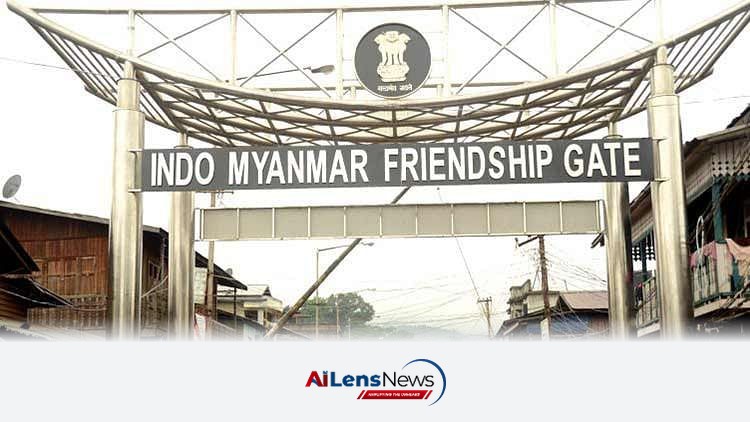



India's northeastern border with Myanmar remains contentious, with ongoing fencing efforts raising fears among local communities about land loss and security.
Imphal, India Aug 22, 2026 ALN: India’s easternmost border, running along its neglected northeastern states, remains unsettled more than seven decades after independence.
MEA spokesperson Randhir Jaiswal, during his weekly press briefing in the first week of August, stated that certain areas along the India-Myanmar border are yet to be settled and discussions on those sectors are ongoing.
Meanwhile, information circulating on social media and in media reports points to land on the Indian side of the India-Myanmar border being surrendered, exchanged, or “swapped” with Myanmar, although there is no clear information confirming this.
Border concerns have surfaced before, including villagers’ complaints about alleged Myanmar military intrusions and claims that some border pillars have moved from their original locations. However, since the 2023 crisis, the border has come under much greater scrutiny.
The crisis has been attributed by Meitei civil society groups, analysts, and others to the influx of what they describe as “illegal immigrants.” There are fears that such migrants are encroaching on and illegally occupying land and have altered the region's demography, including through alleged increases in new villages and population in rural tribal districts, particularly Kuki and Zomi areas.
Against this backdrop, India has renewed efforts to fence the entire India-Myanmar border.
In 2021, after the Myanmar military junta seized power, thousands fled to neighboring northeastern states, particularly Mizoram and Nagaland. Many came from Chin State, Sagaing, and other ethnic areas bordering India.
The Ministry of Home Affairs subsequently directed northeastern states not to “welcome” Myanmarese fleeing into India. Nevertheless, people from Myanmar continue to shelter in Indian border villages, where civil society organizations and families provide humanitarian assistance.
India shares 5,484 km of border with five neighboring countries, including 1,643 km with Myanmar. accounts for 398 km of that frontier.
India, in agreement with Myanmar, began fencing the border in 2003 in an attempt to curb insurgent activity, but the effort did not achieve major success. With the border now being linked to concerns over Myanmar's unrest and national security, fencing has again become a priority. In 2024, Rs 30,000 crore was approved for the project, which is expected to be completed by 2035-36.
The move has faced opposition from tribal border communities. Crossing the frontier for work, trade, and other purposes has long been part of life in these areas.
India and Myanmar had formalized a “free movement” arrangement in 1968, allowing movement up to 16 km into each other’s territory without visas, documents, or permits. It was revised in 2018 and, following the 2023 violence, reduced to 10 km on either side. Physical fencing could potentially bring the arrangement to an end.
The border areas reportedly affected by the latest fencing fall between pillars 65 and 68 in Chandel district, southeastern . Villagers say 12 tribal villages inhabited by Kukis and related tribes could be affected: Molcham, Khengjang, Phaisan, Khumkot, Khangtung, Changpol, Gamnuom, Joldam, Gamphajol, Thingphai, Laijang, and Jangoubung. The fencing is estimated to cover roughly 50-60 km.
Villagers remain anxious, particularly in the absence of concrete information. With fencing being pushed aggressively, village chiefs have been difficult to reach for comment.
Local opposition is also visible in the dismantling of fencing in several areas, while raw materials have reportedly been taken away or stolen.
David, a young lawyer in Moreh, Tengnoupal district, expressed that Delhi was disconnected from ground realities. “They just consider what is placed on their table by some Delhi-based policy framers without blinking an eye,” he said.
David acknowledged the doubts surrounding reports of land being given to Myanmar but questioned whether there was a “hidden policy” behind the move. “Why India decided to give away parts of its land to Myanmar is a million-dollar question,” he said, asking, “Who stands to gain out of this project?”
Observers noted that village chiefs have little ability to oppose the fencing, given their remote location, limited support, and the wider Meitei-Kuki conflict, in which Kukis have been accused of sheltering “illegal immigrants.”
David, who grew up in Moreh, stated that border disputes were previously resolved locally, with the Myanmar military and BSF working together. The frontier, he said, had traditionally been defined largely by stone pillars and the “mutual understanding of border communities and words of mouth.”
He does not believe fencing will eliminate illegal activity or security threats. “No physical fencing or walls will stop any threats. Nor prevent any armed militants from crossing the fence,” he said, pointing to earlier fencing between Moreh and Kwatha that was intended to curb Meitei insurgent movement but was left incomplete.
He also did not rule out the possibility that New Delhi’s decision had been influenced by the Myanmar junta. Amid criticism, Myanmar’s President Min Aung Hlaing was invited to India and accorded a red-carpet welcome two months ago.
David further pointed to changes around the India-Myanmar Friendship gates at Moreh. A bridge over the Menal river, he said, is no longer painted “black and white” on either side to indicate the border. He suggested the bridge “must have been ‘negotiated’ between the two countries for reasons best known to the authorities in Delhi and Naypyidaw.”
Moreh residents also say the road divider between the two countries has disappeared.
David questioned the map or survey being used for the fencing and asked why local landowners were not consulted. He called for a more sustainable approach to cross-border security that involves local communities.
“When people are involved, there can be no other better security,” he said.
To learn more about the latest developments in Politics, stay updated with our exclusive reports and analyses on AILensNews.

Union Home Minister Amit Shah is set to visit Manipur in early October to initia…

The Kuki-Zo Council has opposed calls for updating the National Register of Citi…

The Just Fair Delimitation (JFD) has announced a two-day general strike in , dem…

Conrad K. Sangma emphasizes the need for a coordinated approach between Meghalay…

Bijoy Kakchingtabam has been elected as the new president of the All Working Jou…