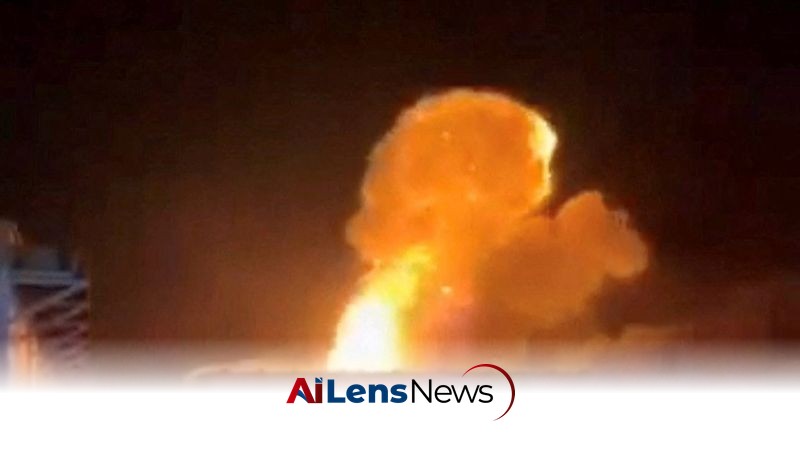


The US has launched military operations against Iranian coastal defense and missile sites, prompting Tehran to threaten wider disruptions in energy exports.
Washington DC, United States Jul 15, 2026 ALN: In a significant escalation of tensions in the Middle East, the United States has conducted military strikes targeting Iranian coastal defense and missile sites. This operation, according to Washington, was aimed at neutralizing military capabilities that have been implicated in attacks on commercial shipping in the region. The strikes represent a continuation of a broader strategy by the United States to counter Iranian influence in the Gulf, a region that has long been a flashpoint for conflict due to its strategic importance and vast energy resources.
The strikes come amid rising concerns over Iran's activities in the Gulf, where it has been accused of threatening maritime security. US officials stated that these military actions were necessary to protect international shipping lanes and ensure the safety of commercial vessels traversing these waters. The Gulf region is a vital artery for global trade, with a significant percentage of the world's oil supply passing through the Strait of Hormuz. Any disruption in this area could have far-reaching consequences for global energy supplies and economic stability.
In response to the US strikes, Iranian officials have issued stern warnings, threatening to disrupt energy exports from the region. Tehran's rhetoric suggests that it may consider closing off key shipping corridors, which could have significant implications for global oil markets. The Iranian leadership has historically portrayed itself as a defender of regional sovereignty, and any perceived aggression from the United States is likely to be met with strong retaliatory rhetoric and potential military responses.
Iran's Foreign Ministry condemned the US actions, labeling them as aggressive and a violation of international law. The ministry emphasized that such military interventions would not go unanswered and could lead to broader regional instability. This statement reflects Iran's long-standing position on foreign military interventions in the Middle East, where it has consistently criticized US presence and actions as detrimental to regional peace and security.
The Iranian military, known for its asymmetric warfare capabilities, may respond through various means, including proxy groups in the region, cyber operations, or direct military action. The potential for retaliation raises the stakes not only for US forces but also for allies and partners in the region, who could find themselves caught in the crossfire of any escalating conflict.
The potential for disruptions in energy exports raises alarms among global markets, especially given the already volatile nature of oil prices. Analysts warn that any significant closure of shipping routes could lead to a spike in oil prices, affecting economies worldwide. The Gulf region is crucial not only for oil exports but also for natural gas supplies, which are vital for energy-dependent economies across Europe and Asia.
The fear of rising oil prices is compounded by existing economic challenges in many countries, which are still recovering from the impacts of the COVID-19 pandemic. A sudden increase in oil prices could exacerbate inflationary pressures, leading to higher costs for consumers and businesses alike. Furthermore, countries that rely heavily on oil imports would face increased trade deficits, potentially destabilizing their economies.
For instance, countries in Europe, which are already grappling with energy supply issues due to geopolitical tensions with Russia, may find it increasingly difficult to meet their energy demands if oil prices surge. Similarly, Asian economies, particularly those of Japan and South Korea, which are heavily reliant on Middle Eastern oil, could see their economic recovery jeopardized by rising energy costs.
The international community is closely monitoring the situation, with various nations calling for restraint from both the US and Iran. Diplomatic efforts are underway to de-escalate tensions, but the path forward remains uncertain. Countries in the region, particularly those that are part of the Gulf Cooperation Council (GCC), are watching closely, as they may be directly affected by any escalation in hostilities.
In the past, regional powers such as Saudi Arabia and the United Arab Emirates have supported US actions against Iran, viewing Tehran as a primary threat to their security. However, there is also a recognition that military escalation could lead to unintended consequences, including retaliatory attacks that could destabilize the entire region. As such, many nations are advocating for dialogue and negotiation as a means to resolve the ongoing tensions.
Furthermore, European nations, which have historically pursued diplomatic engagement with Iran, may find themselves in a difficult position. They have sought to preserve the 2015 nuclear deal, which aimed to limit Iran's nuclear program in exchange for sanctions relief. The recent military actions by the US complicate these efforts, as they may push Iran to further abandon its commitments under the agreement.
The implications of the US strikes extend beyond the immediate region, potentially reshaping geopolitical dynamics and international relations. Countries that have previously maintained a neutral stance may feel compelled to take sides, further polarizing the situation. The potential for a broader conflict involving multiple nations raises concerns about a new cycle of violence in the Middle East, reminiscent of past confrontations.
As the situation develops, the implications of these military actions will likely resonate beyond the immediate region, affecting geopolitical dynamics and international relations. The potential for a broader conflict involving multiple nations raises concerns about a new cycle of violence in the Middle East, reminiscent of past confrontations.
In conclusion, the recent US strikes against Iranian military sites mark a critical juncture in US-Iran relations. With Tehran's threats of wider energy disruptions, the potential for conflict escalation looms large, prompting urgent calls for diplomatic solutions to avert further hostilities. The stakes are high, not only for the countries directly involved but for the global community as well, as the balance of power in the region continues to be a focal point of international attention.
To learn more about the latest developments in World News & International Affairs, stay updated with our exclusive reports and analyses on AiLensNews.

