

More
Checking your session
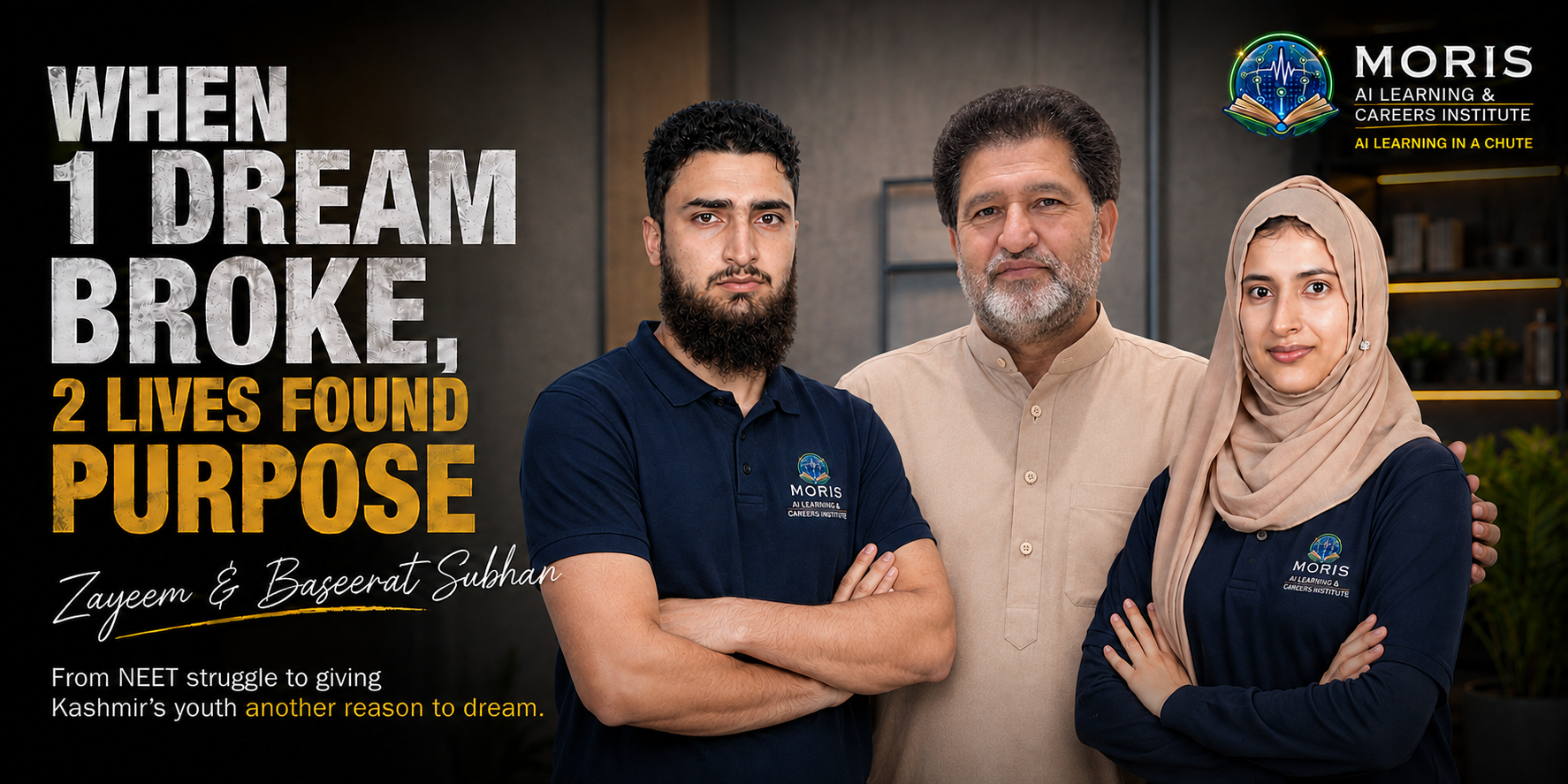



Friday, 28 August 2026 | Baramulla, Jammu and Kashmir, India: In Nehalpora, a village in Pattan tehsil of north Kashmir’s Baramulla district, the story of siblings Zayeem Subhan and Baseerat Subhan did not begin with entrepreneurship, artificial intelligence or plans for a new educational institution.
It began with an examination.
For years, medicine represented one of the clearest professional destinations before them. Like thousands of young people across India, preparation for the National Eligibility-cum-Entrance Test, or NEET-UG, became tied to questions much larger than an examination: career, family expectations, financial independence and what life after school would eventually look like.
The siblings are children of Mohammad Subhan Hurrah, described by the family as a businessman and retired gazetted officer from Baramulla district. Raised in Nehalpora and educated at a school in Baramulla, the two grew up in a household where education was treated seriously.
For Zayeem, that path eventually became a three-year cycle of preparation, examination and starting again.
Records provided for this story state that Zayeem Subhan appeared for NEET-UG three times: in 2023, 2024 and 2025.
The dates correspond with the official examination calendar. NEET-UG 2023 was conducted on 7 May 2023, NEET-UG 2024 on 5 May 2024, and NEET-UG 2025 on 4 May 2025.
Three examinations may occupy only three lines on a document. For a young candidate, however, three attempts can represent a substantial part of early adulthood.
Each attempt means months of textbooks, mock tests, revision schedules and expectations. It means watching friends move into colleges and other careers while deciding whether to prepare once more. It also means confronting a difficult question after every result: continue pursuing the same destination, or accept that life may have to take another direction?
For Zayeem and Baseerat, that question eventually became central to their lives.
The pressure surrounding competitive examinations is not unique to one household in Kashmir.
India’s student mental-health numbers provide a troubling wider context. National Crime Records Bureau data reported for 2023 recorded 13,892 student deaths by suicide, compared with 8,423 in 2013, an increase of about 65 per cent over the decade. Students accounted for roughly 8.1 per cent of all recorded suicide deaths in the country that year.
Government data does not attribute all of these deaths to competitive examinations. The Ministry of Education has specifically noted that recorded causes of student suicides include family problems, relationships, illness and examination failure, among other factors.
Yet the pressure surrounding medical entrance examinations has become an increasingly visible part of India’s discussion about student welfare.
An open-source review published in 2026 traced at least 93 reported NEET-linked student suicides between 2021 and May 2026, including at least 32 during 2025. Such media-based figures should not be treated as an official national dataset or as proof that NEET alone caused every death. They nevertheless point towards a problem that families, educators and policymakers can no longer treat casually.
Against this national background, Zayeem’s experience became intensely personal.
According to accounts shared for this story, repeated examination pressure and uncertainty left the siblings deeply discouraged. At their lowest point, the emotional strain became severe enough that thoughts of suicide entered their conversations.
There is no value in romanticising that moment.
For the family, it was not a dramatic chapter to be celebrated later. It was a warning about what can happen when a young person begins believing that one examination result has become a verdict on an entire life.
The siblings say they ultimately moved away from those thoughts and began looking for another direction.
That distinction matters. Their story is not that despair somehow produced success. It is that intervention, conversation and the availability of another possible future helped them reconsider what they believed their options were.
The siblings’ preparation also overlapped with one of the most controversial periods in the recent history of NEET-UG.
More than 24 lakh candidates registered for NEET-UG 2024, according to the National Testing Agency.
Questions surrounding the examination subsequently led to investigations, litigation and months of public debate.
The controversy requires precision.
The Supreme Court’s August 2024 judgment recorded evidence relating to beneficiaries of a leak in Hazaribagh and Patna, but concluded that the material before it did not demonstrate a systemic or nationwide breach sufficient to order the examination again for all candidates. The Court said beneficiaries of the malpractice could be separated from honest candidates.
Separately, 1,563 candidates who had initially received compensatory marks because of loss of examination time were offered a re-examination, which was conducted on 23 June 2024.
For candidates watching from their homes, however, the legal distinctions did not necessarily remove the broader anxiety surrounding fairness, competition and the enormous consequences attached to entrance examinations.
For Zayeem, the episode contributed to a larger question: what happens to a student when years of preparation appear to leave only one acceptable definition of success?
And what happens when that student lives in a place where the alternatives may not always appear equally visible?
In Kashmir, aspirations for government employment have deep social and economic roots.
A government position can represent stability, predictable income and social security. Medicine, engineering and public-sector recruitment therefore remain important ambitions in many households.
The problem begins when young people believe these are the only respectable routes available to them.
Zayeem and Baseerat began thinking about the distance between the opportunities young people hear about online and the opportunities they can realistically access from districts such as Baramulla.
India’s technology economy may be expanding, but access to it is uneven.
A student in Bengaluru, Hyderabad, Mumbai, Gurugram or Delhi may be surrounded by startups, corporate offices, internships, professional networks and technology events. For a student in a rural or semi-rural part of Kashmir, exposure to the same ecosystem can require substantially more effort.
Geography should not determine ability. It can, however, influence exposure.
That difference became important to the siblings.
Their question gradually changed from, “What happens if we do not become doctors?” to “What else can someone from our district become?”
It was a seemingly simple question with much larger implications.
According to Zayeem, one turning point came when he contacted a mentor associated with Moris Media seeking counselling and career guidance.
The conversation, he recalls, was less about telling him to forget medicine and more about challenging the assumption that his future had ended because one career route had become uncertain.
One idea stayed with him: if one student in Baramulla could feel trapped between an examination, unemployment and family dependence, there were likely many others experiencing the same fear.
The problem, therefore, was not simply Zayeem’s examination result.
It was the absence of visible alternatives.
For a student who had spent years preparing for medical entrance examinations, the possibility of moving into technology, corporate work or artificial intelligence initially seemed far removed from the path he had imagined.
But the siblings began examining that possibility.
Instead of treating their NEET years as time that had been wasted, they started considering whether the discipline developed during those years could be redirected towards another profession.
That shift eventually became the foundation for an educational initiative they now want to build from Kashmir.
Zayeem Subhan and Baseerat Subhan say they have since taken steps towards establishing Moris AI Learning And Career Institute Private Limited, an AI-focused learning and career initiative operating from Near Zangam Flyover, Pattan, Baramulla, Jammu and Kashmir.
For the siblings, the location is important. The institution is not being conceived from one of India’s established technology hubs, but from the same region where their own questions about careers, examinations and limited professional exposure took shape.
The stated objective is to provide students, particularly those from financially constrained and underserved communities, access to technology education, mentorship, internships and employment pathways. Students interested in exploring its learning and counselling process can access the institute’s application and programme information online.
The siblings describe the initiative as an attempt to make career alternatives visible before a disappointed student concludes that no alternative exists.
Their proposed model is deliberately different from the conventional idea of an institute where students attend lectures, complete a syllabus and leave with a certificate.
They say the programme is intended to begin with counselling.
The purpose is to understand a student’s interests, abilities and commitment before placing that student into a particular learning track.
That distinction comes directly from their own experience.
Zayeem spent years pursuing one of India’s most competitive examinations. He does not want another student to spend years following a career merely because everyone around them considers it the safest choice.
A student interested in communication should not necessarily be pushed towards programming. Someone interested in data should not be trained as a designer simply because a course happens to be available. Someone with an aptitude for sales, finance, research, operations, media or technology should have the opportunity to understand how those interests translate into actual work.
The siblings believe career education needs to begin there.
Artificial intelligence has rapidly entered almost every discussion about the future of employment, but the siblings say their project is not intended to teach AI as an isolated subject or fashionable terminology.
Their broader idea is to teach students how technology is being applied inside actual professional departments.
According to programme information supplied by the organisers, the proposed curriculum is being structured around practical applications across hundreds of industry and departmental functions rather than a single generic AI course.
The organisers state that learners would be exposed to applications spanning areas such as research, marketing, media, human resources, business development, operations, customer support, design, data, finance and other professional functions.
These programme numbers and employment pathways are claims made by the organisers and will ultimately need to be measured against enrolment records, training outcomes, internship completion and actual job placements once operations are underway.
That accountability will be important.
A free programme is valuable only if the education itself has value.
A job assurance is meaningful only when students actually receive sustainable employment.
And an ambitious institution should eventually be judged not by the size of its promises, but by what happens to the students who walk through its doors.
One of the initiative’s most significant commitments is financial.
Zayeem and Baseerat say the core AI learning and mentorship programme at Moris AI Learning And Career Institute Private Limited is intended to be offered without tuition fees to eligible students selected through counselling.
The stated intention is to reach students for whom expensive private technology programmes may otherwise be inaccessible.
The organisers estimate that comparable extended training, mentorship and career-development programmes can represent several lakh rupees in education expenditure, although such comparisons vary substantially by institution, programme duration and curriculum.
For families in rural areas, even a fraction of that amount can determine whether a student participates at all.
The siblings therefore want financial circumstances to be separated, as far as possible, from admission into the learning programme.
There is another condition, however.
Free does not mean automatic admission.
They say students would first undergo counselling intended to assess seriousness, career interests and willingness to complete the programme.
Their reasoning is practical. If training resources and professional mentors are being provided without tuition fees, seats should go to candidates willing to invest their time and effort.
For students and families in Pattan who want to understand the programme before making that commitment, the institute has also provided an online application and counselling route.
The programme is being developed with mentoring support associated with Moris Media’s “Digital Doctors” professional network.
According to information provided by the organisation, its broader professional network operates across more than 40 countries, and the learning initiative expects participation from more than 200 professionals and mentors through online and practical sessions.
These figures are organisational claims and should be independently assessed as the programme develops.
For students in Baramulla, however, the more consequential idea may be the ability to interact with working professionals without first leaving Kashmir.
A laptop and internet connection cannot solve every structural employment problem facing a region. They can nevertheless reduce one barrier that historically mattered greatly: distance.
A professional mentor can now speak to a student in Pattan from another Indian city or another country.
A project can be reviewed remotely.
A student can participate in an internship without immediately relocating.
Skills can be demonstrated through work rather than only through an academic certificate.
That is the opportunity the siblings want to explore.
Zayeem and Baseerat also want the initiative to connect education with internships.
According to the proposed structure shared with International News Express, students who successfully progress through relevant learning tracks would be considered for practical assignments, internships and employment pathways within participating businesses and partner organisations.
The organisers have described their objective as providing a job pathway for candidates who successfully meet programme requirements.
Any claim of a “100 per cent job guarantee”, however, carries a high standard of accountability. Its real value can only be assessed after the first cohorts complete training and independently verifiable placement records become available.
For young people, that distinction matters.
Kashmir does not need another certificate that sits inside a folder.
Students need skills that can be demonstrated, work that can be evaluated and employment that can be sustained.
The siblings say this is precisely why practical exposure is being positioned alongside learning.
The initiative is being developed with a particular emotional connection to Pattan and Baramulla, with Moris AI Learning And Career Institute Private Limited establishing its local presence Near Zangam Flyover, Pattan. Its founders, however, say they do not intend to restrict participation to Kashmir.
Their longer-term objective is to reach students from rural and financially constrained communities elsewhere in India as well.
That ambition reflects a problem far beyond one district.
For millions of Indian families, education is also an economic calculation.
Parents spend on coaching, accommodation, transportation, examination fees and repeated attempts because they believe education will eventually create financial stability.
When the expected result does not arrive, the student often carries more than personal disappointment. There can be guilt about money already spent, fear of disappointing parents and uncertainty about becoming financially independent.
That is where the Subhan siblings believe career counselling needs to intervene.
A young person who does not qualify for one examination has not become unemployable.
A student who does not enter medical college has not exhausted the economy.
And a candidate who spent three years preparing for NEET has not lost three years of human worth.
Those statements may appear obvious from a distance. Inside a home where an examination result has dominated life for years, they can be much harder to believe.
Behind the siblings’ plans is also a family that watched their direction change.
Their father, Mohammad Subhan Hurrah, had seen education from the perspective of a government career and later business. His children were growing up in a different labour market, one in which professional opportunities increasingly cross traditional boundaries between education, technology and geography.
The generational contrast is significant.
For many parents, security meant obtaining a recognised degree and entering a stable institution.
For their children, security may increasingly depend on the ability to learn repeatedly as technology changes professions.
Neither model makes the other irrelevant.
Kashmir will continue to need doctors, civil servants, teachers, engineers and government employees. The argument Zayeem and Baseerat are making is simply that these should not be the only futures young people are taught to imagine.
Zayeem’s NEET record remains straightforward:
2023: Attempted.
2024: Attempted.
2025: Attempted.
Those entries cannot tell the reader what happened between examination dates.
They do not show the mornings spent studying.
They do not record disappointment.
They do not show conversations inside the family.
They do not record the point at which a young person questioned whether another attempt was possible.
And they certainly do not show how an abandoned career plan can eventually produce another purpose.
Today, Zayeem does not present his three attempts as proof that NEET itself was a mistake. Thousands of students continue to pursue medicine with commitment and go on to become doctors.
His conclusion is narrower and perhaps more useful: no examination should be allowed to convince a young person that there is no life beyond its result.
Baseerat’s role in the initiative gives the story another dimension.
This is not simply the account of one candidate rebuilding his career. It is a brother and sister attempting to turn a difficult period within their family into an institution intended for other families.
Whether that institution succeeds will depend on execution.
It will depend on the quality of mentors, curriculum, student selection, infrastructure, internship opportunities and eventually employment outcomes.
The founders will also have to demonstrate that the commitments they are making today remain sustainable as the number of students increases.
Those are significant challenges for two young founders.
But their starting question is difficult to dismiss.
What happens to the student who believes there is nowhere else to go?
India’s student-suicide statistics make that question urgent.
NCRB data recorded 13,892 student suicides in 2023. Examination failure is among the causes identified in official reporting, although suicide is complex and should never be reduced to a single factor.
Recent reporting around NEET has added another layer to that concern.
Media analyses have documented dozens of NEET-linked student deaths over recent years. These figures do not establish that the examination caused every death, but they underline the intensity of the environment surrounding one of India’s largest entrance tests.
The lesson should not be that competitive examinations must disappear.
The lesson is that a competitive examination cannot be allowed to become a young person’s entire identity.
Students need credible second choices before they need them.
Schools need career conversations that extend beyond a handful of conventional professions.
Parents need access to information about emerging occupations.
And young people in districts distant from India’s major corporate centres need opportunities to see what those professions actually look like.
That is the gap the siblings say they want to address.
An International News Express examination of the siblings’ stated plans found that their ambition is ultimately broader than teaching students how to use artificial intelligence tools.
Zayeem and Baseerat speak repeatedly about changing the career narrative among young people in Kashmir, particularly in Baramulla and Pattan.
They want a student sitting in Nehalpora to be able to imagine becoming a technology professional, researcher, designer, analyst, strategist, digital professional or entrepreneur without believing that relocation and substantial family wealth must come first.
They also want parents to see private-sector and technology careers as legitimate professional pathways rather than fallback options after a government examination.
That cultural change may prove harder than teaching any technical curriculum.
It requires trust.
Trust from parents.
Trust from students.
Trust that an unfamiliar career can provide stability.
Trust that a programme offered without tuition fees can still maintain professional standards.
And, eventually, evidence that students who complete it are actually moving into meaningful work.
The siblings know that those questions will follow them.
Their answer will have to come through results.
There is an understandable temptation to describe Zayeem and Baseerat’s story as one of triumph after failure.
That description would miss its most important point.
NEET did not make them failures.
Changing careers did not suddenly make them successful.
Their experience instead exposes how narrow the definition of success can become for a young student when only a few professions are repeatedly presented as secure futures.
Their initiative is an attempt to widen that definition.
If it works, its impact will not be measured by whether every participant becomes an AI professional.
It will be measured by whether students discover work that fits their abilities, whether they become financially independent, whether rural families gain access to career information that was previously distant, and whether young people begin to understand that changing direction is a legitimate part of building a life.
For Zayeem, the three dates remain part of his story:
7 May 2023.
5 May 2024.
4 May 2025.
Three NEET examinations.
Three attempts at one future.
What followed was the discovery that there could be another.
For Zayeem Subhan and Baseerat Subhan, the challenge now is considerably larger than clearing an entrance examination. Through Moris AI Learning And Career Institute Private Limited, Near Zangam Flyover, Pattan, they are asking families in Pattan, Baramulla and eventually other underserved communities to reconsider what a viable career can look like.
Their proposed AI learning initiative still has much to prove. Its promises around free education, professional mentorship, internships and employment will need to be tested against actual student outcomes.
But the principle behind it emerged from an experience that thousands of Indian students can recognise.
An examination can determine admission.
It can influence a career.
It can change a plan.
It should never be allowed to determine the value of a life.
For two siblings from Nehalpora, that distinction has become the reason to begin again.
To learn more about the latest developments in Society & Social Issues, stay updated with our exclusive reports and analyses on AILensNews.

M.K. Sinha has taken over as the Additional Director General of Police, CID J&K,…

The Jammu and Kashmir Police have issued a warning to job seekers about potentia…
Syed Mohammad Altaf Bukhari, President of the Apni Party, condemns the governmen…

In a recent address, Chief Minister Omar Abdullah assured residents that electri…