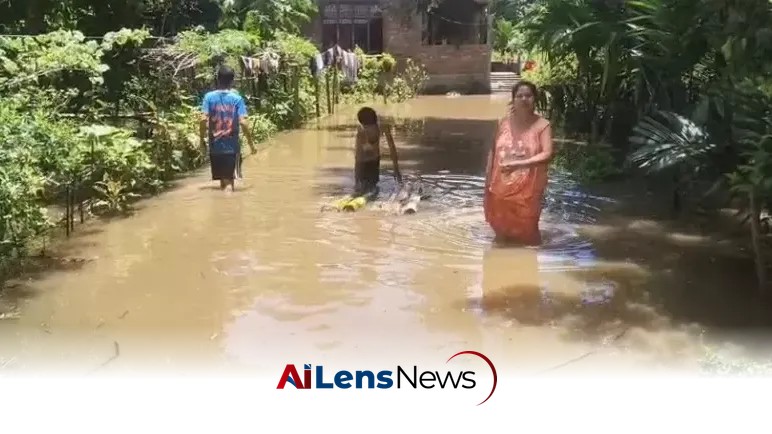


The flood situation in Assam's Jorhat district worsens with five fatalities and over 50,000 residents affected, as authorities scramble to provide relief.
New Delhi, India Jul 21, 2026 ALN: The flood situation in Assam's Jorhat district has deteriorated further on Tuesday, with the death toll rising to five and one person still missing, as tens of thousands of residents remain marooned without basic amenities amid one of the worst flood spells in recent years. The region is grappling with devastating floods that have disrupted the lives of many and caused significant damage to infrastructure and property.
Large parts of the district have been inundated following heavy inflow from the Bhogdoi River, submerging villages, agricultural land, and residential areas. The relentless rains and subsequent flooding have overwhelmed local drainage systems, leading to widespread devastation. The local government and emergency services are struggling to cope with the scale of the disaster, which is exacerbated by the region's geographical vulnerabilities.
The district witnessed another tragedy after a child reportedly died in the floods, taking Jorhat's overall death toll to five. This loss highlights the severe impact of the floods on vulnerable populations, particularly children who are often unable to escape the dangers posed by rising waters. Search operations are also underway for Pabitra Nayak, who went missing after being swept away by strong currents in the Selenghat area. Local authorities have mobilized teams to conduct search and rescue operations, but the adverse conditions have made these efforts challenging.
According to local residents, Pabitra Nayak and another man, Deba Nayak, had attempted to cross floodwaters when the incident occurred. Eyewitness accounts reveal the desperation faced by those trying to navigate the treacherous conditions. "Almost every area, including Jaji and Teok, is under water. In Selenghat, Pabitra Nayak was swept away by the strong current. Deba Nayak somehow managed to cross safely, but Pabitra went missing. Local youths searched for him, but the water level and the force of the current made rescue efforts extremely difficult," a resident said.
According to the Jorhat district administration, the floods have affected 162 villages and 50,987 people, while 4,443 hectares of agricultural land remain under water. These figures illustrate the widespread nature of the disaster and the number of individuals impacted. Agricultural losses are particularly concerning, as they threaten food security for the local population and could have long-term economic implications for farmers and the region as a whole.
As the crisis deepened, survivors narrated harrowing accounts of losing everything they owned, including household belongings, essential documents, and medicines. The psychological toll on affected individuals is significant, as many grapple with the loss of their homes and livelihoods. Among the worst affected are pregnant women, children, and elderly residents, many of whom have been forced to spend days and nights in the open with little access to relief. The conditions are dire, with limited access to food, clean water, and medical assistance, compounding the suffering of those already in distress.
One pregnant woman, now sheltering on an embankment after her house was washed away, expressed the desperation faced by many. She said she had lost all her belongings, including her medical records. "We have nothing left. Everything has been swept away by the flood. We have not received any relief and are now living in a temporary shelter on the embankment. I am four months pregnant and my medical documents, medicines, and all our belongings have been washed away. We need help," she said. This sentiment is echoed by many others who find themselves in similar situations.
Residents have reported that the lack of clean drinking water has become one of the most pressing challenges, with many surviving on whatever food they managed to save before floodwaters entered their homes. The risk of waterborne diseases is heightened in such situations, further exacerbating the public health crisis. "We have never witnessed floods of this magnitude in recent years. The water has taken away everything we owned. We don't know how we will rebuild our lives," another resident lamented. The long-term recovery from such a disaster can take years, and many fear that they may not be able to return to their previous way of life.
The worsening situation in Jorhat forms part of a wider flood emergency across upper Assam, where Sivasagar and Charaideo have also witnessed unprecedented inundation following a cloudburst in the upstream region. The meteorological conditions that led to this flooding are linked to climate change, which has resulted in increasingly erratic weather patterns and extreme rainfall events. Chief Minister Himanta Biswa Sarma stated that the three districts were experiencing water levels unseen in more than half a century.
"Sivasagar, Jorhat, and Charaideo districts are witnessing unprecedented flooding following the cloudburst upstream, with water levels unseen in over half a century. We urge all affected families to cooperate with the authorities and move to safer locations whenever advised," Sarma said in a post on a microblogging platform. His call for cooperation underscores the importance of community engagement in disaster response efforts, as local knowledge and support can significantly enhance the effectiveness of rescue operations.
He also highlighted the extensive damage caused to flood-control infrastructure, resulting in eight embankment breaches in the Jorhat region. This has raised concerns about the effectiveness of existing flood management systems, which may need to be reassessed and reinforced to withstand future flooding events. "Due to exceptionally high flood discharge and hydraulic stress following the cloudburst, eight breaches have occurred in embankments in the Jorhat region. Immediate temporary measures, including bamboo bandalling, bamboo palisading, and emergency protection works using EC bags, have been initiated," he said. These temporary measures are critical for mitigating further damage and preventing additional flooding in the affected areas.
With the humanitarian crisis intensifying and large swathes of the district still submerged, the Chief Minister is scheduled to visit Jorhat, Sivasagar, and Charaideo on Wednesday to assess the flood damage and review ongoing relief, rescue, and flood protection measures on the ground. His visit will be crucial in mobilizing additional resources and support for the affected communities, as well as in coordinating the response efforts of various agencies. The situation remains fluid, and authorities are working tirelessly to provide assistance to those in need, but the challenges are immense.
In conclusion, the floods in Jorhat are a stark reminder of the vulnerabilities faced by communities in flood-prone regions. The immediate focus must be on providing relief and support to those affected, while also considering long-term strategies for disaster preparedness and climate resilience. The lessons learned from this crisis could inform future policies and practices aimed at reducing the impact of such natural disasters on vulnerable populations.
To learn more about the latest developments in Health & Public Safety, stay updated with our exclusive reports and analyses on AiLensNews.

