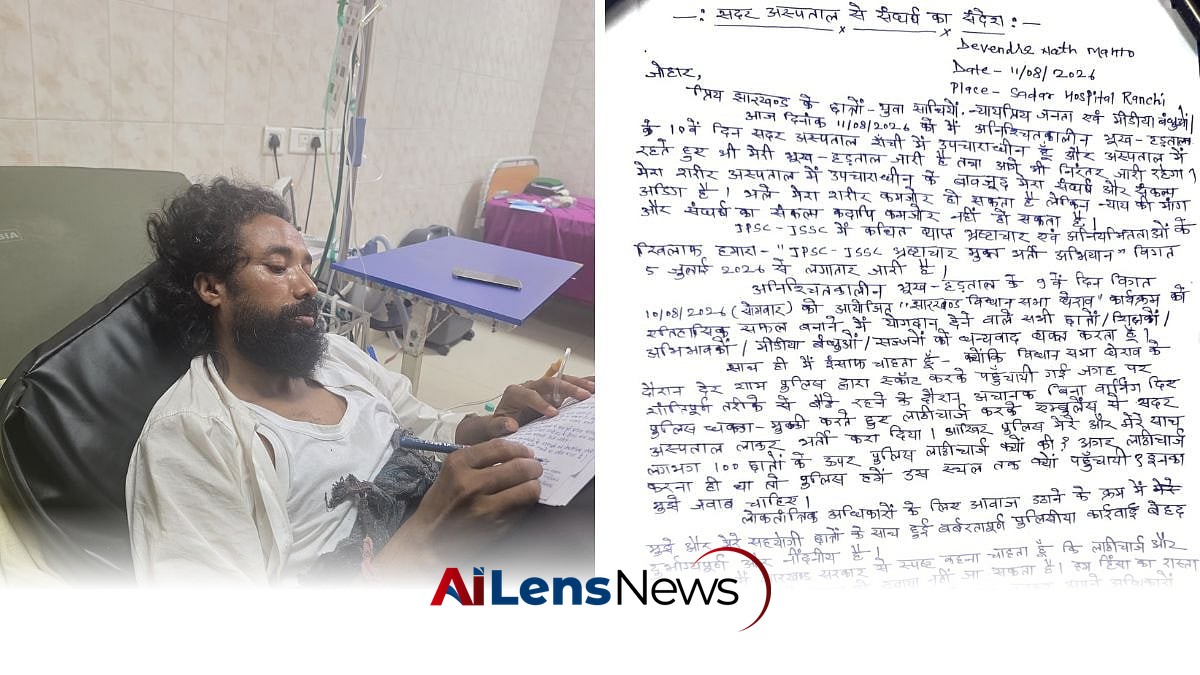


Student leader Devendra Nath Mahto continues his hunger strike for justice over alleged recruitment irregularities, demanding accountability for police actions during protests.
New Delhi, India Aug 12, 2026 ALN: Devendra Nath Mahto, a prominent student leader and social reformer, has recently entered the 10th day of his indefinite hunger strike, which he initiated to draw attention to alleged corruption and irregularities in the recruitment processes of the Jharkhand Public Service Commission (JPSC) and the Jharkhand Staff Selection Commission (JSSC). Mahto's hunger strike, which he has dubbed a "JPSC-JSSC corruption-free recruitment campaign," has garnered significant attention and support from various segments of society, including students, educators, and concerned citizens.
In an open letter shared from Sadar Hospital in Ranchi, where he is currently receiving treatment, Mahto expressed his unwavering commitment to the cause despite experiencing declining health due to the prolonged hunger strike. His letter, titled "Message of Struggle from Sadar Hospital," highlights the physical toll the strike has taken on him but reaffirms his determination to continue advocating for justice and transparency in the recruitment processes of these commissions.
The issues surrounding the JPSC and JSSC have been a source of contention in Jharkhand for some time, with allegations of irregularities and corruption casting a shadow over the integrity of the recruitment processes. These commissions are responsible for hiring candidates for various government positions, and any perceived corruption can have far-reaching implications for employment opportunities and public trust in governmental institutions. Mahto's campaign seeks to address these concerns and advocate for a more transparent and fair recruitment process.
Mahto's activism has been ongoing since July 5, when he first began mobilizing students and other stakeholders to raise awareness about the alleged corruption within these commissions. His efforts culminated in a significant protest event, the "Jharkhand Vidhan Sabha Gherao," which took place on August 10. The event was marked by a large turnout of participants who voiced their grievances and demands for accountability from the government regarding the recruitment processes.
However, the protest was marred by violent clashes between demonstrators and law enforcement. According to Mahto, police resorted to lathicharge—an aggressive crowd control tactic involving the use of batons—against peaceful protesters who had gathered to express their concerns. In his letter, he questioned the necessity of such force, especially when the demonstrators were reportedly sitting peacefully at the designated protest site. This incident has raised significant questions about the appropriateness of police responses to peaceful assemblies and the right to protest in Jharkhand.
Mahto has called for an inquiry into the police's actions during the protest, demanding accountability for the use of force against individuals exercising their democratic rights. He has emphasized that the suppression of peaceful dissent is unacceptable and that those responsible for such actions should face consequences. This call for accountability reflects broader concerns about civil liberties and the treatment of protesters in India, where tensions between law enforcement and citizens advocating for their rights have been a recurring theme.
In addition to addressing the immediate concerns of police violence, Mahto's campaign also highlights a larger issue regarding the treatment of students and young people in the political landscape of Jharkhand. He has alleged that there are systemic attempts to silence the voices of students and the public, suggesting that the government may be using intimidation tactics to quell dissent. This assertion resonates with a growing sentiment among youth in various parts of India, who have increasingly taken to the streets to demand justice, accountability, and transparency from their leaders.
In his letter, Mahto urged students and young people to remain united in their fight for justice, emphasizing the importance of collective action in effecting change. He called on the Jharkhand government to take the demands of the protesters seriously and to engage in meaningful dialogue to address the issues at hand. This appeal for unity and action underscores the potential for youth movements to influence political discourse and policy decisions in the region.
The implications of Mahto's hunger strike and the accompanying protests extend beyond the immediate concerns of the JPSC and JSSC. They reflect a broader struggle for accountability and transparency in governance, particularly in a state where public trust in institutions has been eroded by allegations of corruption. The outcome of this movement could set a precedent for how similar issues are addressed in the future, potentially influencing the conduct of public service commissions and the treatment of protesters across India.
As Mahto continues his hunger strike, he remains hopeful that his efforts will not only lead to justice for those affected by the alleged corruption in the recruitment processes but also inspire a renewed commitment to democratic principles and civil rights among the youth of Jharkhand. His call for action serves as a reminder of the power of collective voices in advocating for change and the importance of standing firm in the face of adversity.
In conclusion, Devendra Nath Mahto's hunger strike represents a critical moment in the ongoing fight for justice and accountability within the recruitment processes of the JPSC and JSSC. As he navigates the challenges of his health and the political landscape, his determination to continue the struggle serves as a rallying point for students and citizens alike, emphasizing the need for transparency and integrity in public service recruitment. The developments surrounding this movement will be closely monitored, as they hold significant implications for the future of governance and civil rights in Jharkhand and beyond.
To understand the broader context of Mahto's hunger strike, it is essential to recognize the historical backdrop of student activism in India. The country has a rich history of student-led movements that have played a crucial role in shaping political discourse. From the anti-emergency protests in the 1970s to the more recent protests against the Citizenship Amendment Act (CAA), students have often been at the forefront, demanding accountability and justice.
In Jharkhand specifically, the youth have been increasingly vocal about their concerns regarding employment opportunities and the integrity of recruitment processes. The JPSC and JSSC are pivotal in providing job opportunities in a state where unemployment remains a pressing issue. Allegations of corruption within these bodies not only affect individual candidates but also undermine the entire system of governance, leading to widespread disillusionment among the populace.
Moreover, the role of social media cannot be understated in this movement. Platforms like Twitter, Facebook, and Instagram have been instrumental in amplifying Mahto's message and mobilizing support. The ability to share information quickly and efficiently has allowed activists to reach a broader audience, fostering a sense of solidarity among students and citizens who share similar grievances.
As the hunger strike continues, it serves as a litmus test for the current government’s response to civil unrest and the demands of its youth. The manner in which authorities handle this situation could either quell or ignite further protests, depending on public perception and the government's willingness to engage with the concerns raised. In this light, Mahto's hunger strike is not just a personal sacrifice but a significant act of political expression that could influence the future of governance in Jharkhand.
Furthermore, the implications of this movement extend to the national stage. With increasing scrutiny on the government's handling of dissent and civil liberties, Mahto's hunger strike could contribute to a larger conversation about the rights of citizens to protest and demand accountability. As similar movements gain momentum across the country, the outcomes of Mahto's actions may resonate beyond Jharkhand, inspiring other regions to address their own issues of governance and corruption.
In summary, Devendra Nath Mahto's hunger strike represents not only a call for justice regarding the JPSC and JSSC but also a broader demand for accountability, transparency, and the protection of civil rights. As the situation unfolds, the eyes of the nation will be on Jharkhand, watching how this pivotal moment in student activism will shape the future of governance and the relationship between citizens and the state.
To learn more about the latest developments in Crime & Law, stay updated with our exclusive reports and analyses on AiLensNews.

