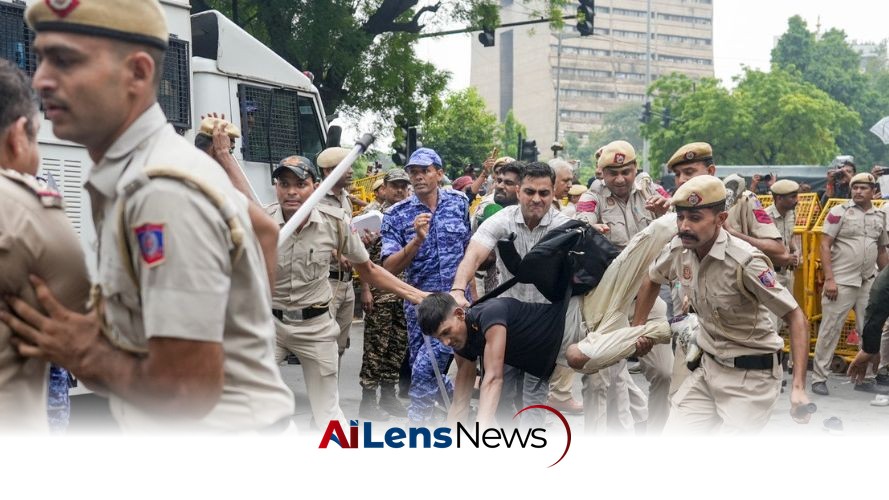


The Delhi High Court declined to hear a petition alleging police brutality against students during a protest march, directing it to be listed for Wednesday.
New Delhi, India Jul 21, 2026 ALN: A day after fierce protests and clashes during the Cockroach Janta Party's (CJP) "Sansad Chalo" march, the Delhi High Court, on Tuesday, declined to urgently hear a petition alleging excessive use of force by Delhi Police against students. The march, which drew thousands of participants, was organized to voice concerns over alleged irregularities in competitive examinations and to demand significant reforms in the examination system.
A division bench comprising Chief Justice D K Upadhyaya and Justice Tejas Karia refused a request for an immediate hearing after the matter was mentioned before the court, directing that the petition be listed on Wednesday. The court's decision to not expedite the hearing reflects a cautious approach towards legal proceedings that stem from politically charged events. "Don't drag the court into all this," the bench remarked, while declining the plea for urgent listing, indicating a reluctance to intervene in what may be seen as a political issue.
The petition in question alleges that the Delhi Police employed excessive force against students participating in the march to Parliament. This claim comes amid a backdrop of increasing tensions surrounding the education sector in India, particularly concerning the integrity of competitive examinations which are a critical pathway for students seeking higher education and government jobs. The CJP has been vocal about the need for transparency and accountability in these processes, which they argue have been marred by corruption and mismanagement.
The court proceedings occurred amidst heightened political and administrative activity following the violent clashes. Union Health Minister J P Nadda visited Ram Manohar Lohia (RML) Hospital and Lady Hardinge Hospital to assess the condition of those injured during the demonstration. This visit underscores the government's concern for public safety and the need to address the fallout from the protests. According to sources, Nadda reviewed the treatment and medical facilities being provided to the injured protesters, emphasizing the government's responsibility to ensure the health and well-being of all citizens, even those involved in protests against the state.
Hospital authorities informed the minister that all those admitted were under medical supervision and receiving necessary care. The minister's involvement highlights the importance of government officials engaging with civil society, especially in times of unrest. His visit followed a meeting on Monday with two representatives of the CJP, during which he reportedly assured them that the government would "internally discuss" the organisation's demands and there would be "no further crackdown" on protests, a statement that may be aimed at de-escalating tensions.
In the aftermath of the protests, Delhi Police have reportedly registered four FIRs against alleged troublemakers, with two more being prepared in connection with incidents of violence, vandalism, and other offences linked to the march. This legal action indicates the police's intent to maintain order and accountability, but it also raises questions about the balance between law enforcement and the rights of citizens to peacefully assemble and protest.
The cases have been registered at Parliament Street, Connaught Place, and other police stations under various provisions of the Bharatiya Nyaya Sanhita (BNS), the Arms Act, and the Prevention of Damage to Public Property Act. These legal frameworks are designed to address public order offenses, but their application can often be contentious, especially in politically sensitive situations like protests. According to Delhi Police, around 60 protesters sustained injuries during the clashes, while more than 118 police personnel, including several senior officers, were injured while attempting to control the situation. This statistic highlights the chaotic nature of the protests and the challenges faced by law enforcement in managing large crowds.
Police reported that around 70 protesters were detained after clashes broke out when demonstrators attempted to proceed towards Parliament despite restrictions in place. The CJP, however, has accused Delhi Police of using excessive force to disperse the protesters, alleging that the police's response was disproportionate to the actions of the demonstrators. This claim of excessive force is a serious allegation that can have broader implications for police conduct and accountability in India.
The organisation also claimed that activist Sonam Wangchuk's wife, Gitanjali J Angmo, was manhandled by police personnel during the protests. Delhi Police rejected the allegation, describing reports that Angmo was assaulted during the protest as "completely false and misleading." This exchange of accusations highlights the contentious relationship between law enforcement and protest movements, often marked by distrust and differing narratives about events on the ground.
The developments came a day after thousands of students, youth activists, and supporters joined the CJP's "Sansad Chalo" march in the national capital, demanding the resignation of Union Education Minister Dharmendra Pradhan and seeking accountability over alleged examination paper leaks and reforms in the country's examination system. The scale of the protest reflects a growing discontent among students and the youth regarding the current state of education and employment opportunities in India. As competitive examinations are seen as gateways to stable careers, any perceived irregularities can lead to widespread frustration and mobilization among affected groups.
The protests also occur against the backdrop of a larger national conversation about the state of education in India, particularly in light of recent controversies surrounding examination leaks and the effectiveness of the current educational policies. Many students feel that the system is rigged, favoring certain groups over others, which has led to calls for greater transparency and fairness in how examinations are conducted and assessed.
As the situation develops, it remains to be seen how the government will respond to the demands of the protesters and whether further actions will be taken by law enforcement to manage ongoing dissent. The outcome of the petition in the Delhi High Court could also set a precedent for how similar cases are handled in the future, especially in terms of balancing the right to protest with the need for public order.
To learn more about the latest developments in Crime & Law, stay updated with our exclusive reports and analyses on AiLensNews.

