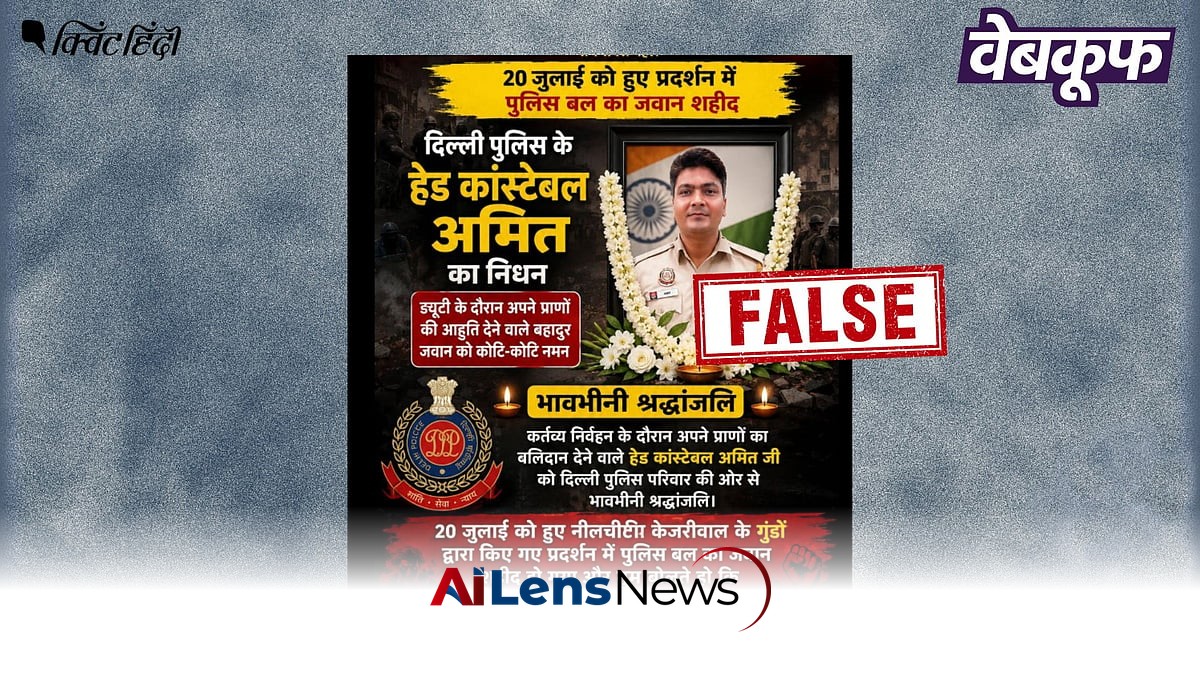


The death of Head Constable Amit was due to a road accident, not during the protests at Jantar Mantar.
New Delhi, India Jul 30, 2026 ALN: On July 20, 2026, a significant protest, termed the "Parliament Chalo" march, was organized by the Cockroach People's Party (CJP), aiming to draw attention to various social and political issues. The event took place in the capital city of Delhi, specifically at Jantar Mantar, a site historically known for public demonstrations and protests. This location has been a focal point for various civil movements and has often witnessed clashes between demonstrators and law enforcement agencies. The choice of Jantar Mantar as the venue for the protest was emblematic of its long-standing tradition as a space for citizens to voice dissent and demand accountability from the government.
During this particular march, tensions escalated between the protesters and security forces, leading to clashes that resulted in injuries on both sides. Reports indicated that several students participating in the protest were injured due to police baton charges, which have become a common response by law enforcement during large-scale protests in India. The use of force by police during such events often raises questions about the balance between maintaining order and respecting the rights of citizens to peacefully assemble and express their views. This incident was not an isolated one; protests in India have frequently encountered similar responses from authorities, leading to a cycle of unrest and confrontation.
Amidst the chaos of the protests, a claim began circulating on social media platforms asserting that Head Constable Amit of the Delhi Police had been killed during the Jantar Mantar protests. This claim rapidly gained traction, with various posts and messages suggesting that the head constable's death was a direct consequence of the clashes between the protesters and police. Social media has become a powerful tool for disseminating information, but it can also be a breeding ground for misinformation, particularly during high-stakes events like protests.
Claim: The assertion that Head Constable Amit was killed during the protests at Jantar Mantar is false.
Investigations into the claim revealed that Head Constable Amit had actually died in a road accident, which occurred prior to the protests. This information was corroborated by multiple sources, including official statements from the Delhi Police. The verification of facts is crucial in an era where rumors can spread rapidly, often leading to public panic or misplaced anger. The swift debunking of this claim is a testament to the importance of responsible journalism and fact-checking in maintaining the integrity of public discourse.
To ascertain the truth behind the viral claim, a detailed fact-checking process was undertaken. Utilizing Google Lens, an image search was conducted on the viral social media post. This search led to an official tribute post on the Delhi Police's Instagram account dated July 16, 2026. In this post, the Delhi Police expressed their condolences, stating, "Delhi Police Head Constable Amit tragically passed away in a road accident while on duty. A speeding vehicle struck him at the Singhu border under #dcp_outernorth." This official acknowledgment was further supported by a similar post on the Delhi Police's Facebook account, which reiterated that Amit's cause of death was indeed a road accident, not linked to the protests at Jantar Mantar.
In addition to the social media posts, a search for related news articles led to a report from The Hindu, which detailed the circumstances surrounding Head Constable Amit's death. The report confirmed that he was managing traffic at the Singhu border when he was struck by a speeding vehicle around 6 PM. The severity of his injuries necessitated immediate medical attention, and he was transported to Satyawadi Raja Harishchandra Hospital in Narela, where he was pronounced dead by medical personnel. This tragic incident highlights the dangers faced by police officers while on duty, particularly those involved in traffic management during high-stress situations such as protests. The Singhu border, a site of significant traffic and often a point of contention during protests, has seen its fair share of incidents involving law enforcement and citizens alike.
Conclusion: The misleading connection between the death of Head Constable Amit and the protests at Jantar Mantar has been debunked. His tragic passing was a result of a road accident, emphasizing the need for accurate reporting and the responsible sharing of information in the age of social media. The spread of misinformation during sensitive times can lead to increased tensions and confusion among the public. This incident serves as a critical reminder of the responsibility that comes with the power of social media to shape narratives and influence public opinion.
As the situation continues to evolve, it is crucial for individuals to critically evaluate the information they encounter online, especially during events marked by unrest and public demonstrations. Fact-checking initiatives play an essential role in combating misinformation, ensuring that the public remains informed with accurate and verified information. The role of fact-checkers and media literacy programs is becoming increasingly important as misinformation can easily distort public perception and impact societal stability.
In light of this incident, it is advisable for citizens to remain vigilant and report any information they suspect may be false or misleading. Verification services can help clarify the facts and prevent the spread of rumors that could exacerbate already volatile situations. The responsibility of the public extends beyond mere consumption of information; it includes active participation in the verification process to foster a more informed society.
The implications of such misinformation extend beyond the immediate context of the protests. They can influence public perception of law enforcement, the legitimacy of protest movements, and the overall political landscape. As society grapples with the complexities of free speech, civil rights, and public safety, the responsibility of both the media and the public to seek the truth becomes ever more critical. The dynamics of information dissemination in the digital age necessitate a collective effort to uphold the principles of transparency and accountability.
In conclusion, while protests like the "Parliament Chalo" march are essential for democratic expression, it is equally important to ensure that narratives surrounding such events are based on factual evidence. The tragic death of Head Constable Amit serves as a reminder of the risks faced by those in law enforcement and the importance of accurate reporting in maintaining public trust and understanding. It is imperative that as a society, we work towards fostering a culture of truth and integrity in communication, especially during times of crisis and unrest.
To learn more about the latest developments in Crime & Law, stay updated with our exclusive reports and analyses on AiLensNews.

