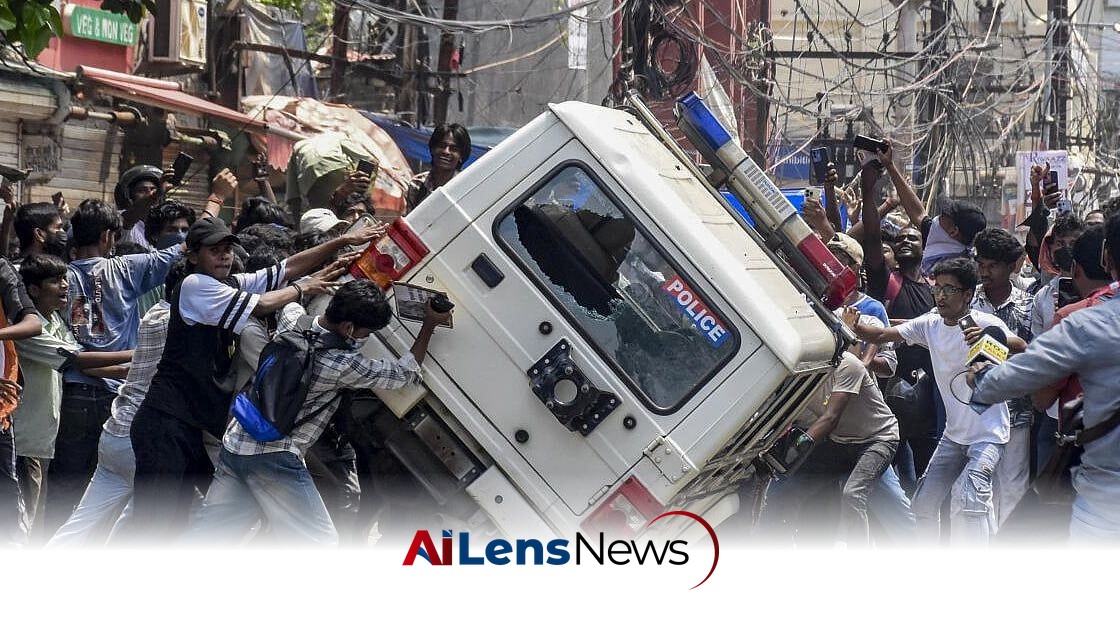


Protests across Bihar against the NEET paper leak escalate into violence, with allegations of police firing and multiple injuries reported.
Patna, India Jul 25, 2026 ALN: Patna: Left-wing student organisations held demonstrations across Bihar, some of which turned violent, on Saturday in support of a statewide bandh against NEET question paper leak and police action on protesting students. The National Eligibility cum Entrance Test (NEET) is a highly competitive exam that determines admission to medical colleges in India, and any irregularities or perceived injustices surrounding it can lead to significant unrest among students and their supporters.
The protests were largely triggered by allegations of a leak of the NEET question paper, which has raised serious concerns regarding the integrity of the examination process. The NEET exam is crucial for aspiring medical students, and any suggestion of malpractice can lead to widespread discontent among students who invest significant time and resources in their preparation. In this context, the protests reflect a broader frustration with systemic issues in the education sector, particularly regarding transparency and fairness.
According to police, the bandh turned violent in Patna, Saran, Siwan, Aurangabad, and Bhagalpur, while protests in Samastipur, Nawada, and Nalanda were largely peaceful. Security has been tightened with heavy police deployment in all districts of the state. Such a response is typical in situations where protests escalate, as authorities aim to prevent further violence and maintain public order.
Leader of Opposition in Bihar Assembly, Tejashwi Yadav, alleged that police fired at protesters in Siwan district, and he criticized Chief Minister Samrat Choudhary for the incident. This accusation, if true, raises serious questions about police conduct and the use of force during public demonstrations. The relationship between the government and student bodies has often been fraught, and incidents like this can exacerbate tensions.
He posted a video of the purported incident on X and, along with it, stated, "During the protest in Siwan, police resorted to direct firing with an AK-47 on students. When a criminal... becomes chief minister, then police fire bullets at innocent students." Such allegations can lead to public outcry and demand for accountability from law enforcement agencies. However, officials did not confirm any firing against the protesters, and PTI could not ascertain the veracity of the video. This discrepancy highlights the challenges in obtaining accurate accounts during chaotic situations.
The protest was held at JP Chowk in the district, a location that has been a focal point for various demonstrations in the past. Former MLA and CPI(ML) leader Amarjeet Kushwaha, who was present during the protest, stated, "The protesting students faced brutal police action; even women were not spared." This claim underscores the potential for gendered violence in protests, as female protesters may face additional risks in such confrontations.
Amid reports of clashes, Superintendent of Police Puran Chandra Jha stated, "We have videographed the incident and will take strict action against the miscreants. There were three groups of protestors, of which only one had taken permission for the stir. They clashed near Gandhi Maidan, and police had to fire tear gas shells and use mild force." This suggests that not all groups involved in the protests were acting in accordance with legal guidelines, which complicates the situation further.
Protesters also clashed with police in the state capital's Dak Bungalow Chouraha and pelted stones at the personnel of the force, following which several students were detained. The use of stone-pelting as a tactic during protests is not uncommon in India, and it often leads to an escalation of violence. "They pelted us with stones. They even tried to break the barricade. We have detained several students. Police are on high alert. We will trace the troublemakers and take appropriate action against them," Patna's Senior Superintendent of Police (SSP) Kartikeya K Sharma told reporters. This proactive stance by law enforcement indicates a commitment to maintaining order but also raises concerns about the potential for overreach and excessive force.
Amid claims that crude bombs were also hurled at the police during the protest, the police officer mentioned that the claims were being verified. Additionally, leaves of all police personnel have been cancelled to maintain law and order, another officer said. The mention of potential bomb threats adds a serious dimension to the protests, as it indicates that some participants may be willing to escalate violence to make their point.
Janshakti Janta Dal chief Tej Pratap Yadav visited Ram Gulam Chowk in Patna to extend support to the protesting students and was later detained by the police. The involvement of political leaders in student protests can often amplify the situation, as it brings additional attention and scrutiny to the issues at hand.
The bandh to protest against examination irregularities turned violent in Saran district's Chhapra, where students threw stones at police personnel, set an official car ablaze, and vandalized several other vehicles. Such acts of vandalism can detract from the original message of the protests and lead to public backlash against the student movements.
Violence during the protest was also reported in Aurangabad district, where two police officers and a journalist were injured by protestors. Police stated that more than a dozen protesters who were allegedly involved in stone-pelting have been detained. The injury of journalists in such scenarios raises concerns about press freedom and the safety of media personnel covering protests.
In Bhagalpur, a protest march started peacefully from Station Chowk but turned violent, with police being targeted by protesters who also blocked roads near the Tilkamanjhi crossing. Police had to resort to baton-charging to disperse the crowd. The escalation from peaceful protests to violence is a common trajectory in civil unrest, often fueled by a combination of frustration, perceived injustice, and heavy-handed police responses.
Bhagalpur District Magistrate Alankrita Pandey stated that the situation was under control and several protesters have been detained. "Students pelted stones and vandalized two police vehicles. No persons were injured. We have identified several people through CCTV footage, and some of them have been detained. Strict action will be taken against the miscreants," said Bhagalpur SSP Pramod Kumar Yadav. The use of technology, such as CCTV, to identify suspects in protests is a growing trend, raising ethical questions about surveillance and privacy.
A similar situation was witnessed in Purnia, where a peaceful protest march turned violent, with protesters breaking barricades and pelting stones at police officials. Window shields of some private vehicles were also shattered by the agitators. This indicates a pattern of unrest that may be spreading across multiple districts, reflecting a widespread sentiment among students and their supporters.
In Sitamarhi district, protesters marching towards the collectorate pelted stones at police officers, injuring several personnel, including Superintendent of Police Amit Ranjan. Three vehicles, including one carrying a BJP flag, were set on fire, police said. The targeting of political symbols during protests can indicate a deeper dissatisfaction with the current government and its policies.
According to a senior officer, the injured were shifted to a hospital, and additional forces were rushed to the protest site to maintain law and order. The deployment of additional forces is typical in situations where unrest is anticipated, but it can also lead to further tensions if not managed carefully.
Protesters carrying banners of All India Students Association (AISA) and Revolutionary Youth Association (RYA) also blocked the Samastipur-Patna main road by burning tyres and raised slogans against the government. The use of roadblocks is a common tactic in protests, as it draws attention to the cause but can also disrupt daily life for ordinary citizens.
In Madhepura district, over a dozen students, including NSUI's state vice president Nishant Yadav, were detained as they assembled at the TP College Chowk to hold a protest. The detention of student leaders can have a chilling effect on future protests, as it may deter others from participating for fear of repercussions.
Nawada and Jehanabad witnessed largely peaceful protests amid heavy police deployment. "We are committed to maintaining law and order and ensuring the safety of the people. I appeal to the people to cooperate with us and not believe in any misinformation and rumours," Jehanabad SP Kota Kiran Kumar said. This statement reflects a common theme among law enforcement during protests, emphasizing the need for public cooperation while also addressing potential misinformation that can exacerbate tensions.
Student leaders carried out a protest march in Nalanda district's Bihar Sharif amid heavy police deployment. RYA's Nalanda district president Viresh Kumar alleged that 100 paper leak incidents had occurred under the tenure of Union Education Minister Dharmendra Pradhan. This assertion highlights the ongoing frustrations regarding the management of educational assessments and the accountability of government officials.
Referring to police action against protesters in New Delhi and Bihar, RYA's Nalanda district president Viresh Kumar claimed the administration was being authoritarian. Such sentiments are not uncommon in student movements, where perceived government overreach can galvanize support for protests.
The protest was violent in Lakhisarai district too, leading to police resorting to baton-charge. Ara railway station in Bihar's Bhojpur district witnessed a ruckus as protesters squatted before a passenger train. Police later managed to remove them from the tracks and ensured the train's onward journey safely. This incident underscores the disruptive potential of protests, as they can impact transportation and daily life for many citizens.
Overall, the protests in Bihar reflect a complex interplay of student dissatisfaction, allegations of corruption and malpractice in the education sector, and the response of law enforcement. The implications of these protests could be far-reaching, potentially influencing policy discussions around education reform and the relationship between students and the government. As these events unfold, the situation will require careful monitoring to ensure that the rights of protesters are respected while also maintaining public order.
To learn more about the latest developments in Crime & Law, stay updated with our exclusive reports and analyses on AiLensNews.

