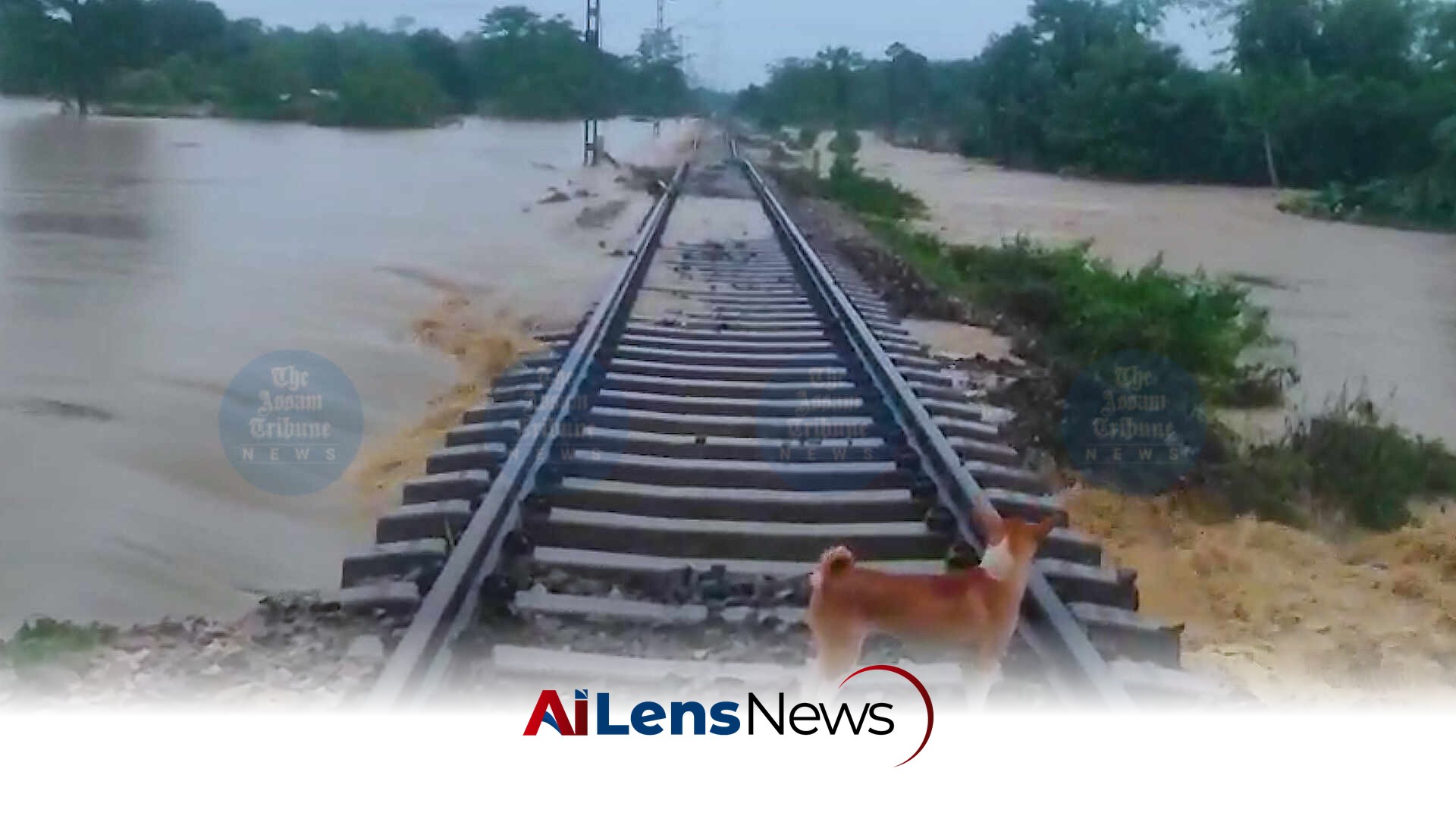


Heavy rains have disrupted railway services in Assam, prompting urgent restoration efforts by the Northeast Frontier Railway. Nighttime train operations have been suspended for safety.
Dispur, India Jul 26, 2026 ALN: Heavy rain-triggered floods and landslides have disrupted railway services in parts of Assam, prompting the Northeast Frontier Railway (NFR) to intensify restoration work across affected sections at the earliest. The ongoing monsoon season in Assam, which typically spans from June to September, has brought significant rainfall, leading to widespread flooding and landslides that have severely impacted infrastructure, including the crucial railway networks.
NFR Chief Public Relations Officer Kapinjal Kishore Sharma stated that restoration work is being carried out on a war footing in flood-hit stretches under the Tinsukia Division, where railway formations have sustained extensive damage. The Tinsukia Division is one of the key railway divisions in Assam, facilitating the movement of goods and passengers across the region. The floods have not only disrupted train services but have also posed a risk to the safety of railway operations, necessitating immediate action.
Between Simalguri and Lakwa, railway teams are engaged in cess protection and formation strengthening works. Cess protection refers to the measures taken to prevent erosion and ensure the stability of the railway embankment. A ballast rake has been positioned at the site, while boulders are being unloaded from wagons to reinforce the damaged railway embankment. This is crucial in preventing further damage during subsequent rainfall, as the integrity of the embankment is vital for safe train operations.
Restoration of the railway formation is also underway in the Simalguri–Namtiali section, where stone dust and boulders are being continuously unloaded to facilitate the early reopening of the route. The use of stone dust helps in stabilizing the track bed and providing a solid foundation for the railway tracks. In the Amguri–Selenghat section, protection and strengthening works are in progress using sandbags, bamboo piling, and rail piling to stabilize vulnerable stretches. These methods are traditional yet effective in addressing immediate threats posed by flooding and landslides.
Similar bamboo piling and cess protection works are being undertaken between Simalguri and Sibsagar Town, with ballast being mobilized to reinforce the track formation and expedite restoration. The deployment of more than 700 laborers, assisted by heavy machinery, including Poclains and JCBs, across all affected locations highlights the scale of the restoration efforts. The use of heavy machinery is essential in expediting the restoration process, allowing for quicker removal of debris and reinforcement of damaged areas.
Sharma noted that ballast, boulders, sandbags, stone dust, and rails are being transported continuously to strengthen damaged railway formations and speed up restoration. The continuous supply of these materials is critical to ensure that restoration work does not face delays, particularly given the unpredictable nature of the monsoon rains. Senior officers of the Tinsukia Division are closely monitoring the restoration works to ensure effective coordination, timely deployment of resources, and adherence to safety standards.
Meanwhile, train services on the strategically important Lumding–Badarpur Hill Section under the Lumding Division have also been affected after railway tracks on Line 1 and Line 2 near New Harangajao station settled due to heavy rainfall. The Lumding–Badarpur Hill Section is known for its challenging topography, which makes it particularly susceptible to landslides and erosion during the monsoon. At present, all train movements are being operated through Line 3 under enhanced safety monitoring. In the interest of passenger safety, services through the affected stretch have been suspended during night hours from 7 p.m. to 5 a.m., while daytime operations are being allowed under regulated conditions with continuous monitoring.
The restrictions have resulted in the rescheduling, cancellation, and regulation of several trains on the Lumding–Badarpur Hill Section. Railway personnel, engineering teams, and heavy machinery have been deployed to restore the affected tracks, with NFR expressing confidence that normal train operations will resume once the restoration work is completed safely. The disruption of services not only affects daily commuters but also has wider implications for the transportation of goods, which can impact local economies.
Railway officials indicated that the Lumding–Badarpur hill section in Assam's Dima Hasao district remains particularly vulnerable during the June-to-September monsoon period, when landslides, waterlogging, and soil erosion frequently damage railway infrastructure. This vulnerability is exacerbated by the region's geographical features, including steep hills and heavy rainfall, which create a challenging environment for maintaining rail services. Such disruptions often affect rail connectivity across the Northeast, particularly Tripura, Mizoram, Manipur, and parts of southern Assam, hampering passenger movement as well as the transportation of essential commodities.
The restoration effort comes amid a grim flood situation in Assam. As of Saturday, floods had affected 10 districts and around 810 villages, while nearly 1.15 lakh people were sheltering in relief camps. The flood-related death toll has crossed 62, with Sivasagar, Charaideo, and Jorhat among the worst-affected districts. The Dikhou, Disang, and Dhansiri rivers continue to flow above the danger level, further aggravating the situation. The rising water levels pose a significant risk not only to human life but also to infrastructure, agricultural lands, and local economies.
The government and local authorities are working to provide relief to affected populations, but the scale of the disaster presents significant challenges. Floods in Assam are not uncommon; however, the frequency and intensity of these events have raised concerns about climate change and its impact on the region. As the restoration of railway services continues, it is essential for local authorities and the NFR to develop long-term strategies to mitigate the effects of future floods and ensure the resilience of railway infrastructure.
In conclusion, the ongoing efforts by the Northeast Frontier Railway to restore rail links in Upper Assam highlight the critical importance of maintaining transportation infrastructure in the face of natural disasters. The implications of these disruptions extend beyond the immediate impact on rail services, affecting the livelihoods of many and the overall economic stability of the region. As restoration work progresses, the focus will also need to shift towards enhancing the resilience of the railway network to withstand future climatic challenges, ensuring that communities can remain connected and that essential goods can continue to be transported across the region.
To learn more about the latest developments in Transport & Mobility, stay updated with our exclusive reports and analyses on AiLensNews.

