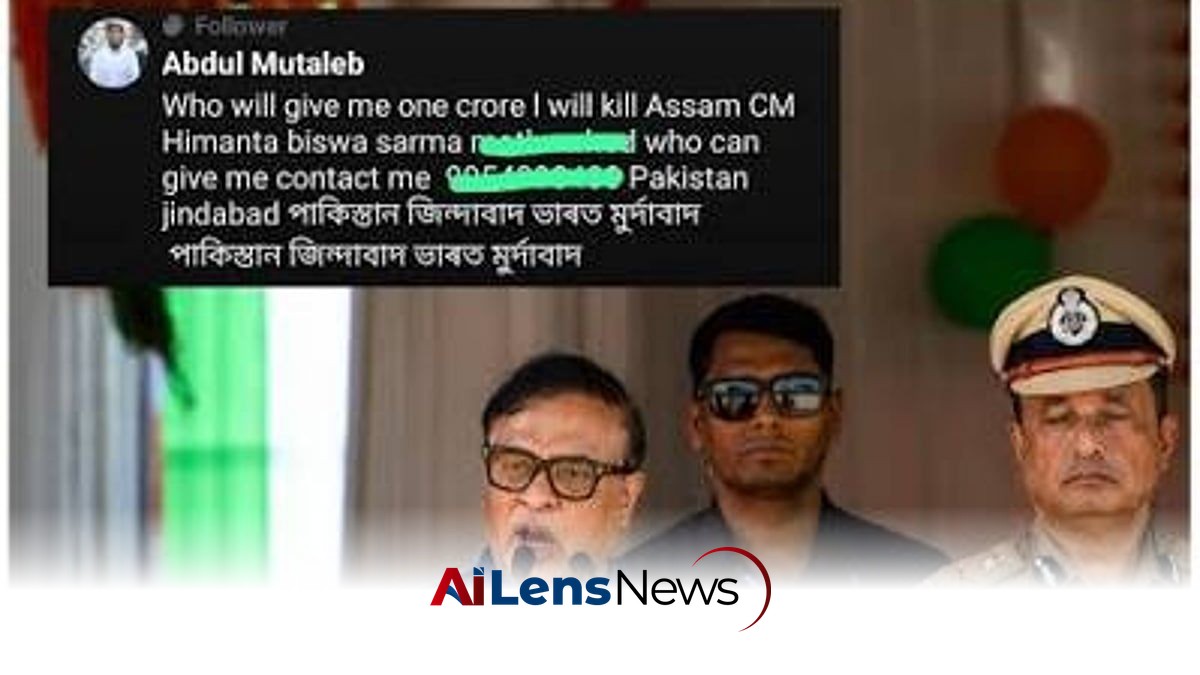


Assam Chief Minister Himanta Biswa Sarma received a death threat during his live-streamed Independence Day address, prompting security investigations.
Dispur, India Aug 15, 2026 ALN: Guwahati: Today, the Chief Minister Himanta Biswa Sarma has allegedly received a death threat during his Independence Day address streamed live on Facebook. A Facebook user identified as Abdul Mutaleb reportedly posted a threatening comment while the Chief Minister’s address was being broadcast. In the comment, the user allegedly claimed that he would kill Sarma in exchange for Rs 1 crore and called on anyone willing to provide the money to contact him.
The comment also reportedly contained pro-Pakistan slogans and remarks critical of India, including references to “Pakistan Zindabad.” This incident has sparked significant concern among security agencies, as it not only threatens the safety of a high-ranking official but also raises questions regarding the security protocols in place during such public events.
The context of this threat is crucial to understanding its implications. Independence Day in India is a significant national holiday, commemorating the country’s freedom from British colonial rule in 1947. It is marked by flag-hoisting ceremonies, parades, and speeches by prominent leaders. The occasion is attended by thousands of citizens, making it a high-profile event where the security of leaders is paramount. Given the historical backdrop of various threats faced by political leaders in India, this incident highlights ongoing concerns regarding the safety of public officials.
In recent years, there have been numerous incidents of threats and violence against politicians across the country, which has led to a heightened focus on security measures. The rise of social media has also complicated the landscape, as platforms like Facebook and Twitter can be used to disseminate threats rapidly and anonymously. As a result, law enforcement agencies are increasingly tasked with monitoring online activity for potential threats against public figures.
After the alleged threat, security agencies have reportedly begun efforts to identify and locate the person behind the account. Police sources stated that the cyber cell team and local police are examining the authenticity of the profile to determine whether it belongs to a genuine individual or is a bot account allegedly operated from outside India. This investigation is crucial, as it could reveal whether the threat is a serious concern or simply the work of an internet troll attempting to provoke a reaction.
The Assam police have a history of dealing with security threats, especially in a region where ethnic tensions and insurgency issues have been prevalent. The state has seen various forms of unrest, and the government has often had to navigate complex social dynamics. The Chief Minister, in particular, has been a vocal figure in addressing issues related to illegal immigration and ethnic identity in Assam, which has made him a polarizing figure among different groups.
Furthermore, the use of social media for making threats is not unique to this incident. It reflects a broader trend where individuals feel emboldened to express violent sentiments behind the anonymity of the internet. The rise of such behavior has prompted discussions about the need for stricter regulations on social media platforms and the responsibilities they hold in monitoring and managing harmful content.
This incident also raises questions about the adequacy of security measures during public addresses. In light of this threat, it is likely that the Assam government will reassess its security protocols for public events, especially those attended by high-profile officials. Increased security presence, thorough background checks on attendees, and enhanced monitoring of social media platforms may become standard practices in the wake of this incident.
Moreover, the implications of this threat extend beyond immediate security concerns. It also underscores the growing polarization in Indian society, where political discourse can quickly devolve into violent rhetoric. The ability of individuals to mobilize support for extremist views through social media can lead to real-world consequences, as seen in this case. The government’s response to such threats will be closely watched, as it will be indicative of its approach to handling dissent and ensuring public safety.
As the investigation unfolds, it is essential for the authorities to address not only the immediate threat posed by this individual but also the underlying issues that contribute to a culture of violence and intimidation in political discourse. Engaging with communities, promoting dialogue, and fostering an environment where dissent can be expressed peacefully will be crucial in mitigating such threats in the future.
In conclusion, the death threat against Chief Minister Himanta Biswa Sarma during a significant national event raises critical issues surrounding political safety, the role of social media in facilitating threats, and the broader implications for civil discourse in India. As authorities work to identify the individual behind the threat, it is a reminder of the challenges faced by public officials in a complex and often contentious political landscape.
Furthermore, the threat comes at a time when India is grappling with a multitude of challenges, including rising political polarization, social unrest, and the impact of misinformation spread through digital platforms. The government’s ability to respond effectively to such threats will not only determine the safety of its leaders but also set a precedent for how similar incidents are handled in the future.
In light of the current political climate, it is imperative for the government to engage in a comprehensive review of security protocols to ensure that public officials can perform their duties without fear of violence or intimidation. This may involve collaboration with cybersecurity experts to better monitor and respond to threats made online, as well as fostering a culture of accountability among social media users.
The incident also highlights the importance of public discourse in a democracy. It raises the question of how political differences can be expressed without resorting to threats or violence. The government, civil society, and community leaders must work together to promote a culture of respect and constructive dialogue, which is essential for a healthy democratic process.
As the nation reflects on its journey toward independence and the values of freedom and democracy, incidents like this serve as a stark reminder of the ongoing challenges that must be addressed to ensure that all citizens can engage in political discourse safely and peacefully.
- Assam Legislative Assembly Celebrates 80th Independence Day Of India
To learn more about the latest developments in Crime & Law, stay updated with our exclusive reports and analyses on AiLensNews.

