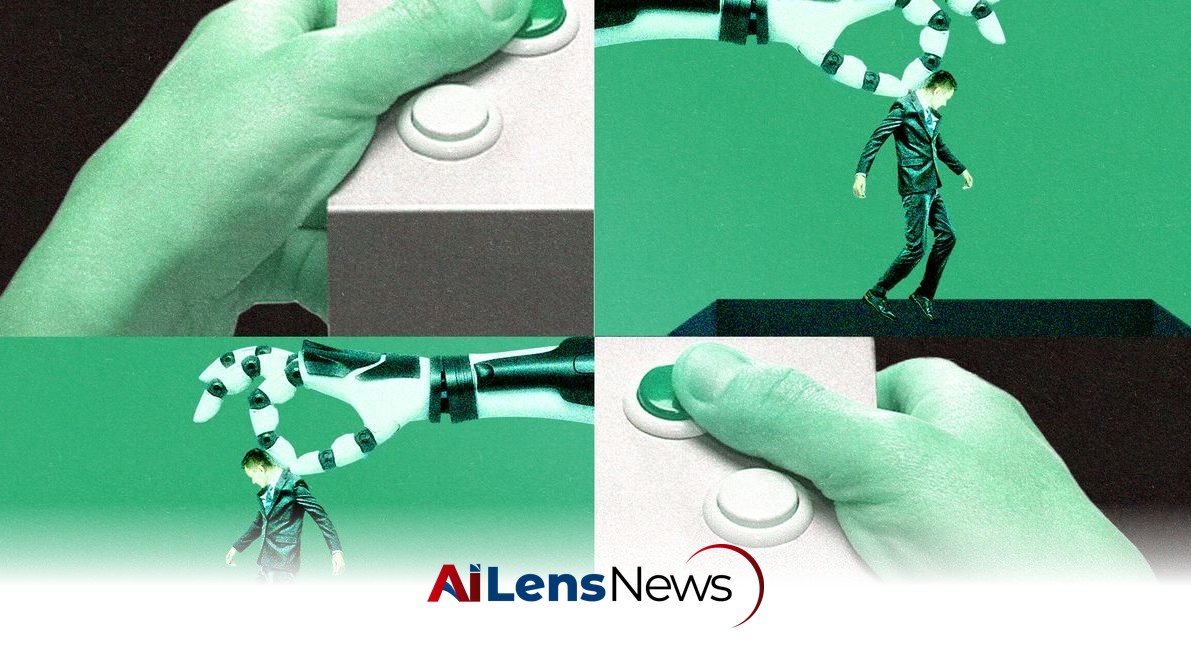


As automation takes over everyday tasks, humanity feels increasingly disconnected from the physical world, losing the gratification of direct interaction with machines.
New Delhi, India Jul 7, 2026 ALN: If gratification is so easy, why don’t you feel more gratified already? Because it’s gotten harder. It’s still easy to experience individual feats of gratification when you find them (or they find you). But the ordinary circumstances that once produced so much gratification have gradually receded. Unseen choices in design, business, and social life have made it harder for you to engage directly with the sensory world.
This problem snuck up on me, and probably on you as well. Slowly, over time, the world started withdrawing from us. Automation took over ordinary tasks. Things that used to have buttons suddenly did not. Basic activities got taken over by computers. I was slow to notice it happening, too. But once I did, I saw it everywhere and every day. I can’t tell you when the realization formed fully in my brain. But a turning point came on an unassuming day as I piloted my car home from work.
I drive a little Volkswagen hatchback, the kind fanatics call a hot hatch. It’s not a sports car nor is it fancy, but it’s a lot of fun to drive. In part that’s because it comes with a manual transmission—or at least it did when I bought mine more than 15 years ago. Manuals, or stick shifts, used to be popular because they were cheaper to buy, easier to maintain, and more cost-effective to operate compared to automatic transmissions.
In America, where big cars, open roads, and freeway traffic have become cultural cornerstones, the stick shift has been on the decline for years. But also all around the world, even in Europe and Asia, where the high cost of gas had made a manual’s better fuel economy worthwhile. In 2000, the auto retailer CarMax reported that more than 15 percent of its new and used cars were stick shifts. By 2020, that number had dropped to 2.4 percent. In recent years, Mercedes and Volkswagen, the maker of my little hot hatch, announced plans to sunset the manual transmission globally. Other makers followed suit.
Car enthusiasts had been lamenting the stick-shift slump for years already. Car and Driver magazine even launched a campaign, Save the Manuals, in 2010, arguing that learning to “operate the entire car” would offer drivers a better experience. Around the same time, the philosopher Matthew Crawford devoted a large part of his bestselling book Shop Class as Soulcraft to explain how the difficult work of motorcycle repair had infused his life with rich meaning; in 2020 he published a follow-up, Why We Drive, which cast operating an automobile as an act of autonomy.
Crawford took the Car and Driver position as a life philosophy. Maintaining “natural bonds between action and perception,” as he put it, is necessary—not only to operate a motor vehicle safely and effectively, but also to feel fully human in the age of machines. Like the clothes you wear, the food you eat, the apartment in which you live, machinery extends your experience while also changing it. A car (or a computer, a paintbrush, a marshmallow) is a prosthesis. When you put on a suit, you become yourself, but different. Just like the jockey who rides a horse—or the driver who pilots an automobile.
To illustrate the point, Crawford tells a story about test-driving a 400-horsepower Audi RS3 with all the options, including a paddle-shifting automatic transmission. It was powerful and capable, he says, but he “could not connect with the car.” The human operator and the machine felt out of sync.
This is a precious observation. Crawford’s grievance might have felt a bit disconnected at the time, appealing to gearheads who still cared about clutching and shifting. But only a few years later, it became clear that soon enough, nobody would be able to do so because of electric vehicles (EVs).
Internal-combustion-engine cars burn fuel to spin drivetrains that require gearing to transfer the power generated by the engine to the wheels. But EVs have a totally different drivetrain. Their electric motors more seamlessly transfer power to the wheels. When the manual finally does die, something bigger than driving will be lost, too: an essential, everyday device that someone—even if not you—can actually feel operating.
Sitting in my car one summer day a few years ago, my brain connected these two ideas—Crawford’s lament about the decline of automobile autonomy and the EV’s forthcoming clobbering of manual transmissions. I wrote an article about the end of the stick shift for The Atlantic, thinking a few readers might see themselves in the idea, too. It turned out millions did. And not just dudes or gearheads—people of all ages, genders, and walks of life from all around the world felt the same loss I did.
And not just for the manual transmission alone, but also for everything it represents: the constant, invisible connection between your life and the sensory world.
That lesson was emphasized for me some weeks after the stick-shift article was published, when my assistant handed me a postcard. Apart from ads or packages, I don’t receive real mail anymore, especially at the office, so the event was notable. But so was the card. Lime green, it was embossed on one corner with its postal value—50 francs, in a crest that also bore the French national motto, Liberté, égalité, fraternité. In the opposite corner another embossing bore stalks of wheat and a date, 1994, five years before that country’s transition to the euro. Someone had saved this postcard for 30 years and had then decided to give it to me.
The sender had added US postage in the form of two 20-cent stamps. One read Olympics 84 next to a stylized long jumper; the other was an engraved blue bighorn sheep. I recognized them both from a stamp collection I had as a kid. Christopher, who signed the card, must have kept them in an album or a drawer for four decades, unused. Until now, when a fresh cancellation stamp—Boston, 25 Aug 2022—had finally spent their value. “Really enjoyed your piece on the stick shift,” Christopher wrote by hand on the card in deep-blue ink. “I was a valet car parker in the 80s. Dad drove a semi in the 50s. Grandfather drove ambulance in WWI France.” Holding the card, bending it in my hand, moving it around atop my desk—all those sensations felt of a piece with shifting my car, the topic that had inspired my reader’s correspondence.
The stick shift’s practical benefits—cheaper price, better fuel economy, easier repair—are long gone, lost to the progress of engineering. Years ago, those advantages had become excuses to justify the real benefit of the manual: to deliver a sense of control over the machinery of human invention. The automobile became universal, and even if you didn’t drive a stick yourself (or even know how), you couldn’t avoid seeing others do so, in person or in movies or even just in memory. And so, the stick shift became a powerful cultural symbol of the human body working in unison with the engineered world. That’s the loss that now faces us.
Before the stick shift died because cars don’t need multi-speed transmissions anymore, it died because automatics were easier to use and because there were few obstacles preventing that ease of use from spreading—especially in the United States. Oldsmobile offered the first viable automatic transmission in 1940, at an add-on cost of about $1,250 in today’s dollars. But World War II diverted the resources and commitments of General Motors to wartime production, and its automatic transmissions went into tanks instead of passenger cars. That accidental delay might have been essential to the technology’s later rise. For one, engineers had more time to make automatics work better. For another, the automatic’s widespread consumer adoption got postponed until the postwar boom, when families were buying homes in the suburbs and increasing their commitment to the commute.
America is big and sprawling. Clutching and shifting through traffic is bothersome, and doing so for a long time is irritating. Long drives and frequent freeway idles make the automatic easier to operate. The ideology of automobile transportation, which became ascendant in the United States, connected car travel with comfort and tranquility, even as it also signified individualism and power. Those values fused during the 1950s, and they often did so in relation to the automobile: Innovations such as air-conditioning, the drive-in restaurant, TV dinners, and home appliances made the car and its consequences easier to tolerate. The novelty of all these technologies was also naturally tied to individual sensory experience. Your house now felt cool inside, even when it was hot out! You could drive your car with two hands on the wheel at all times, no need to shift! When technological change is new, you can feel the change in your body directly. That sensation subsides over time.
It’s one thing to opine on what’s lost when the stick shift ends. But why that loss has arisen is different across the world. In the United States, the ideals of ease grew relatively unfettered by the constraints of cost, supported by use cases in which that ease was justified. But elsewhere in the world, where drives were shorter and operating costs higher, ease was never a major appeal, let alone one that would justify the cost of pursuing it. Until now, when EVs are aligning lowered cost with ease of use, thanks to the accident that a cheap-to-charge electric motor also doesn’t require shifting.
Turning Christopher’s postcard over in my hands, I was struck by the profound impact of this loss. It was much broader and deeper than I’d realized when writing the stick-shift story. Christopher had even stamped the back with the profile of an automobile, along with the words “Ford Anglia, Made in England by Lesney,” the company that made Matchbox-type die-cast cars in England (and whose real counterparts had stick shifts). The disconnect between control and outcome was everywhere. When was the last time I even thought about postage stamps, let alone cut one from a roll or sheet by its perforations and licked it to apply to a mailing? Or embossed stationery, or the handwritten note, or the very idea of sending a letter? All these acts were irrelevant to me, but I didn’t remember choosing to forgo them. This little card, seemingly just a trifle, became an object lesson in all the tiny, quotidian opportunities for direct control that once absolutely flooded ordinary life, but now seem rare.
Our lives have become dematerialized. People once had many opportunities, every day, to operate the equipment that runs their lives in something like the way Crawford talks about operating a motor vehicle. But over time, those encounters became less common. Along the way, life became unarguably easier, and better, too. But it also became much less gratifying because the sources of gratification—basic actions such as shifting a car or licking a stamp—became outmoded. Your sensory life has been separated from your senses.
To learn more about the latest developments in AI & Robotics Innovations, stay updated with our exclusive reports and analyses on AiLensNews.

