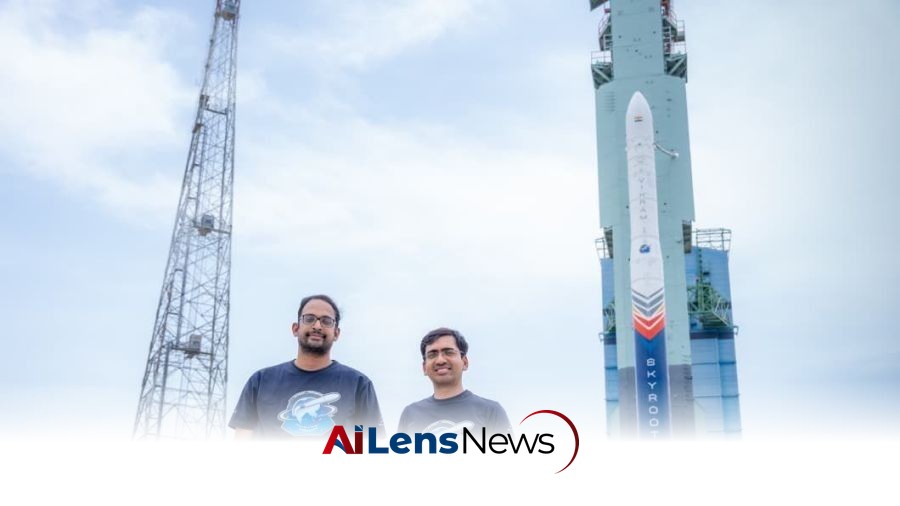


Former ISRO scientists Pawan Kumar Chandana and Naga Bharath Daka lead Skyroot Aerospace, achieving India's first private orbital launch with Vikram-1.
Kohima, India Jul 18, 2026 ALN: What started as an ambitious idea by two former ISRO scientists in 2018 has grown into India's biggest private space success story, with Pawan Kumar Chandana and Naga Bharath Daka leading Skyroot Aerospace to the country's first private orbital launch.
Founded in Hyderabad, Skyroot Aerospace aims to make satellite launches as routine and affordable as booking a commercial flight. The founders now lead the company as Chief Executive Officer and Chief Operating Officer, respectively, overseeing a team of more than 1,000 professionals working across rocket design, propulsion, avionics, and launch systems.
Pawan Kumar Chandana, who cleared the IIT entrance exam in his first attempt, joined the Indian Institute of Technology (IIT), Kharagpur. Unlike many of his peers who opted for high-paying jobs in technology, Chandana pursued his passion for space and rockets, leading him to the Indian Space Research Organisation (ISRO). At ISRO, he contributed to the GSLV Mk III, India's heaviest launch vehicle, earning an internal innovation award during his six years at the Vikram Sarabhai Space Centre in Thiruvananthapuram.
Naga Bharath Daka, co-founder and Chief Operating Officer of Skyroot Aerospace, previously worked as a flight computer engineer at ISRO, where he designed and developed several avionics modules for Indian launch vehicles. An alumnus of IIT Madras, Daka holds a master's degree in Microelectronics and VLSI Design, along with a bachelor's degree in Electrical Engineering. His extensive experience in avionics and semiconductor technologies has been crucial in developing Skyroot Aerospace's launch vehicles.
With their combined expertise and vision, Chandana and Daka are not only transforming the landscape of space exploration in India but also inspiring a new generation of engineers and entrepreneurs in the aerospace sector.
The significance of the Vikram-1 mission cannot be overstated. It marks a pivotal moment in India's space narrative, showcasing the capabilities of the private sector in a field that has historically been dominated by government entities. The Indian Space Research Organisation (ISRO) has long been recognized for its achievements, including the Mars Orbiter Mission and the Chandrayaan lunar explorations. However, the emergence of private players like Skyroot Aerospace signifies a shift towards a more diversified and competitive space economy.
The Indian government has been actively promoting private participation in the space sector, recognizing its potential to enhance innovation, reduce costs, and accelerate the pace of development. In 2020, the Indian Space Association (ISA) was established to facilitate collaboration between the government and private companies, paving the way for initiatives that support the growth of private aerospace ventures. This supportive ecosystem has allowed Skyroot Aerospace to thrive and innovate.
Skyroot's flagship launch vehicle, Vikram-1, is designed to carry small satellites into orbit, catering to the growing demand for satellite launches from various sectors, including telecommunications, earth observation, and scientific research. The increasing reliance on satellite technology for services such as internet connectivity, weather forecasting, and disaster management has created a burgeoning market for affordable launch services. By offering competitive pricing and reliable launch schedules, Skyroot aims to capture a significant share of this market.
In addition to its commercial objectives, Skyroot Aerospace is also committed to fostering a culture of innovation and research within the aerospace community. The company actively collaborates with academic institutions and research organizations to promote knowledge sharing and skill development. This initiative is crucial for nurturing the next generation of aerospace engineers and scientists who will drive future advancements in space technology.
The success of the Vikram-1 mission could have far-reaching implications for India's position in the global space industry. As more private companies emerge, India could become a significant player in the international space launch market, competing with established players from the United States, Russia, and China. This competition could lead to lower launch costs on a global scale, benefiting countries and organizations looking to deploy satellites.
Moreover, the success of Skyroot Aerospace could inspire other entrepreneurs in the Indian aerospace sector to embark on their ventures, further diversifying the industry and fostering innovation. The entrepreneurial spirit demonstrated by Chandana and Daka serves as a testament to the potential of India's talent pool and the importance of supporting startups in high-tech sectors.
As Skyroot Aerospace continues to develop its technology and expand its capabilities, the focus will also be on sustainability and environmental considerations. The aerospace industry faces increasing scrutiny regarding its environmental impact, and companies are under pressure to develop greener technologies. Skyroot is exploring eco-friendly propulsion systems and sustainable practices in its operations, aligning with global efforts to reduce the carbon footprint of space activities.
The journey of Pawan Kumar Chandana and Naga Bharath Daka is a remarkable example of how vision, determination, and collaboration can lead to groundbreaking achievements. Their story is not just about the launch of a rocket; it embodies the spirit of innovation that is essential for the future of space exploration. As they continue to push the boundaries of what is possible, they are also paving the way for a new era of space exploration in India, one that is characterized by inclusivity, accessibility, and sustainability.
In conclusion, the Vikram-1 mission represents a significant milestone for Skyroot Aerospace and the Indian space sector as a whole. With pioneers like Pawan Kumar Chandana and Naga Bharath Daka at the helm, the future looks promising for private space ventures in India. Their contributions will likely inspire future generations to dream big and pursue careers in science, technology, engineering, and mathematics (STEM), ultimately contributing to the advancement of India’s space capabilities and its position on the global stage.
To learn more about the latest developments in Startup Innovations, stay updated with our exclusive reports and analyses on AiLensNews.

