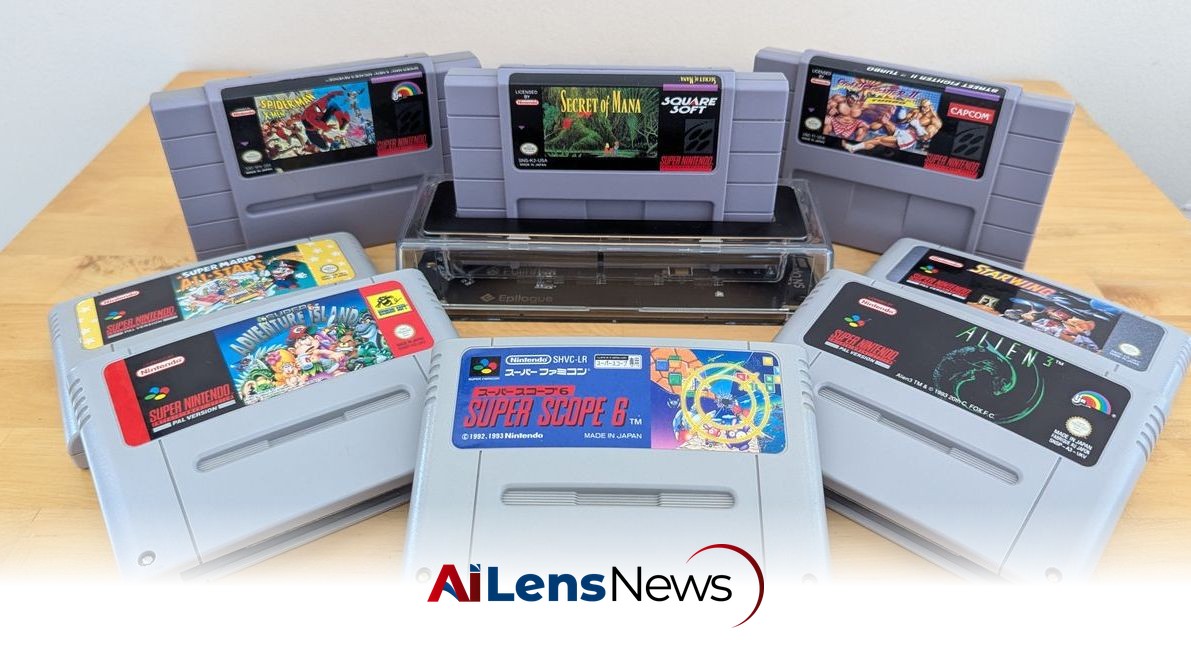


The Epilogue SN Operator offers a seamless way to play Super Nintendo games on modern devices, enhancing retro gaming experiences with new features.
New Delhi, India Jul 9, 2026 ALN: With Sony cutting disc production for PlayStation consoles by 2028, the future looks bleak for anyone who likes actually owning their video games. The past, though, well, that’s never looked brighter, with the retro gaming sector offering more opportunities than ever to enjoy the games of yesteryear.
There are now heaps of field-programmable gate array (FPGA) consoles that effectively remake original consoles, supporting authentic game cartridges on modern displays—like Analogue’s excellent N64 mimic, the Analogue3D. But Romania-based Epilogue has been going a slightly different route. Its Operator line is a burgeoning series of plug-in cart slots that let you play original cartridges on your computer, running the games through emulation.
The delightful GB Operator was first out of the gate earlier in 2026, supporting carts from three generations of Game Boy hardware. Epilogue is now following up with the SN Operator, which does the same for Super Nintendo Entertainment System and Super Famicom carts—and does so rather brilliantly.
Like its predecessor, the SN Operator is a simple perspex cuboid, albeit bigger, measuring 185 × 70 × 37 millimeters to accommodate the much larger SNES game cartridges. The cart slot now boasts guard flaps to protect the inner circuitry from dust and debris—much like Nintendo’s original consoles did—and the whole unit benefits from a rubber base that keeps it stationary on any desk, despite its mere 230-gram base weight.
The greater size means it’s not as portable as the GB Operator (I certainly wouldn’t want to lug it and a bunch of full-size carts around to play via my laptop on the go), but the original hardware was always a home console, so it’s no real loss.
Setup remains simple. Connect the device to your computer (Windows, macOS, Linux, and even Raspberry Pi are supported) via the included 1-meter braided USB-C to USB-C cord—which also provides power—install Epilogue’s Playback software, slot in your chosen game, and you’re good to go.
The SN Operator continues to offer a host of visual options and filters for how games run, with screen modes ranging from pixel-perfect representations to CRT replicas—oddly, some imitating the grayscale appearance of the Game Boy—and modifiers to how fast or slow a game runs, including fast-forward and rewind features.
Somewhat annoyingly, it doesn’t seem to offer a “true” full-screen view of your games—expand Playback to fill your monitor, and although you’ll get a much larger view of the game, it’s one with black borders on all four sides. If there’s a way to get the original 4:3 aspect-ratio image to fill the middle of the screen with only pillar-box borders, I’ve not found it in any of the settings.
Image scaling aside, if you don’t like how Playback initially handles the emulation, you can tweak it. The popular BSNES emulator is enabled by default, with five versions of Snes9X included, and any other emulator core you prefer can be added manually. That’s getting deep into the weeds, though, since for most players, the SN Operator’s plug-and-play approach will more than suffice. It’s worth noting that not all cores support achievement tracking through Retro Achievements, another returning feature that looks to be a mainstay of the Operator line.
The SN Operator continues to allow you to make legal copies of cartridges you own, backing up a cart’s image to your computer in seconds. This is purely for your own archival purposes—you’ll still need an actual cartridge inserted to play.
At this point, you’re probably thinking the SN Operator sounds like it’s just the GB Operator for SNES carts. Honestly? It kind of is, and that would probably be good enough for retro fans—it’s a fantastic tool for viable SNES gaming in 2026. However, Epilogue hasn’t rested on any laurels, instead tailoring its latest gadget to the unique needs and features of the hardware it emulates.
One of the biggest wins is its universality. Unlike the various generations of Game Boy consoles, which always allowed you to play games from anywhere in the world, the SNES had plenty of region restrictions in place. Carts were physically incompatible—the blocky North American carts won’t fit the rounded slots of the Japanese Super Famicom or the European Super Nintendo consoles, and vice versa—and featured lockout chips.
There were workarounds—European or Australian gamers will likely remember dual-boot adapters that used a local cart to spoof the console into accepting an imported American game—but with different TV standards to consider, most players were effectively limited to only the games released in their home territory.
With the SN Operator, that’s all consigned to the past. All cart sizes fit, and lockout chips are ignored—insert a game from anywhere in the world and, so long as it’s still in good working order, it’ll load. Modern displays mean old hurdles like different NTSC or PAL display standards are irrelevant.
That brings a few material benefits for purists. When the NTSC versus PAL distinction was an issue, it often meant PAL games ran more slowly due to the standard’s lower 50-Hz refresh rate compared to NTSC’s 60 Hz. Being in the UK, I can finally play Street Fighter II Turbo at its original speed, or the classic action platformer Spider-Man and the X-Men in Arcade's Revenge without Spidey feeling like he’s web-swinging through mud. Region-free also benefits North American players, allowing previously incompatible exclusives from other countries to be imported without worry—great for cult curiosities like Konami’s Pop’n Twinbee games, only released in Japan and Europe.
The Playback software even identifies which region’s version of the game it is—accurately clocking my UK copy of Star Wing (Nintendo couldn’t use the Star Fox name at the time). Counterfeit carts are detected, too. Speaking of Star Fox/Wing, there’s a host of options to tweak how the SN Operator handles Mode 7, the SNES’s pseudo-3D visual trickery. Throwing in super-sampling and upscaling features can give 30-plus-year-old games quite a glow-up.
Another great touch is how it accounts for classic accessories like the SNES Mouse, supporting titles like Mario Paint or Populous II—a strategy game and another PAL exclusive—with your regular, modern, non-SNES mouse. That same mouse can stand in for the Super Scope, Nintendo’s bulky light-gun peripheral designed for obsolete CRT screens. The only downside is that the precision afforded by a high dots-per-inch (dpi) mouse cursor makes those games incredibly easy, as I discovered with a Japanese copy of Super Scope 6, a six-game showcase for the tool. (Incidentally, it’s really only two games, Blastris and LazerBlazer, with three modes each—historically false advertising!) Still, there were only ever 12 Super Scope games released, so it’s great to see even this incredibly niche category of games considered.
By far the best improvement over the GB Operator, though, is an expanded suite of save data tools. Directly saving progress to a cart as you would on a real SNES remains a baked-in feature, and the SN Operator retains the ability to transfer game saves between your computer and cart, but now virtual save states are supported. At any point, you can create snapshot saves of wherever you are in a game—an absolute godsend in playing through Secret of Mana, a sizeable '90s Japanese role-playing game (JRPG), and one I can now pick up and put down without worrying about in-game save points.
The SN Operator remains a victim of the same supply constraints as the original game cartridges that the GB Operator faced. Its greatest appeal will be to those who already have vintage games on hand—the device itself might be a bargain at $60, but newcomers should expect sticker shock when building a library, given how expensive some of the Super Nintendo’s best-loved games are on the secondary market.
Fancy playing Square’s genre-defining JRPG Chrono Trigger on its original hardware, in English? Prepare to pay hundreds of dollars just for the cartridge. That’s not Epilogue’s fault, but it is a barrier for any retro-curious players or would-be gaming historians. Then again, Sega recently announced anniversary reissues of the first two Sonic the Hedgehog games on “museum-grade archival” Sega Genesis/Mega Drive carts—still pricey at $100 each, but perhaps a step toward authentic cart rereleases on a wider scale.
Taking advantage of the SN Operator’s region-free nature by importing Japanese editions of rarities might seem a financially savvy workaround—a Japanese copy of Chrono Trigger goes for roughly $20, usually—but it brings you face to face with its most disappointing oversight: There’s currently no support for translation packs. Although often fan-made, these are a fixture of the retro gaming and emulation scene, so it’s disappointing you can’t load one up alongside an authentic cart.
Epilogue tells me translation pack support is a feature it’s looking into adding to Playback in a future update, so it might not be a permanent stain on its record. Fascinatingly, the team is “also currently working on online multiplayer for SN Operator.” (Total speculation, but I also wonder if online features could lead to some form of support for Satellaview games, even though they weren’t cart-based.)
The SN Operator isn’t quite the perfect way to play SNES or Super Famicom games, but it comes about as close as possible, especially for its price bracket. If Epilogue can deliver on translation support and a fuller full-screen view, this will be almost impossible for classic Nintendo enthusiasts to ignore.
To learn more about the latest developments in Product Innovations, stay updated with our exclusive reports and analyses on AiLensNews.

