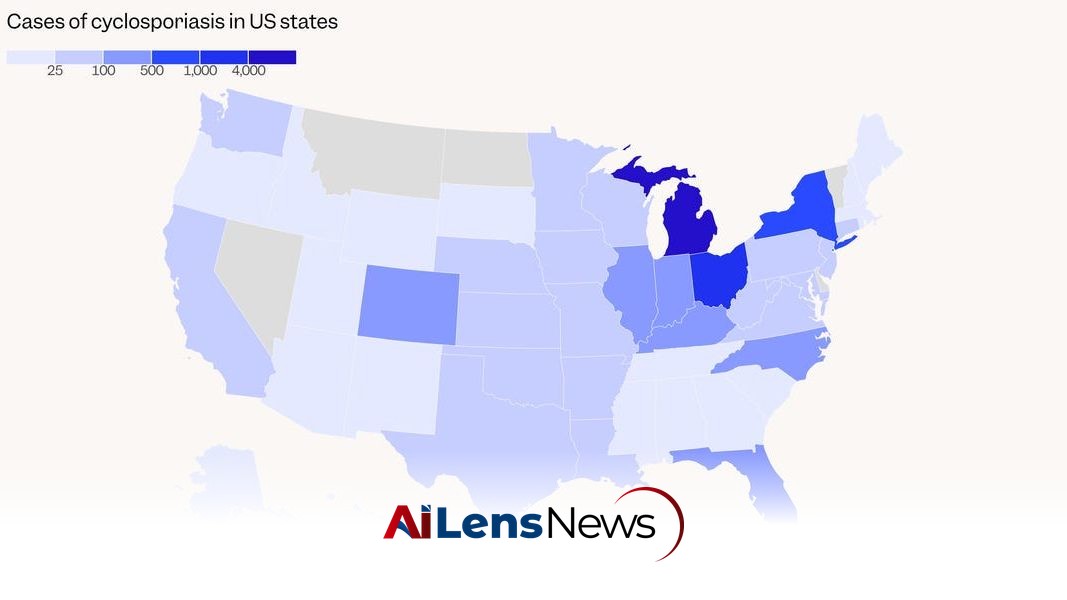


Michigan leads in cyclosporiasis cases amid a widespread outbreak linked to contaminated food. Maps illustrate affected states and recalls.
Washington DC, United States Jul 22, 2026 ALN: The Midwest remains the hotspot of an outbreak of cyclosporiasis, a parasitic infection that can trigger weeks of watery diarrhea. This outbreak has raised significant public health concerns, particularly as it spans a wide geographic area and involves multiple states.
At least 11,276 cases of cyclosporiasis have been reported across 46 states in 2026, according to Georgetown University's Health Security Operations Center, which is tracking state and national-level data. The sheer number of cases indicates a widespread issue, necessitating close monitoring and response from health authorities.
Cyclosporiasis is caused by the Cyclospora cayetanensis parasite, which is primarily spread through contaminated food and water. Symptoms of the infection can include watery diarrhea, nausea, stomach cramps, fatigue, and loss of appetite. The onset of symptoms can be delayed, taking up to two weeks to appear, which complicates efforts to trace the source of outbreaks. The illness can last for several weeks, and in some cases, symptoms can recur.
There are a number of potential sources of confusion in this outbreak, including differing state and federal case counts, and how the FDA and Taylor Farms have shared information on the suspected source of infections. This discrepancy between reported cases highlights the challenges faced by public health officials in tracking and managing outbreaks effectively.
In contrast to Georgetown's count, the CDC reported in its latest cyclosporiasis update on July 15 that it had confirmed 1,645 domestic cases of cyclosporiasis and was aware of more than 5,100 cases that need further analysis to confirm. Some state health departments are tallying cases as part of the ongoing outbreak, while others include all cases reported in 2026 in their figures. This variation in reporting can lead to confusion and uncertainty about the true scale of the outbreak.
According to the CDC, the typical cyclospora season lasts until late August, and cases could continue to rise until then. This timeline suggests that health officials will need to remain vigilant as the summer progresses, particularly in areas that have already reported cases.
Overall, data shows that the bulk of cases have been identified in the Midwest and mid-Atlantic states, as seen in the map below. This concentration of cases raises questions about potential sources of contamination in these regions, including agricultural practices and food distribution systems.
Katelyn Jetelina, assistant professor adjunct of epidemiology at Yale School of Public Health, wrote in her public health newsletter, Your Local Epidemiologist, on July 21 that several outbreaks are running at once, including one suspected to be caused by cilantro in New York. She described the Midwest outbreak as "its own beast" that wasn't yet slowing down. This characterization underscores the complexity of the situation, as multiple sources of infection can complicate public health responses.
On Friday, Taylor Farms voluntarily recalled iceberg lettuce from the US that was sourced from central Mexico, as shown below. This recall is a significant action in response to the outbreak, as it aims to remove potentially contaminated products from the market.
Taylor Farms informed shoppers who had bought iceberg lettuce distributed June 29th through July 16th in the following states to not consume it and to throw it out: Alabama, Arkansas, Connecticut, Florida, Georgia, Iowa, Illinois, Indiana, Kansas, Kentucky, Louisiana, Massachusetts, Maryland, Michigan, Missouri, Mississippi, North Carolina, New Hampshire, New Jersey, Ohio, Oklahoma, Pennsylvania, South Carolina, Tennessee, Texas, Virginia, and Wisconsin. This extensive list of affected states highlights the widespread distribution of the recalled product and the potential risk to public health.
The FDA stated in an update to its website that consumers should "not eat recalled iceberg lettuce from Taylor Farms de Mexico" and noted that its investigation is ongoing. The ongoing nature of the investigation indicates that health officials are still working to determine the full scope of the issue and any additional sources of contamination.
However, other foods can't be ruled out as potential sources of infection. The complexity of food distribution networks means that contaminated products can easily enter the food supply chain without detection. As such, public health officials continue to monitor various food items and sources as they investigate the outbreak.
Jetelina pointed out that iceberg lettuce was recalled in 27 states "due to a combination of the complexity of food distribution networks and continued uncertainty around where people are most impacted." This statement underscores the challenges faced by health officials in pinpointing the exact source of contamination, which is crucial for controlling the outbreak and preventing further cases.
Posing the question, "When will this end?" Jetelina stated, "No one knows. Either the contaminated food works its way out of circulation, or it takes a few weeks, the temperatures get cool, and the parasites no longer mature on produce (basically killing themselves off). It's hard to tell from the data alone if this outbreak is coming to a close given that it's significantly delayed." This uncertainty emphasizes the need for continued public health vigilance and consumer awareness as the outbreak unfolds.
Cyclospora spreads through contaminated food and water, and symptoms, including watery diarrhea, nausea, and stomach cramps, can take up to two weeks to show, making it difficult to trace back to a definitive source. The parasite is resistant to disinfectants, and washing food doesn't guarantee its removal, as it is particularly good at sticking to produce. This resilience complicates efforts to ensure food safety.
Health authorities recommend cooking foods to at least 158 degrees Fahrenheit to definitively kill the parasite. This temperature is crucial for ensuring that any potential contamination is eliminated before consumption. Additionally, buying whole heads of lettuce and peeling back the outer layer of leaves rather than choosing pre-washed, bagged, or pre-mixed salads is a good move for those who are more risk-tolerant. This approach allows consumers to take more control over their food safety practices.
In summary, the ongoing outbreak of cyclosporiasis in the Midwest and other parts of the United States poses significant public health challenges. With a high number of reported cases and ongoing investigations into potential sources of contamination, health officials must remain vigilant and proactive in their efforts to protect public health. Consumers are also encouraged to stay informed and take appropriate precautions to reduce their risk of infection as the situation develops.
To learn more about the latest developments in Health News, stay updated with our exclusive reports and analyses on AiLensNews.

