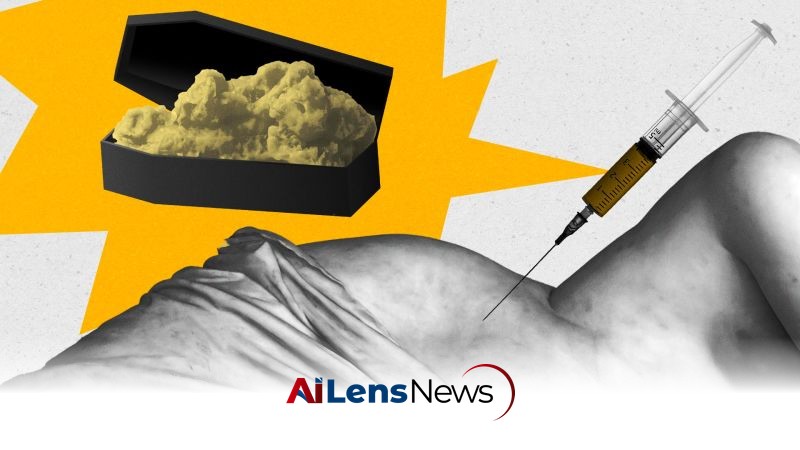


The rise of AlloClae, an injectable body contouring product using cadaver fat, raises ethical questions about beauty standards and body modification.
Washington DC, United States Jul 13, 2026 ALN: Sandra*, a 43-year-old media lawyer based in Los Angeles, had been toying with the idea of breast augmentation since her 20s, but was always put off by the pain of the procedure, the long recovery time and the idea of having “this kind of foreign sac in your body.”
So when Sandra, who wanted to protect her identity for privacy reasons, heard about a new injectable body contouring product last summer, she was intrigued. No synthetic fillers, no implanted sacs, no downtime.
“You hit a certain age and you decide, I’m going to do something for myself at this point,” she said. The product she found — alloClae, pronounced allo-clay like the earthy sculpting material — is quick to administer. Nicknamed the lunchtime boob-job, it often takes less than an hour to inject and doesn’t need general anaesthesia or a hospital setting. Plus, the aftercare instructions, Sandra said, were “shockingly easy.” The fact that alloClae uses fat harvested from donated dead bodies, or cadavers as they’re referred to in the scientific community, didn’t really pose an issue. “I was fine with that,” she said.
A growing number of people in the US appear to feel the same. Tiger Aesthetics, the company that manufactures alloClae, said more than 2,000 patients have been injected with it since May 2025. It’s a buzzy topic on Reddit’s popular plastic surgery page, as potential patients ask questions, seek reviews and swap doctor recommendations.
In 2026, it’s clear that what once might have been classed as body modification is now seen simply as body maintenance. It has never been easier, or more mundane, to drastically alter one’s physical form. Rib remodeling. Upper blepharoplasty. Lower blepharoplasty. Mid-facelift. Lower facelift. Deep-plane facelift. As science and surgical technique progress ad nauseam, so does our appetite for new curves, tighter skin, sharper jawlines.
AlloClae — one of the more inventive products in this category— is our latest reminder. But for every plastic surgery clinic calling the injectable a “next-generation” advancement, there’s an equal number of headlines branding it “zombie filler” or “corpse injections.”
If there is a boundary line in the pursuit of the perfect look, are we finally butting up against it? What does it mean if society widely embraces injecting cadaver fat in the service of beauty? Could alloClae become as common as Botox?
In the end, your opinion of alloClae might depend on your opinion of death.
AlloClae was first released in the US in 2024 to board-certified plastic surgeons with a track record of working with fat, and since January to a wider net of doctors including “mid-level providers” like physicians assistants, nurse practitioners and aesthetic nurses. (Tiger Aesthetics said it trains nurse practitioners, who are not permitted to inject into the breast, on special injection technique.)
Dr. Luis Macias, a double-board-certified plastic surgeon in LA who was one of a select few doctors to receive alloClae early, has witnessed the product’s rising popularity first-hand. “I have to buy a lot of syringes at a time, and talk to the rep constantly about it,” he said in a phone interview. “I feel like I’m talking to my Porsche dealer… It’s ridiculous.” The price for one 12.5cc syringe of the soft tissue corrector can run up to roughly $2,250.
Marketed as “off-the-shelf” fat, or “bottled fat grafting,” as one PR email put it, alloClae is touted as an alternative to autologous fat grafting — where a patient’s own fat is removed via liposuction and transferred into another area.
It isn’t the first product in this area of cosmetics. Renuva, a similar shelf-stable cadaver fat injectable made by not-for-profit organization MTF Biologics, first launched around a decade ago. The key difference between the two, Macias said, is volume. Because Renuva’s maximum syringe size is just 3ccs, it was commonly used in smaller areas like the hands, face and neck, whereas the largest syringe of alloClae can hold around 22cc of more product. “It’s a little chunkier,” said Macias. “A little firmer.”
In the age of GLP-1s where bodies seem to be shrinking left and right, donated cadaver fat is plugging an emerging gap in the market. Around 11% of Americans are currently on medications such as Ozempic and Wegovy for weight loss, according to a report published this month. Macias says a number of his patients on GLP-1s are keen to add fat back into their bodies, now that they can spot treat areas and design their silhouette. “They want it back in the breast and buttocks, in the face,” he said. “Those are very common areas that we’re re-volumizing after we get rid of the excess skin.”
Caroline Van Hove, president of Tiger Aesthetics, agreed the rise in these drugs has been “complementary” to alloClae. “What these patients are finding is that as they’ve lost quite substantial amounts of weight, it’s also left them disfigured in certain areas where they have lost real targeted volume,” she said over Zoom. “In areas that, in their opinion, define their femininity.”
To meet the booming demand, Van Hove said the company is scaling up production, which might sound difficult for a company that relies entirely on the donation of dead bodies. Macias says he’s yet to see a patient bat an eyelid at where the fat comes from. “Maybe it’s because of the market I’m in,” he said. “Los Angeles, right?”
Do families, and donors, know their bodies can be used in this way? The short answer is not always.
Organ and whole body donation are often understood as the ultimate selfless acts — a grieving family using their loss to improve someone else’s life, or further scientific research.
Organ donation is relatively straightforward — in the US it is tightly controlled by federal law. But whole body donation and non-transplant human tissue banks are a different story. Regulation varies by state and there is currently no mandatory federal accreditation or licensing requirement for either body donation organizations or non-transplant tissue banks, which are not regulated by the US Food and Drug Administration. This means there is largely no federal oversight of the hundreds of facilities receiving tens of thousands of gifted dead bodies per year.
Still, Van Hove called whole body donation a “stringent and highly regulated area.” She said Tiger Aesthetics only has contracts with tissue banks connected with the Association for Advancing Tissue and Biologics — a voluntary accrediting body established in 1976 with the aim of increasing public trust by providing additional scrutiny to the donation process. Donors “have to complete a very extensive dossier releasing their consents,” Van Hove said, adding that it can take between 3 and 6 months to “clear” a donor’s medical record and approve the anatomical gift. “Obviously the form does not say ‘Do you want to donate your organs or tissue to alloClae?’” she said. “But it allows the donor to really indicate whether or not they want it exclusively for investigative research, medical research or if they’re also allowing for-profit purposes and so on, or if they have no restrictions at all.”
Whether it’s ethical is another question, especially since families of donors are not compensated for their loved one’s body. “It really is betraying altruism to make money,” Arthur Caplan, professor of bioethics at NYU’s Grossman School of Medicine, said of the industry.
To learn more about the latest developments in Health News, stay updated with our exclusive reports and analyses on AiLensNews.

