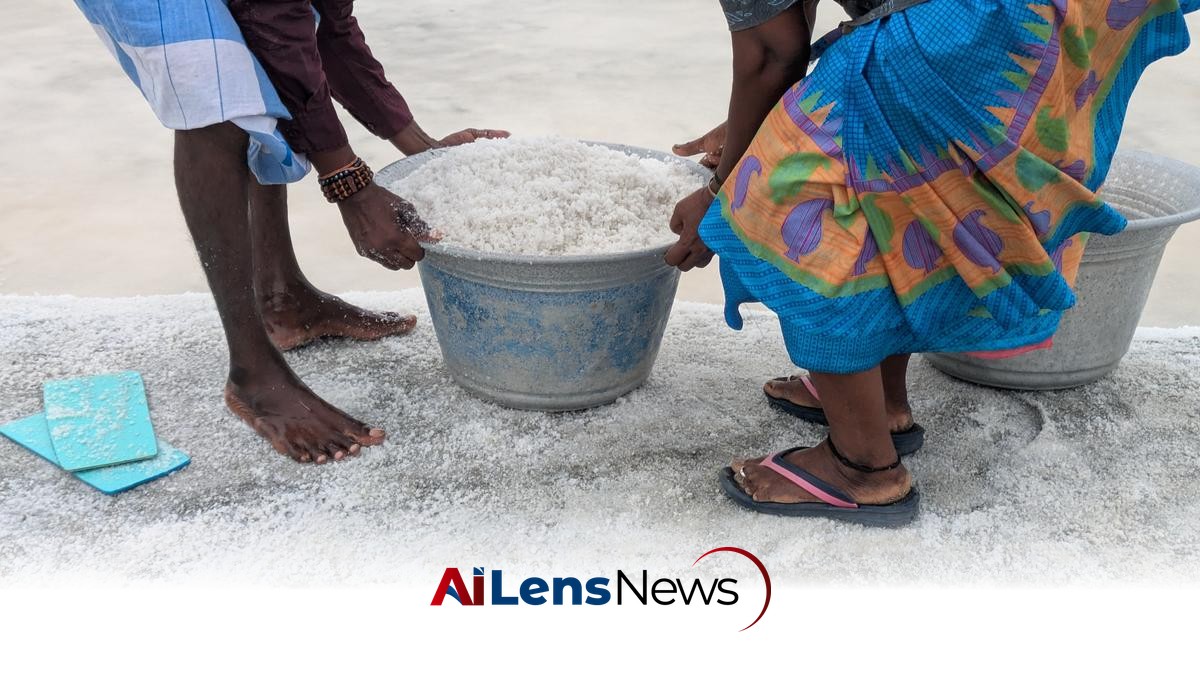


In Marakkanam, salt pan workers grapple with extreme weather conditions that threaten their livelihoods. While they endure harsh summers, unseasonal rains disrupt production, leading to financial instability. Government support remains limited, exacerbating their struggles.
Chennai, India Jul 22, 2026 ALN: As swelters through one of its harshest summers in recent years, many look to the sky hoping for relief in the form of an afternoon shower. But in the salt pans of Marakkanam, rain is the one thing workers cannot afford to wish for. Every spell of rainfall stalls salt production for days and costs them wages.
So, even as they endure hours under a relentless sun that reflects off the white salt fields with blinding intensity, they hope for the heat to continue. It is a cruel irony that the weather which leaves workers dizzy, dehydrated, and exhausted is also what keeps their livelihoods alive.
This year, temperatures crossed the 40°C mark across several districts well into June, while high humidity made conditions feel even more oppressive. According to the Regional Meteorological Centre (RMC), the State recorded its second-highest average minimum temperature for June since 2015.
Nights remained nearly one degree Celsius warmer than normal, offering little relief to workers after a long day of manual labour. The lack of overnight cooling, coupled with prolonged daytime heat, left much of reeling under persistent heat stress. Even by mid-July, weak southwest monsoon conditions delayed widespread rainfall, extending heatwave-like conditions across many parts of the State.
Salt work is typically available from January to August in . Women earn between ₹400 and ₹500 a day, while men are paid ₹700 to ₹750. Workers usually begin around 6 a.m. and finish by 10 a.m., or until whenever the work is done, and come back around 3 p.m. when the volume of harvested salt is high.
Salt production follows a timed process that depends on dry weather. Seawater is channelled into evaporation pans and left to evaporate for several days until salt crystals form. The crystallised salt is then raked into piles, left to dry further, scraped into baskets and carried to large heaps, where it is covered with tarpaulin sheets until traders arrive to purchase it. Every change in the weather is closely watched, for even a brief drizzle can ruin an entire day’s harvest.
Navaneetham, 45, points to her legs, where the skin has darkened the skin, after years of working in the salt pans. “I always have boils on my feet,” she says.
She and her husband have taken a salt pan on sub-lease and do all the work themselves because they cannot afford to hire labourers. “We can’t pay anyone else, so we handle everything,” she says. The work is seasonal, which means the family has to manage without an income for nearly six months every year.
“We somehow survive by borrowing money. That’s how we’ve been eating,” she says. Their son, who completed a B.Com degree, briefly joined them in the salt pans but left for Chennai because he could not bear the heat.
provides a ₹5,000 annual monsoon relief assistance to registered salt pan workers to help sustain their families during the rainy months (October to December) when production halts. The aid is distributed to families registered under the Manual Workers Social Security and Welfare Board.
Since the assistance is provided on a per-family basis, only one member of the household is eligible to receive it. Although both Navaneetham and her husband are salt pan workers, the family received the State government’s ₹5,000 financial assistance for only one beneficiary.
Marakkanam is among ’s traditional salt-producing regions, alongside major centres such as Thoothukudi, Vedaranyam and Cuddalore. However, unlike Thoothukudi, where large, contiguous salt fields enable large-scale production, Marakkanam’s salt pans are relatively smaller and more fragmented.
According to a salt pan manager, Thoothukudi remains the State’s largest salt-producing hub as the economies of scale keep production costs lower. “The pans there are much larger, so the cost of production is lower. The quality is also better. Buyers are willing to transport salt over longer distances because the overall cost still works out in their favour,” he says. As a result, traders often procure salt from Thoothukudi despite the higher transportation costs, making it a more competitive market compared to Marakkanam.
The monsoon has always marked the end of the salt-making season, but, Sarasu, 50, a resident of Villivakkam in Marakkanam, says unseasonal summer showers are now eating into what was once a dependable period of work.
“It is becoming more and more precarious. Earlier, we could count on earning through most of the summer. Now, unseasonal rains cut the season short, and we somehow manage. The monsoon months are the hardest,” she said.
To get by, her family borrows small sums from neighbours, self-help groups and moneylenders, like most salt pan workers. With agricultural work becoming increasingly scarce during the off-season, her husband takes up whatever manual work he can find, often loading and unloading sacks for daily wages. But the earnings are irregular, and the loans accumulate. “We are trapped in a recurring cycle of debt. Because of this, I could not even get my children educated. They are doing odd jobs for survival now,” she says.
As Selvalakshmi, 45, steps out of the salt pan after nearly four hours of work, she reaches for her neck. “... my neck hurts,” she exclaims with a weary smile. But there is no time to rest. She has to leave for her second job.
Widowed after her husband died of kidney disease, Selvalakshmi works two jobs to make ends meet. Once she finishes harvesting salt, she heads to a nearby cashew processing unit, where she removes the husk from cashew kernels. The work is paid on a piece-rate basis — ₹35 a kilogram.
“Yesterday, I managed to finish only five kilograms,” she says. “It’s difficult because I go there after finishing work here. By then, I’m already exhausted.”
Her husband, who had also worked in the salt pans, struggled with kidney disease before his death. In a 2023 study of seven Indian salt pans, published in Kidney International Reports, researchers from the Sri Ramachandra Institute of Higher Education and Research, led by Vidhya Venugopal, found that 87% of workers were exposed to unsafe levels of heat stress, while most consumed only about one litre of water during a workday. Many showed signs of dehydration and heat strain, and workers exposed to excessive heat were nearly three times more likely to have reduced kidney function.
For Sudha, 35, the workday does not end when she steps out of the salt pan. It is only then that another concern begins: finding drinking water.
A resident of Pallampakkam village, she says there is no water because seawater intrusion has left the groundwater saline and unfit for drinking. “We’ve submitted petitions and even staged demonstrations, but we still don’t have drinking water,” she says. Residents depend largely on the neighbouring village for potable water.
Like most women working in the salt pans, Sudha starts her day with only tea and biscuits before heading to work. Aches have become part of the job. “Every part of the body hurts. It’s always there,” she says.
After work, some workers try to fill their bottles at a petrol bunk on the way home. But the shared autorickshaw that ferries them six to seven kilometres from their villages charges extra if it has to make the detour. Most instead rely on drinking water stored in cans at the salt pans by the lessee who manages the worksite, carrying home whatever they can.
In 2025, frequent summer showers brought the salt-making season to an abrupt end by June, nearly two months earlier than usual. Every rainy day means another day without work, which forces many families to borrow money to meet daily expenses. Workers say the State’s one-time financial assistance of ₹5,000 is nowhere near enough to sustain them through months without income.
Salt pan workers are among the communities most vulnerable to a changing climate. Their livelihoods depend on long spells of hot, dry weather for salt to crystallise, yet a single untimely shower can halt production for days. As rainfall patterns become increasingly erratic and extreme weather events more frequent, the financial precarity of salt pan workers is only expected to deepen, researchers say.
With few factories in and around Marakkanam, some women turn to agricultural labour during the off-season. But even that is uncertain. As Marakkanam is a town panchayat, they are ineligible for work under the Mahatma Gandhi National Rural Employment Guarantee Scheme (MGNREGS), leaving them with few safety nets when the weather cuts short the salt season.
M. Krishnamoorthy, State vice president of the Unorganised Workers Federation, said the monsoon relief assistance should not be treated as charity and that the ₹5,000 support is inadequate to sustain workers through the off-season.
“Salt is fundamental to everyday life. It is in every meal we eat and is used across industries. The workers who produce it deserve far better compensation,” he said, adding that the board should be made operational by levying a cess on salt traders to generate funds for the welfare of salt workers.
To learn more about the latest developments in Sustainability, stay updated with our exclusive reports and analyses on AiLensNews.

