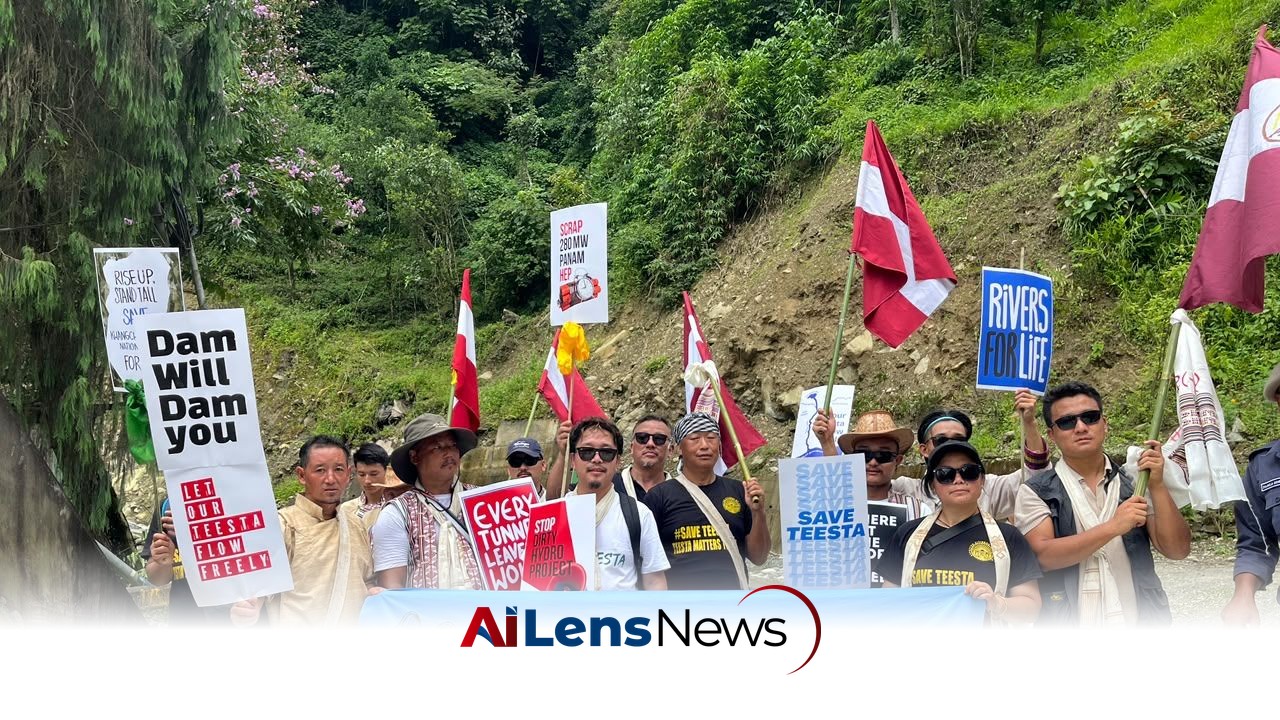


The ongoing march 'Teesta Matters to Me' highlights the deep connection between local communities and the Teesta River, advocating for sustainable development in the Eastern Himalayas.
Imphal, India Jul 24, 2026 ALN: When we envision the Himalayas, the pahaad, many of us fall into a romantic, Bollywood-inspired sense of peace, or perhaps a whimsical Ghibli-esque imagination. Snow-capped peaks, fluttering prayer flags, winding rivers, and villages tucked into mountain slopes have become symbols of tranquillity in our collective imagination.
While much of this holds, being born here, living here, breathing this mountain air, and working alongside one another in these hills is a profound privilege that people are only now truly beginning to appreciate.
The Eastern Himalayas are uniquely blessed, nurturing an astonishing portion of the planet’s biodiversity despite accounting for only a small fraction of the Earth’s land surface.
Within the span of a single day’s journey, one can move from lush tropical forests teeming with orchids, hornbills, butterflies, and ferns, to temperate woodlands of oak and rhododendron, before climbing into alpine meadows where blue sheep graze beneath glaciers, and elusive snow leopards leave only their tracks behind.
Few places on Earth contain such extraordinary ecological diversity compressed into such a dramatic vertical landscape.
These mountains are also the cradle of some of Asia’s most significant rivers. The Teesta, the Brahmaputra, tributaries of the Ganges, and countless mountain streams originate in these heights, carrying freshwater to hundreds of millions of people downstream. In every sense, the Eastern Himalayas are one of South Asia’s great water towers.
Yet, while one could praise these mountains endlessly, a critical issue remains.
The voice of the mountains is not being heard.
Today, however, that voice is walking.
On 24 July 2026, the Affected Citizens of Teesta (ACT) began the first day of their four-day foot march titled Teesta Matters to Me. As the first day’s journey from Dzongu to Mangan comes to a close, the march continues a movement that has endured for nineteen years, one of the longest-running Indigenous environmental movements in the Eastern Himalayas.
Over the coming days, the marchers will travel through Rangpo and Melli before concluding at Triveni, the sacred confluence of the Teesta and Rangit rivers, where a traditional Lepcha ritual will mark the end of the journey.
At first glance, it may appear to be another protest march.
It is much more than that.
It is a celebration of a river that has shaped landscapes, cultures, livelihoods, and identities for centuries. It is also a renewed call to rethink the way we imagine development in one of the world’s most ecologically fragile mountain regions.
ACT has reiterated demands that have defined its struggle for nearly two decades: the scrapping of the proposed 520 MW Teesta Stage IV Hydroelectric Project by NHPC and the 280 MW Panan Hydroelectric Project in Dzongu; fresh Environmental Impact Assessments for all existing hydropower projects along the Teesta; and the declaration of the Teesta–Rongyong stretch in Dzongu as a River Sanctuary, recognising its exceptional ecological significance, including its remarkable butterfly diversity.
The march also raises concerns following the Teesta Stage VI disaster, questions of accountability, and the rights of communities that continue to bear the consequences of large-scale hydropower development.
Yet beyond every memorandum, every demand, and every kilometre walked lies a much larger question.
What does development truly mean in a place where nature itself is the foundation of life?
To many outside the mountains, the Teesta is simply a river flowing through Sikkim and northern Bengal. It is measured in cubic meters of water, megawatts of electricity, or engineering potential.
For those who have grown up alongside it, the Teesta has always been something else entirely.
It nourishes forests, farms, and villages. It shapes seasons and ceremonies. It carries stories, songs, rituals, and memories that have travelled with its waters for generations. Like many Himalayan rivers, it is not merely a natural resource waiting to be harnessed. It is part of a living relationship between people and place.
This understanding gave rise to ACT in 2007, when members of the Lepcha community and other concerned citizens began opposing a series of proposed mega hydropower projects in the ecologically and culturally sensitive landscape of Dzongu.
Their prolonged hunger strikes became one of India’s defining environmental protests, ultimately contributing to the cancellation of four major hydropower projects in the region.
Nearly two decades later, the questions remain remarkably similar.
What kind of future do we want for these mountains?
Across the Indian Himalayan Region, mountain communities are being pulled in two opposing directions.
On one side, climate change introduces profound uncertainty into daily life. Retreating glaciers, erratic rainfall, glacial lake outburst floods, cloudbursts, and increasingly frequent landslides are reshaping landscapes that have long depended upon seasonal rhythms.
Rivers are changing too. Communities that have lived with these ecosystems for generations are witnessing transformations unlike anything their elders remember.
On the other hand, the younger generation continues to migrate to cities in search of education, employment, and opportunities for stability that villages often struggle to provide.
Many young people grow up caught between these two worlds, with one foot in the village and the other reaching towards the city.
In this space between staying and leaving, something quiet begins to disappear.
The ecological knowledge that once flowed naturally between generations slowly fades.
The wisdom of knowing when to harvest particular plants, how to cultivate steep slopes without causing erosion, how to read changing weather, or how to gather forest resources without exhausting them is rarely written in books. It lives in practice, in observation, in conversation, and in memory.
When those who carry this knowledge leave or pass away before it is shared, we lose far more than tradition.
We lose our storytellers, elders, and the languages through which mountains have long explained themselves.
There is a widespread misconception that if humanity steps back, nature will restore itself. The reality here is far more intricate.
These landscapes have been shaped over centuries through deeply interconnected relationships between people and the land. Terraced fields depend upon continuous maintenance to preserve their structure.
Forests have long been managed through customary practices, seasonal harvesting, and deliberate restraint. Rivers are understood not merely as water sources but as living systems around which community life is organised.
When these communities disappear, the land does not simply return to an untouched wilderness. Terraces crumble, traditional irrigation systems decay, ancient footpaths disappear beneath vegetation, and local ecological knowledge vanishes alongside those who carried it.
In this context, abandonment is not conservation.
A significant part of the challenge lies in the way development has been imagined for mountain regions.
Economic models designed for the plains are often built for large industries, extensive infrastructure, economies of scale, and uninterrupted connectivity. The Himalayas operate differently.
Villages are scattered, roads are fragile, distances are measured not merely in kilometres but in landslides, rivers, and changing weather, and transport is expensive.
Geography itself shapes opportunity, yet mountain landscapes are repeatedly expected to fit development models designed elsewhere.
When those models become the only measure of success, local livelihoods steadily unravel. Agriculture declines. Forest-based practices become economically unviable. Traditional skills lose value. Young people leave. Along with them departs a centuries-old relationship between people and landscape.
No one should be asked to choose between protecting their homeland and securing a dignified future for their family.
Equally, no mountain community should be forced to leave simply because prevailing ideas of development fail to recognise the realities of mountain life.
Perhaps the real question is not how the mountains can become more like the plains.
Perhaps the question is how we have allowed ourselves to believe that there is only one definition of progress.
The conversations unfolding along the Teesta today are therefore about much more than dams.
They ask: Who gets to decide what development should look like?
Whose knowledge matters? Can rivers be valued for more than the electricity they produce? Do communities living with the consequences deserve a meaningful voice in shaping their future?
These are questions that resonate far beyond the Himalayas.
Across the country, citizens are increasingly asking what meaningful development should look like. Students have gathered to demand fairness, transparency, and accountability in education reforms.
Communities continue to raise concerns over projects such as the Ken–Betwa River Link, questioning their ecological and social consequences. Indigenous peoples, farmers, environmentalists, researchers, and young citizens are, in different ways, asking remarkably similar questions about participation, justice, and the future we are choosing to build.
As the first day of the ACT march comes to an end, its footsteps carry more than banners and slogans. They honour those who fasted for our rivers previously, those who walked before, those who organised quietly for years, and those who refused to let the Teesta be reduced to a line on an engineering map.
A reminder to all of us that our rivers are not simply water flowing through valleys; they are a living system that sustains forests, wildlife, farms, cultures, and communities.
Ultimately, safeguarding the Eastern Himalayas is not solely about protecting wildlife or forests. It is about ensuring that the communities who have mastered the art of living alongside these mountains can continue to thrive with dignity, resilience, and genuine opportunity.
As people across the country walk, protest, question, organise, and imagine different futures for rivers, forests, classrooms, communities, and future generations, this article, too, is offered in solidarity.
It stands with those walking for the Teesta, with those advocating for meaningful education reforms, with communities defending rivers elsewhere, and with everyone who believes that development must remain accountable to both people and the landscapes that sustain them.
The future of these mountains will not be secured by forcing a choice between conservation and development, but by making the two separable.
The mountains have always been speaking.
Today, they are walking.
The question is whether we are finally ready to walk with them.
To learn more about the latest developments in Conservation, stay updated with our exclusive reports and analyses on AiLensNews.

