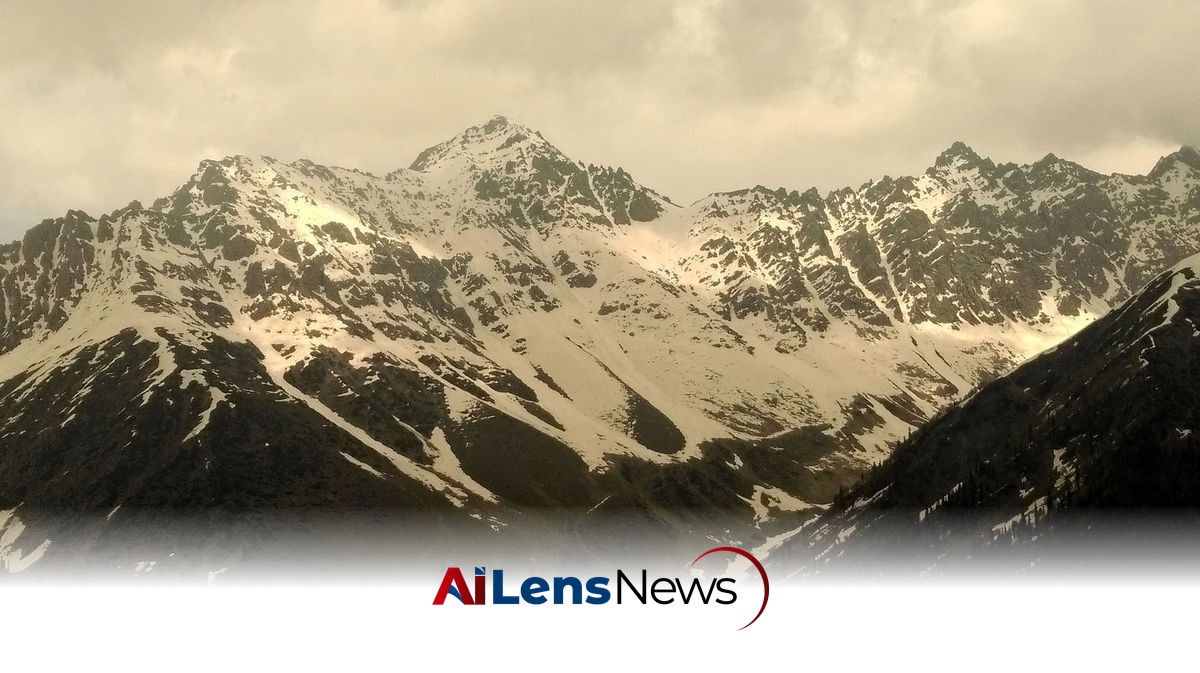


A recent study reveals alarming warming trends in Jammu and Kashmir's high-altitude regions, threatening the ecology and water supply.
Leh, India Jul 13, 2026 ALN: A study has found that Jammu and Kashmir’s high-altitude belt has warmed by nearly 1°C in just the last twenty years. This is a very dangerous trend as these mountains feed our rivers, sustain our orchards, and prop up our tourism.
Climate change is an urgent global issue, but its impacts are often felt more acutely in specific regions, such as the mountainous areas of Jammu and Kashmir. The region, known for its stunning natural beauty and rich biodiversity, is undergoing significant changes that threaten its ecological balance and the livelihoods of the people who depend on its resources. The findings of the study conducted at the Indian Institute of Technology (IIT) Kharagpur highlight the alarming rate at which the high-altitude areas are experiencing warming, which is not just a statistic but a reality that affects millions.
What’s especially worrying is how unevenly this warming is playing out. Higher altitude areas such as Bhaderwah, Pahalgam, and Gulmarg are heating up much faster than low-lying Jammu. Scientists call this elevation-dependent warming, and it’s hitting exactly where Kashmir’s ecology can least afford it: the snowfields and glaciers that regulate the region’s entire water supply. This phenomenon of elevation-dependent warming is critical to understand as it indicates that the effects of climate change are not uniformly distributed. Instead, they vary significantly with altitude, leading to disproportionate impacts on local ecosystems and communities.
The implications of this warming are profound. The glaciers and snowfields in these high-altitude areas act as natural reservoirs, storing water in the form of ice and snow, which gradually melts and feeds into rivers during warmer months. As these glaciers retreat and snowpacks thin, the timing and quantity of water flow into rivers can change drastically. This shift poses serious risks to agriculture, drinking water supplies, and hydroelectric power generation, all of which are vital to the region's economy and the well-being of its inhabitants.
The strangest part of the study conducted at IIT Kharagpur is that nights are warming faster than days, particularly in the run-up to the monsoon. At some stations, annual temperatures have crept up by as much as 0.3°C per decade, but pre-monsoon night-time lows have jumped by nearly double that, 0.6°C per decade. Warmer nights mean the land gets less chance to cool down, snow melts faster than it should, and the whole rhythm of mountain hydrology gets disturbed. This alteration in temperature patterns can lead to earlier snowmelt, which in turn can exacerbate flooding during the monsoon season, as rivers swell with the sudden influx of water from melted snow rather than a gradual release throughout the summer months.
The researchers point to two forces feeding off each other: shrinking snow cover means less sunlight gets reflected back into space, so the ground and air absorb more heat instead, and rising moisture in the atmosphere is trapping that heat through the night. Put simply, as the snow vanishes, it stops doing its job of keeping things cool, which only speeds up the vanishing. This cycle of warming and melting snow is a critical concern, as it not only affects local weather patterns but also has broader implications for climate systems beyond the region.
This situation is further complicated by the socio-economic context of Jammu and Kashmir. The region's economy heavily relies on agriculture, tourism, and hydropower—industries that are all sensitive to climate variability. Farmers depend on predictable water supplies for irrigation, while the tourism sector thrives on the region's natural beauty, which is intrinsically linked to its snow-covered mountains and lush landscapes. As climate change alters these foundational elements, the livelihoods of many families are at risk. The potential for increased frequency of flash floods, landslides, and water shortages poses a direct threat to the safety and security of local communities.
None of this is hypothetical. Retreating glaciers, thinner snowpack, shifting river flows, and a growing risk of flash floods, landslides, and water shortages all threaten ways of life built around a mountain water cycle that used to be predictable. The unpredictability of weather patterns can lead to crop failures, loss of income, and increased poverty, particularly among the most vulnerable populations who lack the resources to adapt to these changes.
The study’s authors are calling for better high-altitude monitoring and real adaptation planning. The Himalaya has long been called the Third Pole for its vast frozen reserves. This study is a reminder that even poles can melt. For Kashmir, the question is no longer whether the climate is changing, but how quickly its people, policymakers, and institutions can adapt. Adaptation strategies may include improving water management systems, investing in climate-resilient agricultural practices, and enhancing disaster preparedness to mitigate the impacts of extreme weather events.
In conclusion, the findings from the IIT Kharagpur study underscore the urgent need for comprehensive climate action and sustainable development strategies in Jammu and Kashmir. As the region grapples with the realities of climate change, it is imperative for stakeholders at all levels—from local communities to government officials—to work collaboratively towards solutions that protect both the environment and the livelihoods of the people who call this beautiful region home. The challenges posed by climate change are significant, but with proactive measures and a commitment to adaptation, it is possible to safeguard the future of Kashmir's high-altitude ecosystems and the communities that depend on them.
The study's findings also raise questions about the broader implications of climate change in mountainous regions globally. The Himalayas are not an isolated case; similar patterns of warming and glacier retreat are being observed in other mountain ranges around the world, including the Andes, the Rockies, and the Alps. As these regions experience similar climatic shifts, the interconnectedness of global water systems becomes increasingly apparent. The melting glaciers in one part of the world can have downstream effects thousands of miles away, impacting water availability and agricultural practices in regions that depend on these water sources.
Furthermore, the socio-political dynamics in Jammu and Kashmir complicate the climate change narrative. The region has a history of conflict and political instability, which can hinder effective climate action and adaptation efforts. Local governance structures may be strained, and resources may be diverted away from long-term sustainability initiatives towards immediate security concerns. This highlights the need for a multifaceted approach to climate resilience that integrates environmental, economic, and social dimensions, ensuring that climate action does not exacerbate existing inequalities or tensions.
In light of these challenges, education and community engagement become critical components of a successful adaptation strategy. Raising awareness about climate change and its impacts can empower local populations to take action and advocate for their needs. Community-led initiatives that focus on sustainable practices, conservation efforts, and disaster preparedness can foster resilience at the grassroots level. Additionally, collaboration with scientific communities can help bridge the gap between research and local knowledge, ensuring that adaptation strategies are grounded in the realities of the region.
In summary, the warming of Jammu and Kashmir’s high-altitude belt serves as a microcosm of the larger climate crisis facing our planet. The urgency to address these changes cannot be overstated. As the region faces the dual challenges of climate change and socio-political complexities, it is crucial to adopt a holistic approach that prioritizes sustainability, resilience, and inclusivity. Only through concerted efforts can we hope to navigate the uncertainties of climate change and protect the invaluable resources and communities that define this remarkable region.
To learn more about the latest developments in Climate Change, stay updated with our exclusive reports and analyses on AiLensNews.

