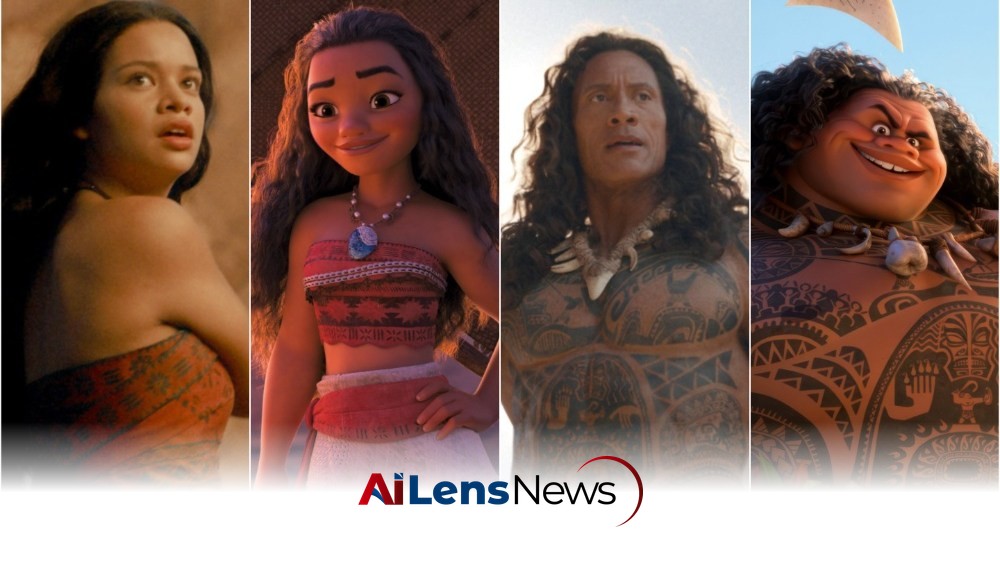


Moana and Maui are back in a live-action remake of Disney's beloved animated musical, set to release on July 10. Discover the cast and character comparisons.
New Delhi, India Jul 11, 2026 ALN: Moana and Maui are setting sail once again — this time, in live-action.
Releasing in theaters July 10, Disney’s animated musical “Moana” comes back to life with a brand new live-action remake led by Catherine Laga’aia, who stars as the titular character. This remake follows in the footsteps of other successful Disney live-action adaptations, such as "The Jungle Book," "Beauty and the Beast," and "Aladdin," which have brought beloved animated classics back to the big screen with a fresh perspective and new technology.
Similar to the original, the film follows Moana’s journey to restore the heart of Te Fiti and help her village people of Motunui. The story is rooted in Polynesian mythology and culture, which has been both praised for its representation and critiqued for its commercial appropriation. Dwayne Johnson reprises his role as the shapeshifting demigod Maui, who joins Moana on her quest (while also treating audiences to a new and improved rendition of “You’re Welcome.”)
Jemaine Clement also returns to the story as the CGI-version of the crab Tamatoa, who is known for his love of all things shiny. “Moana” will also welcome in new faces to bring the story to life, including Laga’aia, who is making her film debut. The casting of Laga’aia has been particularly notable as it reflects Disney's commitment to diversity and representation in its films, especially in roles that celebrate Pacific Islander culture.
As for those who’ve grown to love the animated film’s chaotic animal sidekicks, you need not worry, as even Pua and Heihei will be returning to tag along on Moana’s journey across the sea. These characters provide comic relief and serve as a reminder of the importance of companionship and loyalty throughout Moana's adventure.
Here is a look at the key characters and the actors who bring them to life:
After Auli’i Cravalho’s angelic voice introduced the world to “How Far I’ll Go” ten years ago, newcomer Catherine Laga’aia leads this new take and appears as the brave titular character who learns to embrace her love of the sea. Born in Sydney, Australia, the 19-year-old breakout star previously appeared in three episodes of “The Lost Flowers of Alice Hart” as a young version of Candy, the character played by Frankie Adams. Laga’aia grew up with eight siblings; her father, Jay Lagaʻaia, is also a performer, appearing in Star Wars films like “Attack of the Clones” and “Revenge of the Sith” as Tycho Celchu. The casting of Laga’aia not only reflects her talent but also highlights the importance of nurturing new talent in the industry.
Dwayne Johnson returns to play the cocky, shapeshifting demigod Maui, who accompanies Moana on her journey to return Te Fiti’s heart and save the island of Motunui. The ten-time WWE world champion quickly became a major blockbuster star through roles in the “Jumanji” films, “Fast & Furious” and “Black Adam.” Johnson’s portrayal of Maui has been widely celebrated for its humor and charisma, making the character a fan favorite. In recent years, he was in the awards conversation for director Benny Safdie’s “The Smashing Machine” and recently set a lead role in “Sing Sing” director’s new film, “Free Byrd.” Johnson’s involvement in the film not only brings star power but also a level of authenticity, as he has Polynesian heritage and has expressed a deep respect for the culture represented in the film.
Gramma Tala, played by Rena Owen, is the heart of “Moana” as both Moana’s grandmother and the storyteller who helps the Kakamora tribe reconnect with their roots. Owen, who was born in New Zealand, has worked with the likes of George Lucas and Steven Spielberg, appearing in “A.I. Artificial Intelligence,” voicing Taun We in “Star Wars: Episode II – Attack of the Clones” and portraying Nee Alavar in “Star Wars: Episode III – Revenge of the Sith.” She recently reprised her role as Taun We in a 2021 episode of “Star Wars: The Bad Batch.” Gramma Tala’s character is crucial in guiding Moana on her journey, emphasizing the importance of family and ancestral wisdom in Polynesian culture.
John Tui (“Fast & Furious Presents: Hobbs & Shaw,” “Solo: A Star Wars Story”) takes up the mantle of Chief Tui, Moana’s protective father and leader of the people of Motunui. Although encouraging of Moana following in his footsteps as chief, he is wary of her desire to explore the ocean beyond their island home. Temuera Morrison (“Aquaman,” “Star Wars: Episode III – Revenge of the Sith”) originated the role, with longtime Lin-Manuel Miranda collaborator Christopher Jackson (“Hamilton,” “In the Heights”) providing the singing voice for Chief Tui in the animated film. This dynamic between father and daughter adds depth to the narrative, exploring themes of tradition versus exploration, and the generational gap in understanding one’s role within a community.
Moana’s perceptive mother, Sina both understands her daughter’s longing for the water but wants to protect her from danger. Samoan New Zealand actor Frankie Adams (“The Expanse,” “Shortland Street”) steps into the role, taking over from Nicole Scherzinger (“Sunset Boulevard,” “The X Factor”) in the original. Sina’s character reflects the nurturing yet protective nature of motherhood, showcasing the balance between encouraging independence and ensuring safety for one’s children.
Jemaine Clement (“Rio,” “What We Do in the Shadows”) returns as the glitzy king crab Tamatoa, and it’s hard to imagine anyone else delivering the catchy song “Shiny” in the same way. The jewel-encrusted crustacean harbors a grudge against Maui and fiercely guards his shiny collection, including the demigod’s fishhook after it falls into his lair. Tamatoa serves as a colorful antagonist in the story, embodying themes of vanity and self-obsession, while also providing a memorable musical number that adds to the film’s charm.
Moana’s trusty, if a little skittish, pet pig Pua would follow her anywhere, even if he’s a little unsure of the ocean. The live-action production used a mix of real animals and animatronics to bring Moana’s sidekick to life. The animated Pua was voiced using a combination of real pig vocalizations and sound effects from voice actor Frank Welker, whose long list of credits includes Fred Jones in “Scooby Doo,” Pegasus in “Hercules,” Cri-Kee in “Mulan” and Abu, Rajah and the Cave of Wonders in “Aladdin.” Pua’s character serves not only as a companion to Moana but also as a symbol of innocence and the bond between humans and animals.
Heihei is a constantly confused rooster who accidentally joins Moana on her quest after seeking refuge in her boat. Always unaware of what’s happening around him, Heihei is simply along for the ride. His presence in the story adds a layer of humor and lightheartedness, providing comic relief during tense moments and showcasing the unpredictability of adventure.
The Kakamora are hostile nomads floating across the sea who are easily identified by their armor made of coconut. Always ready to engage in battle, they are small but dangerous, especially when the hundreds of them band together. The Kakamora serve as a formidable obstacle for Moana and Maui, illustrating the challenges one must face on the path to achieving their goals, while also adding excitement and action to the narrative.
Te Kā is the giant, dangerous demon of earth and fire Moana must get past to successfully restore the heart of Te Fiti. Gramma Tala first tells Moana the story of Te Kā, who awoke when Maui stole the heart of Te Fiti. While battling the demigod, the heart was ultimately lost in the sea, which only infuriated Te Kā more. This character represents the destructive consequences of greed and the importance of respecting nature, serving as a pivotal force in the narrative that challenges Moana to confront her fears and responsibilities.
With a blend of returning favorites and fresh talent, the live-action “Moana” promises to enchant both new audiences and longtime fans alike. The film is expected to utilize cutting-edge technology to bring the vibrant landscapes and characters to life, creating an immersive experience that captures the spirit of the original while offering a new interpretation for today’s viewers. As Disney continues to explore the live-action format, the success of “Moana” may pave the way for future adaptations of other animated classics, further blending the lines between animation and live-action storytelling. The cultural significance of “Moana” also highlights the ongoing conversation about representation in Hollywood, as audiences increasingly seek stories that reflect diverse heritages and experiences. The film’s release is not just a nostalgic return to a beloved story, but also a celebration of the rich traditions and narratives of the Pacific Islands, which resonate with themes of identity, bravery, and the enduring bond between people and their culture.
To learn more about the latest developments in Movies, stay updated with our exclusive reports and analyses on AiLensNews.

