

The Tamil Nadu chief minister's movie, marketed as his last, disappoints with lazy storytelling and tacky execution.
New Delhi, India Jul 23, 2026 ALN: The recent release of Jana Nayagan, starring the immensely popular actor Vijay, has sparked a flurry of discussions among critics and fans alike. Designed as a component of Vijay's political campaign during the recent Tamil Nadu Assembly elections, the film has faced a tumultuous journey to its release. Initially delayed by the censor board, it has been widely available on pirate sites for several months prior to its official launch in cinemas, coinciding with Vijay's ascension to the position of Chief Minister of Tamil Nadu. This backdrop, rich in political intrigue, is arguably more captivating than the narrative presented in the film itself.
Directed by H Vinoth, Jana Nayagan is being characterized as an action drama that doubles as a thinly veiled piece of political propaganda. Critics have pointed out that the film relies heavily on Vijay's star power to engage audiences, to the extent that Vinoth appears to have neglected the fundamentals of storytelling and cinematic experience. For a film that is touted to be Vijay's final cinematic offering, given his new political responsibilities, the execution of Jana Nayagan has been described as astonishingly lackluster.
The plot of Jana Nayagan draws inspiration from the Telugu film Bhagavanth Kesari (2023) and is interspersed with themes of women's empowerment, corruption, communal harmony, and the perils of "dirty politics." Vijay portrays the character of Vetri, a police officer who operates under a personal code when confronting villains. His vigilante approach eventually lands him in prison, where he forms a bond with the jailor Srikanth, played by Gautham Menon, and his daughter Viji, portrayed by Lithanya. This relationship becomes pivotal as Vetri adopts Viji after Srikanth's untimely death, vowing to support her dream of joining the Indian Army.
However, as Viji transitions into her teenage years, she begins to develop her own aspirations, complicated by a peculiar medical condition referred to as "fear phobia," stemming from childhood trauma. Instead of seeking professional help for her panic attacks, Vetri insists that she engage in rigorous training, raising questions about the film's approach to mental health issues. This portrayal may inadvertently contribute to stigma surrounding mental health, as it suggests that personal resolve and physical training can substitute for professional mental health care.
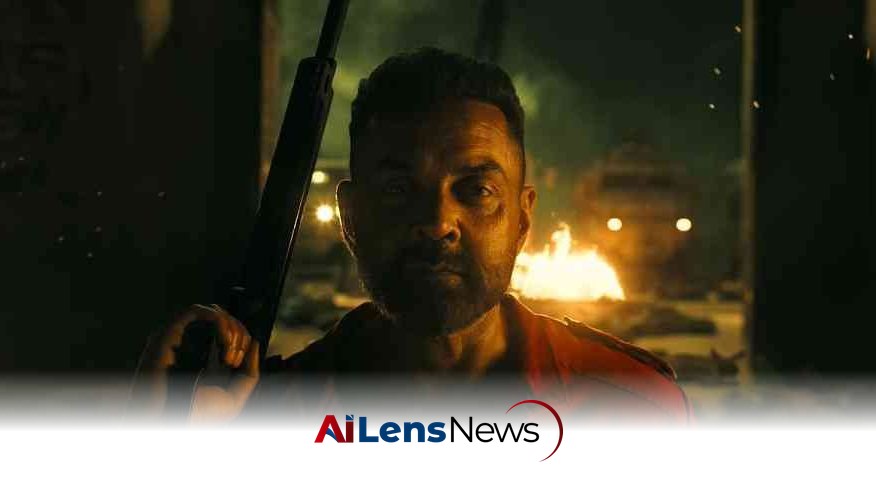
The antagonist, John Himmler, played by Bobby Deol, is depicted as a supervillain who collaborates with the politician Roja Rangaswamy, portrayed by Prakash Raj, to orchestrate chaos in Tamil Nadu using advanced technology, including drones and robot soldiers. Himmler's character is presented as a global threat, having already destabilized regions in Africa, and is set to launch "Operation M-M" in India until he encounters Vetri. This narrative choice raises concerns about the portrayal of foreign villains in Indian cinema, often reflecting broader societal fears and anxieties about global politics.
Pooja Hegde's character, Kayal, enters the narrative as a journalist who, despite her profession, becomes primarily focused on supporting Vetri's mission. This portrayal raises eyebrows, as it suggests a lack of journalistic integrity, positioning her instead as a mere ally in Vetri's quest. The dynamic between Kayal and Vetri remains platonic, yet it is steeped in the typical tropes of cinematic heroism, where the male lead's journey overshadows the female character's agency and professional aspirations.
As the film unfolds over a lengthy runtime of 183 minutes, it frequently resembles a compilation of scenes from Vijay's previous politically charged films, such as Mersal (2017) and Sarkar (2018). Vijay has long been known for his attempts to leverage his mass appeal into tangible political influence, making it all the more perplexing that his purported final role as a heroic figure is marred by a dull and amateurish execution. Some critics have noted that certain scenes appear to have been generated using AI software, further detracting from the film's overall quality. This observation points to a growing concern in the film industry regarding the over-reliance on technology and special effects at the expense of authentic storytelling.
Interspersed with intense action sequences and Vijay's signature dance moves, the film attempts to convey a message about the urgent need for leadership in Tamil Nadu to combat corruption and divisive politics. A particularly telling line of dialogue suggests that the state is in dire straits, lacking a leader who can inspire hope. This is followed by a dramatic shot of Vetri walking through a door illuminated by light, symbolizing his role as a beacon of hope for the people of Tamil Nadu. Such visual metaphors are common in cinema but can often feel clichéd if not executed with originality.
However, while the message may be clear, the medium through which it is delivered has been criticized as hollow and ineffective. The film's reliance on Vijay's star power and its overt political messaging have left audiences and critics alike feeling underwhelmed. The disconnect between the film's ambitions and its execution raises important questions about the role of cinema in political discourse, particularly in a region where film and politics are deeply intertwined. In Tamil Nadu, cinema has historically served as a platform for political expression, with many actors transitioning into successful political careers. This film attempts to navigate that complex landscape but ultimately falls short.
In conclusion, Jana Nayagan serves as a testament to the complexities of blending cinema with political narrative. While Vijay's popularity and charisma remain undeniable, the film's execution has not resonated with audiences in the way that its creators might have hoped. As Vijay navigates his new role as Chief Minister, the implications of this film may linger as a reflection of his cinematic legacy and the challenges of translating that legacy into effective political leadership. The film stands as a reminder that while the stories we tell can be powerful, the manner in which we tell them is equally crucial in capturing the hearts and minds of an audience. The reception of Jana Nayagan may serve as a cautionary tale for future projects that seek to intertwine the realms of film and politics, highlighting the necessity for thoughtful storytelling that respects both the art form and the audience's intelligence.
To learn more about the latest developments in Movies, stay updated with our exclusive reports and analyses on AiLensNews.

