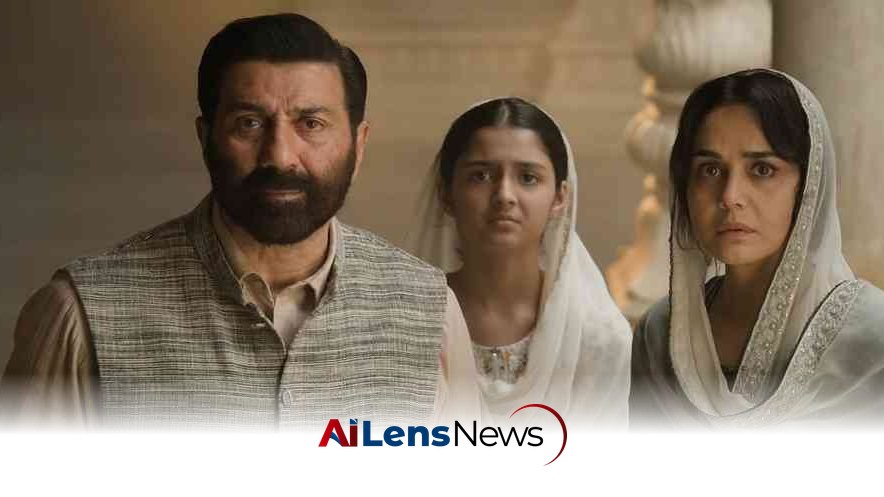



Rajkumar Santoshi's 'Batwara 1947' explores themes of compassion amid Partition, featuring Sunny Deol in a restrained role. Despite its dull storytelling, the film delivers a poignant message against religious bigotry.
New Delhi, India Aug 15, 2026 ALN: A chunk of Sunny Deol’s career is devoted to swinging hand pumps at Pakistanis, bashing in their heads or simply bellowing at them until their eardrums burst. In Rajkumar Santoshi’s Batwara 1947, Deol is in a different zone and a different register. This film marks a significant departure from the typical action-packed roles that have defined much of his cinematic journey, reflecting a more nuanced and sensitive portrayal of a tumultuous period in Indian history.
The Hindi-Punjabi film is adapted from a play about compassion trumping communal hatred during the horrific time of Partition. The Partition of India in 1947 was a cataclysmic event that resulted in the division of British India into two independent dominions, India and Pakistan. This led to one of the largest mass migrations in human history, accompanied by horrific violence, communal riots, and widespread suffering. The film's narrative seeks to explore the human side of this historical tragedy, emphasizing themes of empathy and understanding amidst chaos and division.
In Batwara 1947, Deol plays Sikandar, a Muslim businessman from Meerut who flees to Lahore after being targeted by Hindu rioters. This character serves as a representation of the countless individuals who were forced to abandon their homes and lives due to the rampant communal violence of the time. Sikandar, his wife Hamida (Preity Zinta) and daughter Tanno (Khushi Hajare) enter the mansion allotted to them, only to find an elderly Hindu woman there, a poignant symbol of the shared histories and lives that were torn apart by the Partition.
The house belongs to Durgavati (Shabana Azmi). Her own son and his family are missing. Durgavati refuses to leave until her son returns, embodying the anguish and despair that many families faced during this period of upheaval. Her character illustrates the emotional toll of the Partition, as individuals were not only displaced but also left with the haunting uncertainty of their loved ones' fates.
The domestic quandary is soon eclipsed by the antics of the fanatic politician Yaqub (Abhimanyu Singh), who wants to purge the neighbourhood of its Hindu past. This character represents the dangerous intersection of politics and religion, a theme that resonates strongly in contemporary discourse. The film critiques the rise of religious extremism and the manipulation of communal sentiments for political gain, a warning that remains relevant in today’s socio-political landscape.
Adding to Sikandar’s woes is his son Javed (Karan Deol), who has been catalyzed by the carnage he witnessed back in Meerut and is on Yaqub’s side. Javed’s character reflects the generational impact of violence and hatred, illustrating how the trauma of one generation can influence the beliefs and actions of the next. His alignment with Yaqub serves as a chilling reminder of how easily young minds can be swayed towards fanaticism in the wake of tragedy.
Batwara 1947 is based on Asghar Wajahat’s well-known play Jis Lahore Nai Vekhya, O Jamya E Nai, which translates to "He who has not seen Lahore has not lived." This phrase captures the essence of Lahore as a cultural hub, rich in history and diversity. However, Santoshi’s adaptation, co-written with Wajahat, reduces one of the historic centres of Punjabi culture to a few streets and interior sets. This limitation in the film’s visual storytelling detracts from the vibrant backdrop that could have enhanced the emotional weight of the narrative.
Santosh Sivan is listed as the cinematographer, but you wouldn’t know from the drab, television serial-level visuals. The film’s aesthetic choices do not do justice to the rich tapestry of Lahore’s history and culture, which could have been a powerful visual metaphor for the interconnected lives that were shattered during the Partition.
The storytelling is similarly stodgy and plodding. Despite the weighty themes it grapples with, the film struggles to maintain a compelling narrative pace. Sunny Deol’s famous fists of fury are unleashed in a few scenes, but for the most part, the Bollywood strongman stands around looking befuddled or sharing Durgavati’s tears over her plight. This shift from action to a more subdued emotional performance showcases Deol’s versatility, yet the overall execution leaves much to be desired.
Even the dullness that pervades the 145-minute film can’t conceal its cogent, clear-eyed denunciation of religious bigotry. The film serves as a reminder of the perils of mixing politics and religion, advocating for respect and understanding among different faiths. These messages resonate strongly, as they are as much about Partition-era Lahore as they are about present-day India, where communal tensions continue to simmer beneath the surface.
Ali Fazal plays Habib, a poet with a dodgy wig, wisdom beyond his years, and some of the film’s better monologues. His character serves as a voice of reason amidst the chaos, providing a counter-narrative to the extremist views espoused by Yaqub. In a refreshing change from similar movies, the female characters stand up to Yaqub and his posse of wild-eyed tormentors, be it Preity Zinta’s Hamida or Yaqub’s feisty sister (Kanikka Kapoor). This portrayal of strong female characters adds depth to the narrative, highlighting the important role women played in resisting violence and advocating for peace during the tumultuous times of the Partition.
Zinta is a particularly lively presence, a more full-bodied character than the one-note Sikandar or the persistently hammy Abhimanyu Singh. Her character Hamida embodies resilience and strength, challenging the patriarchal norms that often dictate women’s roles in such narratives. As the passive and yet poignant Durgavati, Shabana Azmi packs a punch. The veteran actor brilliantly brings out Durgavati’s agony over her missing son as well as her deep connections to the only place she can call home. Azmi’s Durgavati radiates care and understanding, which melt Sikandar’s initial opposition and convert him into a warrior for peace.
In conclusion, while Batwara 1947 struggles with pacing and visual storytelling, it remains a significant exploration of the human cost of the Partition. The film's strong messages about compassion, understanding, and the dangers of religious zealotry resonate deeply in today’s world, making it a relevant piece of cinema. Despite its flaws, the performances, especially by Azmi and Zinta, provide moments of emotional depth that linger long after the credits roll. The film serves as both a reminder of a painful past and a call to action for a more inclusive and empathetic future.
To learn more about the latest developments in Movies, stay updated with our exclusive reports and analyses on AILensNews.

